On this page
This sheet covers two NCERT Class 10 Mathematics chapters (Reprint 2026-27): Introduction to Trigonometry and Some Applications of Trigonometry. Both form Unit V of the CBSE Class 10 Mathematics syllabus for 2026-27. Not here: complementary-angle ratios such as sin (90° − A) = cos A, which the current chapter does not include.
What are the six trigonometric ratios in Class 10?
In triangle ABC, right-angled at B, with A acute: BC is opposite A, AB is adjacent to A, AC is the hypotenuse.
sin A = BC / AC (opposite / hypotenuse)
cos A = AB / AC (adjacent / hypotenuse)
tan A = BC / AB (opposite / adjacent)
cosec A = 1 / sin A, sec A = 1 / cos A, cot A = 1 / tan A
tan A = sin A / cos A, cot A = cos A / sin A (denominator non-zero)
sin A ≤ 1 and cos A ≤ 1 (the hypotenuse is the longest side); sec A ≥ 1 for 0° ≤ A < 90°; cosec A ≥ 1 for 0° < A ≤ 90°
Worked example. If sin A = 12/37, take opposite = 12k, hypotenuse = 37k, so adjacent = √(1369 − 144) k = 35k. Then cos A = 35/37, tan A = 12/35, cosec A = 37/12, sec A = 37/35 and cot A = 35/12.
Watch for: "opposite" and "adjacent" depend on the angle. For angle C in the same triangle, AB is opposite and BC adjacent.
What are the values of trigonometric ratios at 0°, 30°, 45°, 60° and 90°?
Each line gives sin, cos, tan, cosec, sec, cot.
0°: 0, 1, 0, not defined, 1, not defined
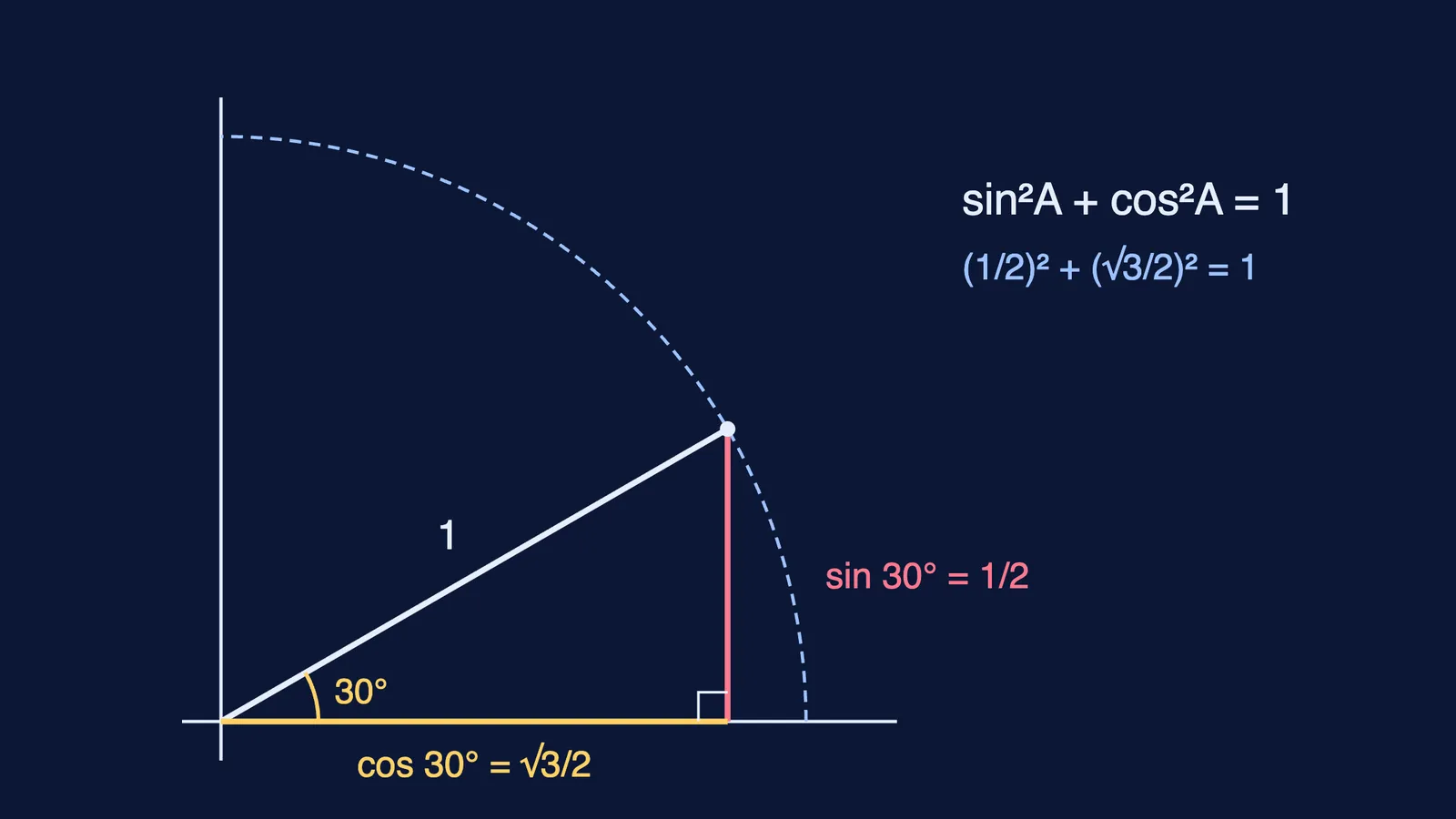
30°: 1/2, √3/2, 1/√3, 2, 2/√3, √3
45°: 1/√2, 1/√2, 1, √2, √2, 1
60°: √3/2, 1/2, √3, 2/√3, 2, 1/√3
90°: 1, 0, not defined, 1, not defined, 0
From 0° to 90°, sin A rises from 0 to 1 and cos A falls from 1 to 0.
To rebuild sin: √0/2, √1/2, √2/2, √3/2, √4/2 for 0° to 90°. Cos is that list backwards; tan = sin / cos.
Worked example. Evaluate (4 sin² 60° + 3 tan² 30°) / (cos 0° + sec² 45°). Top: 4 × 3/4 + 3 × 1/3 = 4. Bottom: 1 + 2 = 3. Answer: 4/3.
Watch for: 2 sin 30° = 1, but sin 60° = √3/2. Likewise sin (A + B) is not sin A + sin B.
Which trigonometric identities do you need for Class 10?
sin² A means (sin A)². All three come from dividing AB² + BC² = AC² by AC², AB² or BC².
sin² A + cos² A = 1, for 0° ≤ A ≤ 90°
1 + tan² A = sec² A, for 0° ≤ A < 90° (tan and sec are not defined at 90°)
1 + cot² A = cosec² A, for 0° < A ≤ 90° (cot and cosec are not defined at 0°)
Rearranged: sec² A − tan² A = 1, so (sec A − tan A)(sec A + tan A) = 1; and cosec² A − cot² A = 1
In terms of sin A (for 0° ≤ A < 90°): cos A = √(1 − sin² A), tan A = sin A / √(1 − sin² A), sec A = 1 / √(1 − sin² A)
The syllabus asks for proof and use of sin² A + cos² A = 1, with only simple identities.
Worked example. If sec A + tan A = 3, find sin A and cos A. Since (sec A − tan A)(sec A + tan A) = 1, sec A − tan A = 1/3. Adding: sec A = 5/3, so tan A = 4/3, cos A = 3/5 and sin A = tan A × cos A = 4/5. Check: 16/25 + 9/25 = 1.
Watch for: sin A + cos A = 1 is not an identity. At A = 30°, sin A + cos A = (1 + √3)/2, about 1.37.
How do you use angles of elevation and depression?
The line of sight runs from the observer's eye to the point viewed. The angle of elevation is between the line of sight and the horizontal when the object is above eye level; the angle of depression, when it is below.
Here h is height, d horizontal distance, l slant length (a kite string or ladder) and θ the angle at the observer.
tan θ = h / d, so h = d tan θ and d = h / tan θ
sin θ = h / l and cos θ = d / l, when the slant length is involved
Angle of depression from a high point = angle of elevation of that point from below (alternate angles between parallel horizontals)
Observer's eye height e: object height = d tan θ + e
Shadow of a pole, Sun at altitude θ: s = h / tan θ
Two points on the same side of a tower, elevations α > β: gap = h (cot β − cot α)
The syllabus limits these to 30°, 45° and 60°, and at most two right triangles.
Worked example. The elevation of a tower's top is 30°; after walking 24 m towards it, 60°. Then h (cot 30° − cot 60°) = 24, so h (√3 − 1/√3) = h × 2/√3 = 24 and h = 12√3 m, about 20.8 m. You are now h / tan 60° = 12 m away; you started at 36 m.
Watch for: depression is measured from the horizontal at the observer's eye, not from the building's wall. Draw the horizontal first.
If your figure is right but the algebra goes wrong, the Fermi Problem Library has worked problems with a step-by-step solver that explains the reasoning rather than printing an answer.
How to revise this formula sheet
Rebuild the 0° to 90° values from the √0/2 to √4/2 pattern daily for a week.
Derive the three identities from AB² + BC² = AC² once, to see where each condition on A comes from.
In identity proofs, note which identity each step uses.
Draw each heights-and-distances figure with the horizontal and right angle before choosing tan, sin or cos.
Then practise with our Class 10 introduction to trigonometry guide and our heights and distances guide for Class 10.