On this page
Surface areas and volumes is Chapter 12 of the current NCERT Class 10 Mathematics textbook, and it asks one thing: take two basic solids, join them, and find the area or volume of the new shape. The CBSE 2026-27 Class X Mathematics curriculum limits the chapter to combinations of any two of cubes, cuboids, spheres, hemispheres, and right circular cylinders and cones.
Not in the current chapter: the frustum of a cone and the conversion of one solid into another (melting and recasting). The NCERT Reprint 2026-27 chapter has only two sections of content, on surface area and on volume of a combination, and neither topic appears.
Symbols used below: r = radius, h = height, l = slant height of a cone, a = edge of a cube, and l, b, h = length, breadth and height of a cuboid. NCERT asks you to take π = 22/7 unless a question says otherwise.
What are the surface area formulas for basic solids?
You met these in Class IX; this chapter builds every combination from them.
Cuboid: total surface area (TSA) = 2(lb + bh + hl); lateral surface area = 2h(l + b)
Cube: TSA = 6a²; lateral surface area = 4a²
Right circular cylinder: curved surface area (CSA) = 2πrh; TSA = 2πr(r + h), for a closed cylinder
Right circular cone: slant height l = √(r² + h²); CSA = πrl; TSA = πr(l + r)
Sphere: surface area = 4πr²
Hemisphere: CSA = 2πr²; TSA = 3πr², for a solid hemisphere (curved part plus flat circle)
Worked example: a cone has r = 6 cm and h = 8 cm. Then l = √(36 + 64) = 10 cm, CSA = (22/7) × 6 × 10 ≈ 188.57 cm², and TSA = (22/7) × 6 × 16 ≈ 301.71 cm².
Watch for: putting h into πrl. CSA uses the slant height l, so find l first whenever the question gives you the vertical height.
What are the volume formulas for basic solids?
Cuboid: V = lbh
Cube: V = a³
Cylinder: V = πr²h
Cone: V = (1/3)πr²h, where h is the vertical height, not the slant height
Sphere: V = (4/3)πr³
Hemisphere: V = (2/3)πr³
Worked example: a steel ball has r = 2.1 cm. Its volume is (4/3) × (22/7) × 2.1³ = 38.808 cm³, and a hemisphere of the same radius holds half of that, 19.404 cm³.
Watch for: halving the diameter. Questions often give the diameter; divide by 2 first. Using the diameter as r makes an area 4 times too big and a volume 8 times too big.
How do you find the surface area of a combined solid?
NCERT's rule: count only the surfaces you can still see after the solids are joined. The faces that touch disappear, so the total surface area of the combination is not the sum of the two TSAs (NCERT, section 12.2).
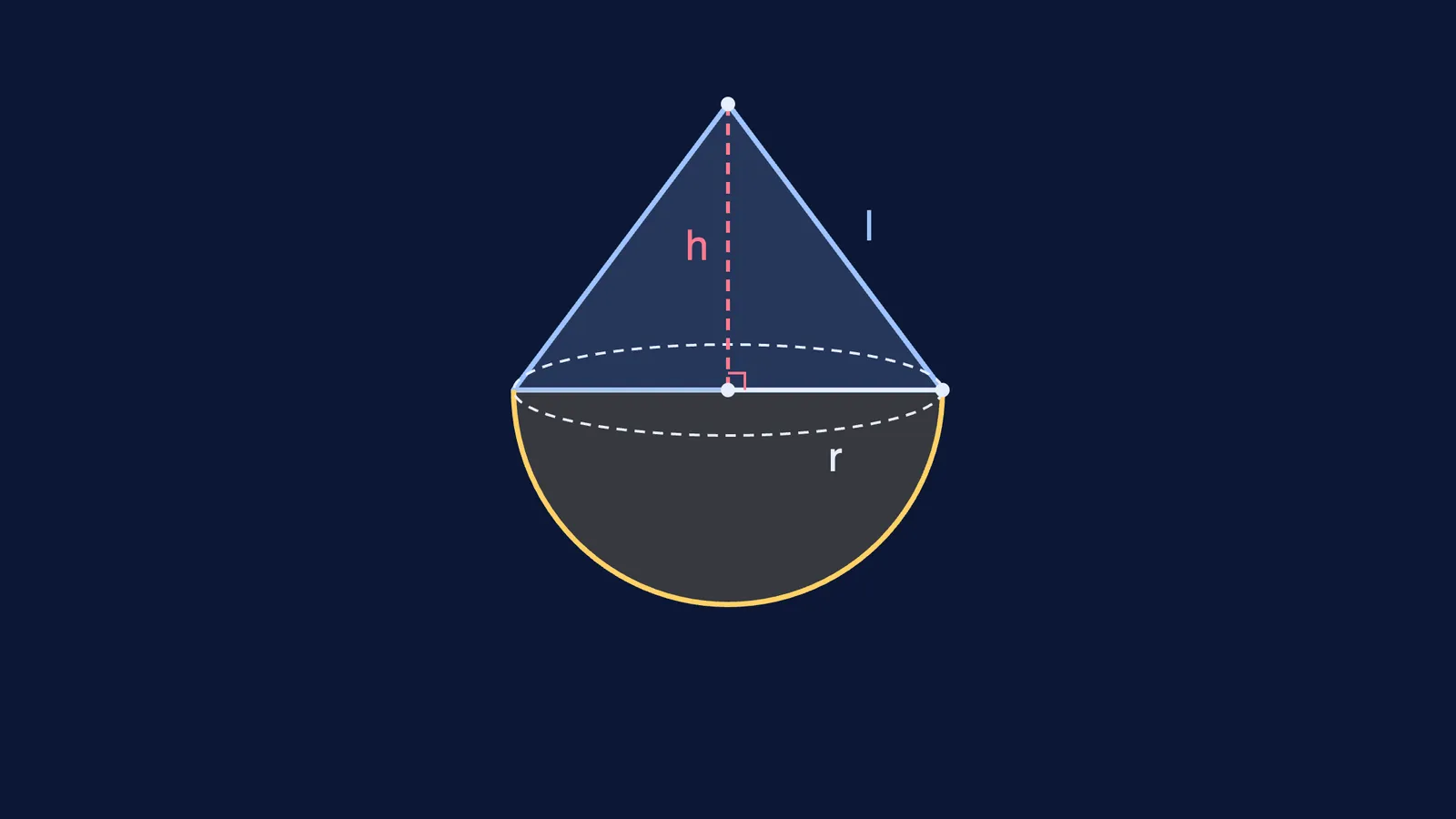
Cone on a hemisphere (a toy or top), same radius r: TSA = πrl + 2πr²
Cylinder with a hemisphere at each end (a capsule or tank), same radius r, cylinder height h: TSA = 2πrh + 4πr²
Hemisphere on top of a cube of edge a, with 2r ≤ a: TSA = 6a² − πr² + 2πr² = 6a² + πr²
Cone on a cylinder of a different radius: CSA of cone + CSA of cylinder + the cylinder's bottom base + the exposed ring π(R² − r²), where R is the larger radius and r the smaller
Shape scooped out of a solid (a hemisphere or cone hollowed from a cylinder): remove the flat area that was cut away and add the curved area of the hollow
Worked example: a capsule is 20 cm long with a diameter of 7 cm, so r = 3.5 cm and the cylinder part is 20 − 7 = 13 cm long. TSA = 2 × (22/7) × 3.5 × 13 + 4 × (22/7) × 3.5² = 286 + 154 = 440 cm².
Watch for: the cylinder's height. The 20 cm includes both hemispheres, so subtract 2r before using 2πrh.
How do you find the volume of a combined solid?
Volume does not lose anything when solids are joined: the volume of a combination is the sum of the volumes of its parts (NCERT, section 12.3). When a part is hollowed out, subtract its volume instead.
Joined solids: V = V₁ + V₂
Hollowed solids: V = V(outer solid) − V(removed part)
Cone on a hemisphere, same radius: V = (1/3)πr²h + (2/3)πr³
Cylinder with two hemispherical ends: V = πr²h + (4/3)πr³
Space left inside a container: V(container) − V(objects inside)
Worked example: a cone of radius 3 cm and depth 4 cm is drilled out of a solid cylinder of radius 3 cm and height 10 cm. V = π × 9 × 10 − (1/3) × π × 9 × 4 = 90π − 12π = 78π ≈ 245.14 cm³ (with π = 22/7).
Watch for: units. Keep every length in the same unit before you multiply, and write cm² for areas and cm³ for volumes.
If your setup keeps coming out wrong, the Fermi Problem Library has worked problems with a step-by-step solver that explains the reasoning rather than printing an answer.
How to revise this formula sheet
Write the six basic solids from memory with CSA, TSA and volume for each, then check against the lists above.
For every NCERT example in sections 12.2 and 12.3, say out loud which faces are hidden before you calculate anything.
Practise the slant height step separately: five quick cones where you are given r and h and must find l.
Leave answers in terms of π until the last line; it keeps the arithmetic short and makes errors easier to spot.
Pair this sheet with our worked guide to surface area and volume of combined solids in Class 10, the sector and segment formulas in Areas related to circles, and our list of Class 10 maths board answer mistakes.