On this page
Arithmetic progressions (AP) is Chapter 5 of the NCERT Class 10 Mathematics textbook. The CBSE Class X Mathematics curriculum for 2026-27 covers deriving the nth term and the sum of n terms, and using them in daily-life problems. For the full chapter, read our arithmetic progressions Class 10 guide.
Symbols: a is the first term, d the common difference, n the number of terms (a positive whole number), aₙ the nth term, l the last term and Sₙ the sum of the first n terms.
Left out: Exercise 5.4, which NCERT marks optional and not from the examination point of view.
What is an arithmetic progression?
An arithmetic progression is a list of numbers in which each term after the first is the previous term plus a fixed number d (NCERT, Chapter 5).
General form: a, a + d, a + 2d, a + 3d, …
Common difference: d = aₖ₊₁ − aₖ, the same for every k. d can be positive, negative or zero.
Test for an AP: a₂ − a₁, a₃ − a₂, a₄ − a₃, … must all be equal.
Arithmetic mean: if a, b, c are in AP, then b = (a + c)/2, or 2b = a + c.
Worked example: 5, 12, 19, 26 has differences 7, 7, 7, so it is an AP with a = 5 and d = 7. The arithmetic mean of 8 and 20 is (8 + 20)/2 = 14.
Watch for: subtracting the wrong way round. For 20, 17, 14, … d = 17 − 20 = −3, not +3. Check every difference: 1, 2, 4 is not an AP.
How do you find the nth term of an AP?
In an AP with first term a and common difference d, the nth term is aₙ = a + (n − 1)d (NCERT, Chapter 5).
nth term: aₙ = a + (n − 1)d, for n = 1, 2, 3, …
Last term of a finite AP with n terms: l = a + (n − 1)d.
Number of terms: n = (l − a)/d + 1, for d ≠ 0. A number x is a term only if (x − a)/d + 1 is a positive whole number.
mth term from the end: l − (m − 1)d. It is the AP read backwards, with first term l and difference −d.
Worked example: for 4, 11, 18, …, 186, a = 4 and d = 7.
25th term: a₂₅ = 4 + 24 × 7 = 172.
Is 300 a term? 300 = 4 + (n − 1) × 7 gives n − 1 = 296/7 ≈ 42.29, not a whole number, so no.
Number of terms: n = (186 − 4)/7 + 1 = 26 + 1 = 27.
5th term from the end: 186 − 4 × 7 = 158.
Watch for: writing a + nd instead of a + (n − 1)d. The 25th term needs only 24 jumps of d.
What is the formula for the sum of n terms of an AP?
The sum of the first n terms of an AP is Sₙ = n/2 [2a + (n − 1)d], and when the last term l is known it is Sₙ = n/2 (a + l) (NCERT, Chapter 5).
Sum from a and d: Sₙ = n/2 [2a + (n − 1)d].
Sum from the first and last terms: Sₙ = n/2 (a + l), where l is the nth term.
Sum of the first n positive integers: 1 + 2 + 3 + … + n = n(n + 1)/2.
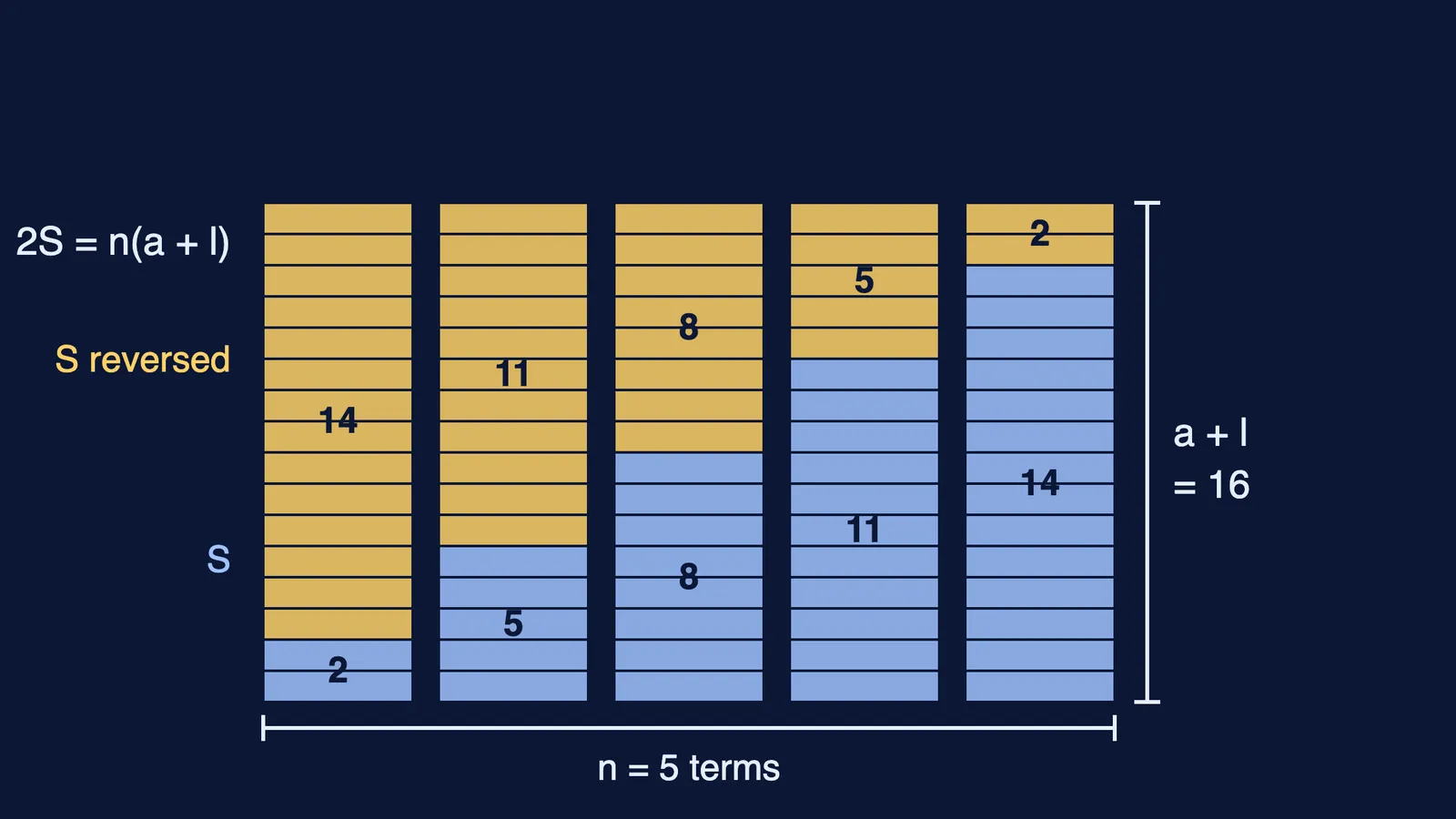
Write the sum forwards and backwards and add: each of the n pairs adds to a + l, so 2S = n(a + l). The picture at the top shows this for 2 + 5 + 8 + 11 + 14.
Worked example: the sum of the first 20 terms of 6, 10, 14, … has a = 6 and d = 4.
S₂₀ = 20/2 [2 × 6 + 19 × 4] = 10 × 88 = 880.
Check with the last term: a₂₀ = 6 + 19 × 4 = 82, and 20/2 (6 + 82) = 10 × 88 = 880.
Sum of the first 50 positive integers: 50 × 51/2 = 1275.
Watch for: mixing up aₙ and Sₙ. "The 20th term" is a₂₀ = 82, not S₂₀ = 880. And in n/2 (a + l), l must be the nth term.
How are Sₙ and aₙ linked?
The nth term of an AP is the sum of the first n terms minus the sum of the first (n − 1) terms: aₙ = Sₙ − Sₙ₋₁ (NCERT, Chapter 5).
aₙ = Sₙ − Sₙ₋₁, for n ≥ 2.
First term: a = a₁ = S₁.
Common difference: d = a₂ − a₁ = S₂ − 2S₁.
Worked example: if Sₙ = 3n² + 2n, then a₁ = S₁ = 5, and for n ≥ 2, aₙ = (3n² + 2n) − [3(n − 1)² + 2(n − 1)] = 6n − 1. Since 6 × 1 − 1 = 5, it holds for n = 1 too: the AP is 5, 11, 17, 23, … with d = 6.
Watch for: expanding 3(n − 1)² carelessly. It is 3n² − 6n + 3, not 3n² − 3. Test your aₙ at n = 1 against S₁.
How to revise this formula sheet
Write aₙ and Sₙ from memory, then derive n/2 (a + l) by reversing the sum.
Before any calculation, write a = …, d = …, n = … on one line.
In "is x a term?" and "how many terms?" questions, check that n is a positive whole number.
Solve each sum with both formulas. See common Class 10 maths mistakes for more checks and the CBSE Class 10 maths paper strategy for timing.
If a step keeps going wrong, the Fermi Problem Library has worked problems with a step-by-step solver that explains the reasoning rather than printing an answer.