On this page
This sheet follows Chapter 7, Coordinate Geometry, of the NCERT Class 10 Mathematics textbook (Reprint 2026-27). A point is written (x, y): x is the abscissa, y the ordinate.
The CBSE Class 10 Mathematics curriculum for 2026-27 lists the distance formula and the section formula (internal division) under Unit III, Coordinate Geometry, which carries 6 of the 80 marks in its course structure. The area-of-a-triangle formula from older editions is not in the current chapter, and external division is left for higher classes. For the ideas behind each formula, read our Class 10 coordinate geometry guide.
What is the distance formula in Class 10?
Symbols: P(x1, y1) and Q(x2, y2) are two points; PQ is the length of the segment joining them, in the units of the axes.
Distance formula: PQ = √[(x2 − x1)² + (y2 − y1)²]. Take only the positive root, since a distance is never negative.
The order of subtraction does not matter: PQ = √[(x1 − x2)² + (y1 − y2)²].
Distance from the origin O(0, 0): OP = √(x² + y²).
Points on the x-axis have the form (x, 0); points on the y-axis have the form (0, y).
Two points on the same axis: the distance is the difference of their non-zero coordinates, larger minus smaller.
Worked example: for A(−3, 4) and B(5, −2), x2 − x1 = 8 and y2 − y1 = −6. So AB = √(64 + 36) = √100 = 10 units. The distance of A from the origin is √(9 + 16) = 5 units.
Watch for: (−6)² is +36. Put brackets around negative differences before you square them.
How do you use the distance formula to test a shape?
These combine the distance formula with geometry facts, as in NCERT's Examples 1 to 5.
Collinear points A, B, C (B between A and C): AB + BC = AC.
Right angle at P in triangle PQR: PQ² + PR² = QR² (converse of Pythagoras theorem).
Square: four equal sides and two equal diagonals.
Point P(x, y) equidistant from A and B: AP² = BP². All such points lie on the perpendicular bisector of AB.
Rhombus area, from the hint in Exercise 7.2: ½ × (product of its diagonals).
Worked example: are P(−1, −3), Q(1, 1) and R(3, 5) in one line? PQ = √(4 + 16) = 2√5, QR = √(4 + 16) = 2√5 and PR = √(16 + 64) = 4√5. Since 2√5 + 2√5 = 4√5, PQ + QR = PR, so the points are collinear.
Watch for: the collinear test adds the lengths, not their squares. Here PQ² + QR² = 40 but PR² = 80. Also, equal sides alone give a rhombus; a square also needs equal diagonals.
What is the section formula?
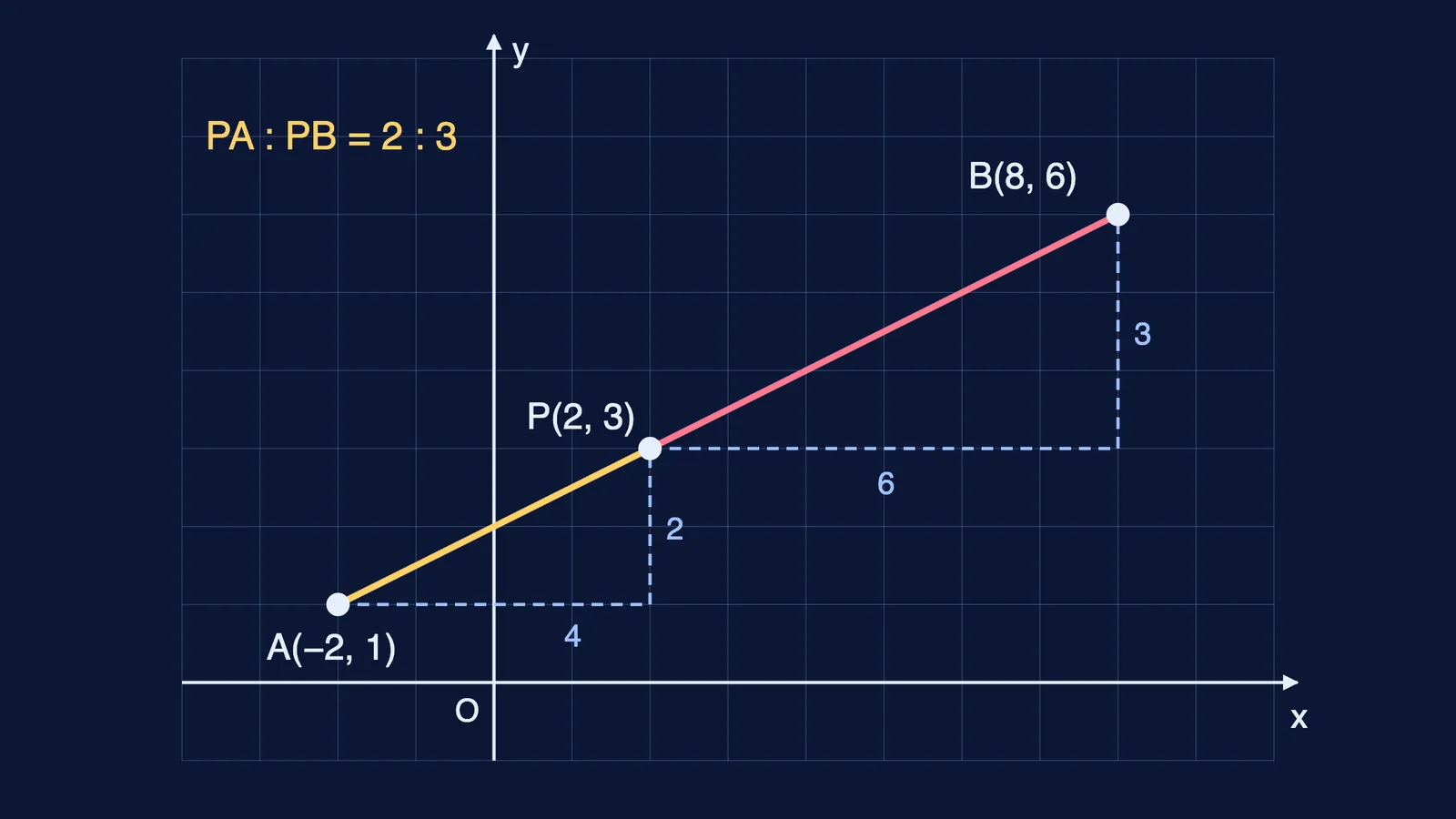
Symbols: A(x1, y1) and B(x2, y2) are the ends of the segment; P(x, y) lies on AB, between A and B, with PA : PB = m1 : m2, where m1 and m2 are positive.
Section formula (internal division): x = (m1x2 + m2x1)/(m1 + m2) and y = (m1y2 + m2y1)/(m1 + m2).
Ratio written as k : 1 (k > 0): P = ((kx2 + x1)/(k + 1), (ky2 + y1)/(k + 1)).
To find an unknown ratio, take it as k : 1, equate one coordinate of P to its given value and solve for k; check with the other coordinate.
Where AB meets the x-axis, the y-coordinate is 0; where it meets the y-axis, the x-coordinate is 0.
Worked example: P divides A(−2, 1) and B(8, 6) in the ratio 2 : 3. Then x = (2 × 8 + 3 × (−2))/5 = 10/5 = 2 and y = (2 × 6 + 3 × 1)/5 = 15/5 = 3, so P is (2, 3). Check: PA = √20 = 2√5 and PB = √45 = 3√5, a ratio of 2 : 3.
Second example: in what ratio does the x-axis divide A(2, −3) and B(−1, 6)? Set (6k − 3)/(k + 1) = 0, so k = ½ and the ratio is 1 : 2. The point is ((−½ + 2)/1.5, 0) = (1, 0).
Watch for: m1 multiplies the coordinates of B, the far end, not A. Swapping them gives the point that divides AB in m2 : m1. Our section formula walkthrough has more ratio and axis questions.
Mid-point, trisection and parallelogram formulas
M is the mid-point of AB.
Mid-point formula (ratio 1 : 1): M = ((x1 + x2)/2, (y1 + y2)/2).
Points of trisection of AB: use the ratios 1 : 2 and 2 : 1 in the section formula. The second point is also the mid-point of the first point and B.
Parallelogram ABCD, vertices taken in order: the diagonals bisect each other, so mid-point of AC = mid-point of BD.
Centre of a circle = mid-point of any diameter.
Worked example: A(1, 2), B(6, 3) and C(8, 7) are three vertices of parallelogram ABCD, in order. The mid-point of AC is (4.5, 4.5). For BD to have the same mid-point, D = (2 × 4.5 − 6, 2 × 4.5 − 3) = (3, 6).
Trisection example: for A(−3, 6) and B(9, −3), the ratio 1 : 2 gives (1, 3) and the ratio 2 : 1 gives (5, 0).
Watch for: "taken in order" means the diagonals are AC and BD. Pairing A with B gives a wrong fourth vertex.
When a ratio or a sign keeps going wrong, the Fermi Problem Library has worked problems with a step-by-step solver that explains the reasoning rather than printing an answer.
How to revise this formula sheet
Derive the distance formula once from a right triangle on graph paper, as NCERT Fig. 7.5 does.
Say the section formula aloud as "m1 with B, m2 with A", then check one answer by measuring PA and PB.
For every shape question, list what you must prove first (four sides, two diagonals, or one sum) before you calculate.
Read our list of Class 10 maths answer mistakes and how to show working before writing full solutions.