

On this page
When you connect two points on a Cartesian plane, finding the exact coordinates of any point along that line comes down to one core tool: the section formula. In Class 10 coordinate geometry, this formula translates geometric proportions into clean algebraic coordinates.
What is the section formula for internal division?
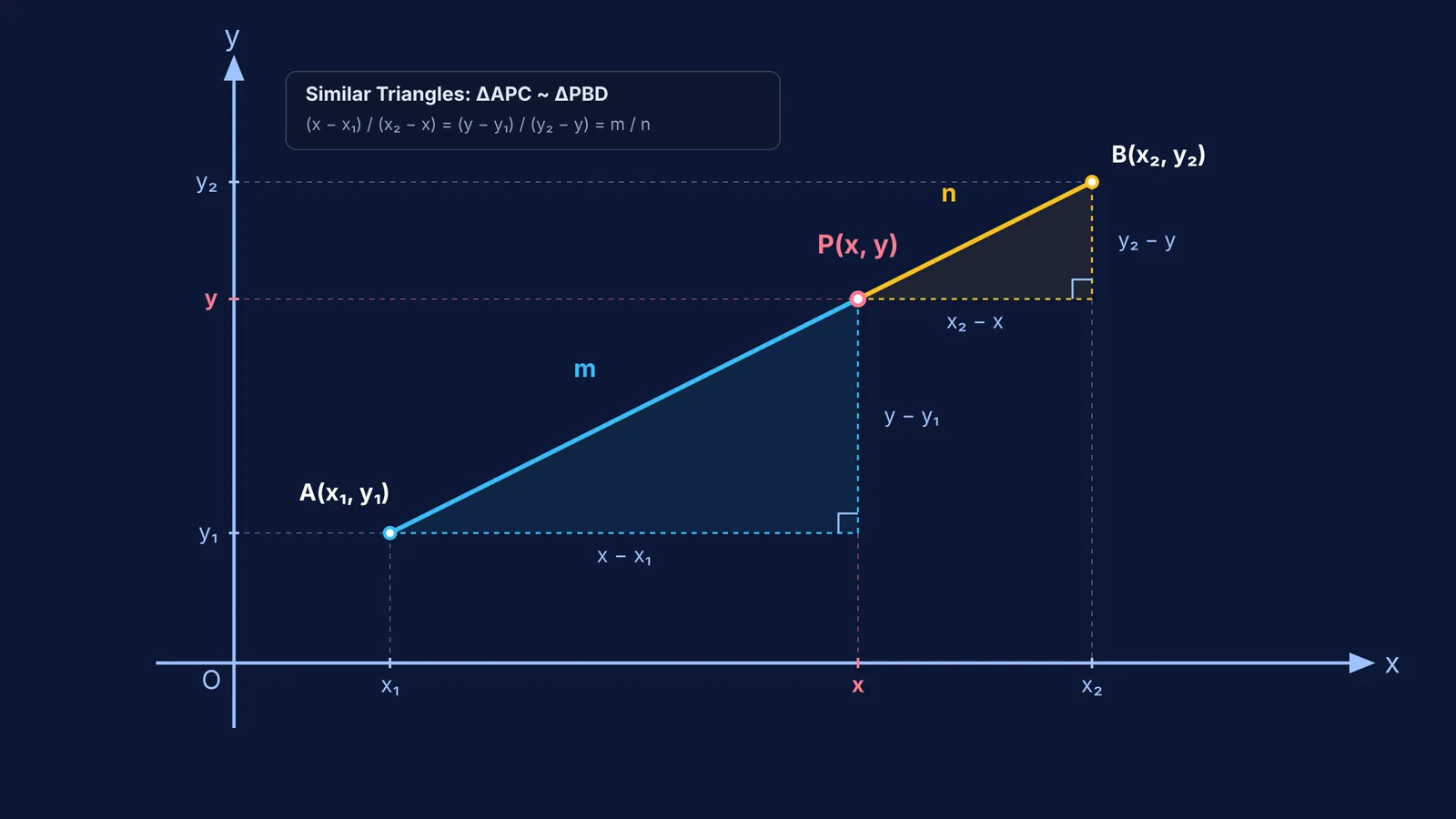
Internal division occurs when a point P(x, y) lies on the line segment connecting endpoints A(x₁, y₁) and B(x₂, y₂), dividing the segment such that the ratio AP : PB equals m : n.
The coordinates of the dividing point P(x, y) are given by:
x = (m x₂ + n x₁) / (m + n)
y = (m y₂ + n y₁) / (m + n)
In NCERT Class 10 Mathematics Chapter 7, this formula is derived using Angle-Angle (AA) triangle similarity. Right-angled triangles constructed below the segment share identical angles, making their horizontal and vertical sides proportional to the hypotenuse ratio m : n. Equating (x − x₁) / (x₂ − x) = m / n and (y − y₁) / (y₂ − y) = m / n yields the two coordinate equations.
Why is the midpoint formula a special case of internal division?
When a point M bisects the line segment AB, it divides the segment into two equal halves. The ratio AM : MB is 1 : 1, which means m = 1 and n = 1.
Substituting these values into the section formula produces the midpoint coordinates:
x = (1 · x₂ + 1 · x₁) / (1 + 1) = (x₁ + x₂) / 2
y = (1 · y₂ + 1 · y₁) / (1 + 1) = (y₁ + y₂) / 2
The midpoint is the arithmetic mean of the two endpoint coordinates. This shortcut frequently applies to segment trisections, which divide a segment into three equal parts. The first trisection point divides AB in the ratio 1 : 2, while the second trisection point divides AB in the ratio 2 : 1, or acts as the midpoint between the first dividing point and endpoint B. Mastering these relationships builds directly on the foundational ideas covered in coordinate geometry in Class 10: distance and section formulae.
How do you find coordinates when a line cuts the x-axis or y-axis?
Axis intersection problems test your ability to connect algebra with geometric definitions:
Any point on the x-axis has a vertical coordinate of zero: (x, 0).
Any point on the y-axis has a horizontal coordinate of zero: (0, y).
Consider finding the coordinates of point P dividing the segment joining A(−1, 7) and B(4, −3) internally in the ratio 2 : 3:
Identify the values: x₁ = −1, y₁ = 7, x₂ = 4, y₂ = −3, m = 2, and n = 3.
Calculate x: x = (2 × 4 + 3 × (−1)) / (2 + 3) = (8 − 3) / 5 = 1.
Calculate y: y = (2 × (−3) + 3 × 7) / (2 + 3) = (−6 + 21) / 5 = 3.
The dividing point is P(1, 3).
When an axis intersects a segment at a given ratio, the zero coordinate determines the intersection point directly. In the official CBSE Class 10 Mathematics Standard Sample Question Paper, Section A features a line segment joining (2, −3) and (5, 6) divided by the x-axis in the ratio 1 : 2. Applying the section formula with m = 1 and n = 2 gives x = (1 × 5 + 2 × 2) / (1 + 2) = 9 / 3 = 3, and y = (1 × 6 + 2 × (−3)) / (1 + 2) = 0 / 3 = 0, confirming the coordinates (3, 0). If the ratio is unknown, assuming the ratio k : 1 allows you to solve for k using the zero coordinate.
What mistakes do students make in Class 10 coordinate geometry?
In an analysis of 1,000 student geometry examination scripts published in *Pythagoras*, researcher Kakoma Luneta found that while learners are expected to operate at Van Hiele deduction levels 3 and 4, the majority operated at level 2 descriptive analysis. In secondary coordinate geometry examinations, students often jump directly into arithmetic without sketching the line, resulting in three common slips:
Reversing the cross product: Multiplying m with x₁ rather than x₂ shifts the dividing point toward the wrong endpoint.
Dropping negative signs: Forgetting parentheses when substituting negative coordinates leads to arithmetic addition errors.
Misreading division parts: In trisection questions, students sometimes use 1 : 3 rather than 1 : 2.
In the CBSE Secondary Curriculum for Class 10 Mathematics, Coordinate Geometry is allocated 6 marks across 15 instructional periods, focusing on internal division. To avoid losing marks, compare your step presentation with Class 10 CBSE maths: board answer mistakes and how to show working and structure exam pacing with the CBSE Class 10 maths paper: a section-by-section plan.
The Fermi Problem Library has worked problems with a step-by-step solver that explains the reasoning rather than printing an answer. When practicing coordinate calculations, Fermi's AI tutor can work out what you already know and build a plan for the session, helping you catch substitution mistakes before exam day.


