On this page
Chapter 11 of the NCERT Class 10 Mathematics textbook (Reprint 2026-27) is short: one section on sectors and segments, two solved examples and one exercise. The formulas are few, but each depends on reading the angle and the figure correctly. This sheet groups them by topic, defines the symbols once, and works one example per group with fresh numbers. For the full chapter walk-through with solved problems, read our guide to areas related to circles in Class 10.
Symbols used throughout: r is the radius, θ is the angle at the centre in degrees (0° < θ < 360°), and π is taken as 22/7 or 3.14, whichever the question says. Lengths are in cm and areas in cm² unless stated.
What circle formulas does this chapter build on?
The chapter builds on the area and circumference of a circle, both used in the NCERT chapter, plus a few definitions.
Area of a circle = πr²
Circumference of a circle = 2πr
Diameter d = 2r
A sector is the region between two radii and the arc they cut off. A segment is the region between a chord and its arc.
Minor and major: the minor sector has angle θ, the major sector has angle 360° − θ. Unless a question says otherwise, "sector" and "segment" mean the minor one.
Worked example: a circle has circumference 44 cm. Then 2 × (22/7) × r = 44, so r = 7 cm, and the area is (22/7) × 7 × 7 = 154 cm².
Watch for: a question that gives the diameter. Halve it before you square it.
How do you find the length of an arc?
Length of arc, l = (θ/360) × 2πr
Perimeter of a sector = l + 2r (the arc plus the two radii)
Arc of the major sector = ((360 − θ)/360) × 2πr
Worked example: r = 14 cm and θ = 45°, with π = 22/7. Then l = (45/360) × 2 × (22/7) × 14 = 11 cm, and the perimeter of the sector is 11 + 28 = 39 cm.
Watch for: when a question asks for the boundary of a sector, "arc length" alone is not the answer. Add both radii.
How do you find the area of a sector?
Area of a sector of angle θ = (θ/360) × πr²
Area of the major sector = πr² − area of the minor sector = ((360 − θ)/360) × πr²
A short form that follows from the two formulas above: area of a sector = ½ × l × r, where l is its arc length
A quadrant is a sector with θ = 90°, so its area is πr²/4
A clock's minute hand turns 360° in 60 minutes, which is 6° per minute; the hour hand turns 30° per hour
Worked example: r = 12 cm, θ = 40°, π = 3.14. The sector's area is (40/360) × 3.14 × 144 = 50.24 cm². The whole circle is 3.14 × 144 = 452.16 cm², so the major sector is 452.16 − 50.24 = 401.92 cm².
Watch for: angles given in a story, such as "the minute hand moves for 20 minutes" (20 × 6° = 120°) or "12 equally spaced spokes" (360° ÷ 12 = 30°). Convert to θ first, then use the formula.
How do you find the area of a segment?
The NCERT chapter summary gives one rule, and the CBSE Class 10 Mathematics curriculum for 2026-27 limits segment problems to central angles of 60°, 90° and 120°. So you only need the triangle OAB for those three angles.
Area of minor segment = area of sector OAB − area of triangle OAB
Area of major segment = πr² − area of minor segment
θ = 60°: triangle OAB is equilateral, chord AB = r, triangle area = (√3/4) × r²
θ = 90°: triangle OAB is right-angled at O, chord AB = r√2, triangle area = ½ × r²
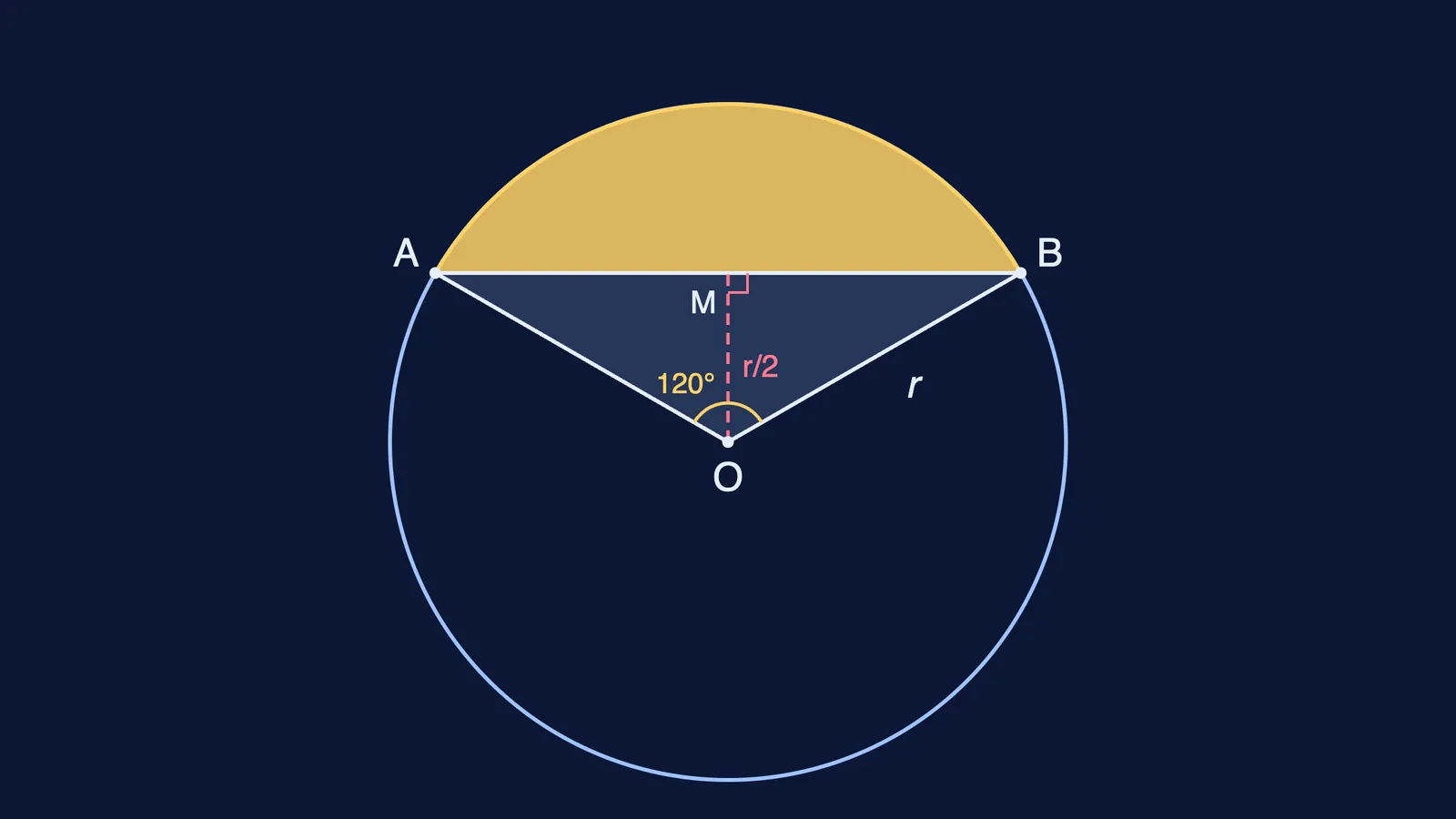
θ = 120°: draw OM ⊥ AB. Then OM = r/2, AB = r√3, triangle area = ½ × AB × OM = (√3/4) × r²
Perimeter of a segment = arc length + chord length
Worked example: r = 10 cm, θ = 120°, π = 3.14, √3 = 1.73. Sector = (120/360) × 3.14 × 100 = 104.67 cm² (rounded). Triangle = (1.73/4) × 100 = 43.25 cm². Minor segment = 104.67 − 43.25 = 61.42 cm². Major segment = 314 − 61.42 = 252.58 cm².
Watch for: using ½ × r × r for the triangle when θ is 60° or 120°. That shortcut works only at 90°, where the two radii are the base and the height. At 120°, the height from O to AB is r/2, not r.
Why is M the midpoint of AB? OA = OB, so triangles AMO and BMO are congruent by RHS, which is how NCERT's Example 2 finds OM and AB. For the chapter just before this one, see our post on circle and tangent theorems in Class 10.
How to revise this formula sheet
Sketch the figure for every question, shade the region asked for, and mark θ at the centre before writing any formula.
Learn the triangle for 60°, 90° and 120° by drawing it with OM, not by memorising three separate answers.
Keep the value of π and √3 the question gives. Mixing 22/7 and 3.14 in one answer changes the decimals.
Check that a major sector or segment plus its minor one adds up to πr². It is a quick test for slips.
Practise mixed shapes, such as a sector cut from a square field, since the same formulas apply. The next chapter, surface areas and volumes of combined solids, uses the same habit of splitting a shape into parts.
If you get a segment answer wrong and cannot see where, the Fermi Problem Library has worked problems with a step-by-step solver that explains the reasoning rather than printing an answer.