On this page
This formula sheet follows Chapter 6, Triangles, of the rationalised NCERT Class 10 Mathematics textbook (Reprint 2026-27), and the topics match the Triangles entry in the CBSE Class X Mathematics syllabus for 2026-27. The chapter is about similarity. The theorem on areas of similar triangles and the Pythagoras theorem proofs are not sections of the current chapter and are not listed in that syllabus entry, so they are left out here.
Symbols used throughout: ~ means "is similar to", ∥ means "is parallel to", ∠A is the angle at vertex A, and k is the common ratio of corresponding sides.
When are two triangles similar?
From NCERT sections 6.2 and 6.3:
Similar figures have the same shape but not necessarily the same size. All congruent figures are similar; the converse is not true.
Two polygons with the same number of sides are similar if corresponding angles are equal and corresponding sides are in the same ratio. For polygons, both conditions are needed.
ΔABC ~ ΔDEF means A ↔ D, B ↔ E, C ↔ F, so ∠A = ∠D, ∠B = ∠E, ∠C = ∠F and AB/DE = BC/EF = CA/FD = k.
Condition: the order of letters fixes which vertices match. For the same pair, ΔBAC ~ ΔEDF is also correct, but ΔABC ~ ΔEDF is not.
Worked example: ΔABC ~ ΔPQR with AB = 6 cm, BC = 8 cm, CA = 9 cm and PQ = 4.5 cm. Then k = AB/PQ = 6/4.5 = 4/3, so QR = 8 ÷ (4/3) = 6 cm and RP = 9 ÷ (4/3) = 6.75 cm.
Watch for: pairing sides by the figure instead of the statement. In ΔABC ~ ΔPQR, BC pairs with QR because of letter positions.
What does the basic proportionality theorem say?
From NCERT Theorems 6.1 and 6.2, Example 1, Example 2 and Exercise 6.2. In ΔABC, D is on AB and E is on AC.
BPT (Thales theorem): if DE ∥ BC, then AD/DB = AE/EC. Condition: the line meets the other two sides at distinct points.
Equivalent forms when DE ∥ BC: AD/AB = AE/AC and DB/AB = EC/AC.
Converse: if AD/DB = AE/EC, then DE ∥ BC.
Trapezium ABCD with AB ∥ DC: if EF ∥ AB with E on AD and F on BC, then AE/ED = BF/FC; diagonals meeting at O give AO/BO = CO/DO.
The CBSE syllabus asks you to prove the BPT and state the converse without proof.
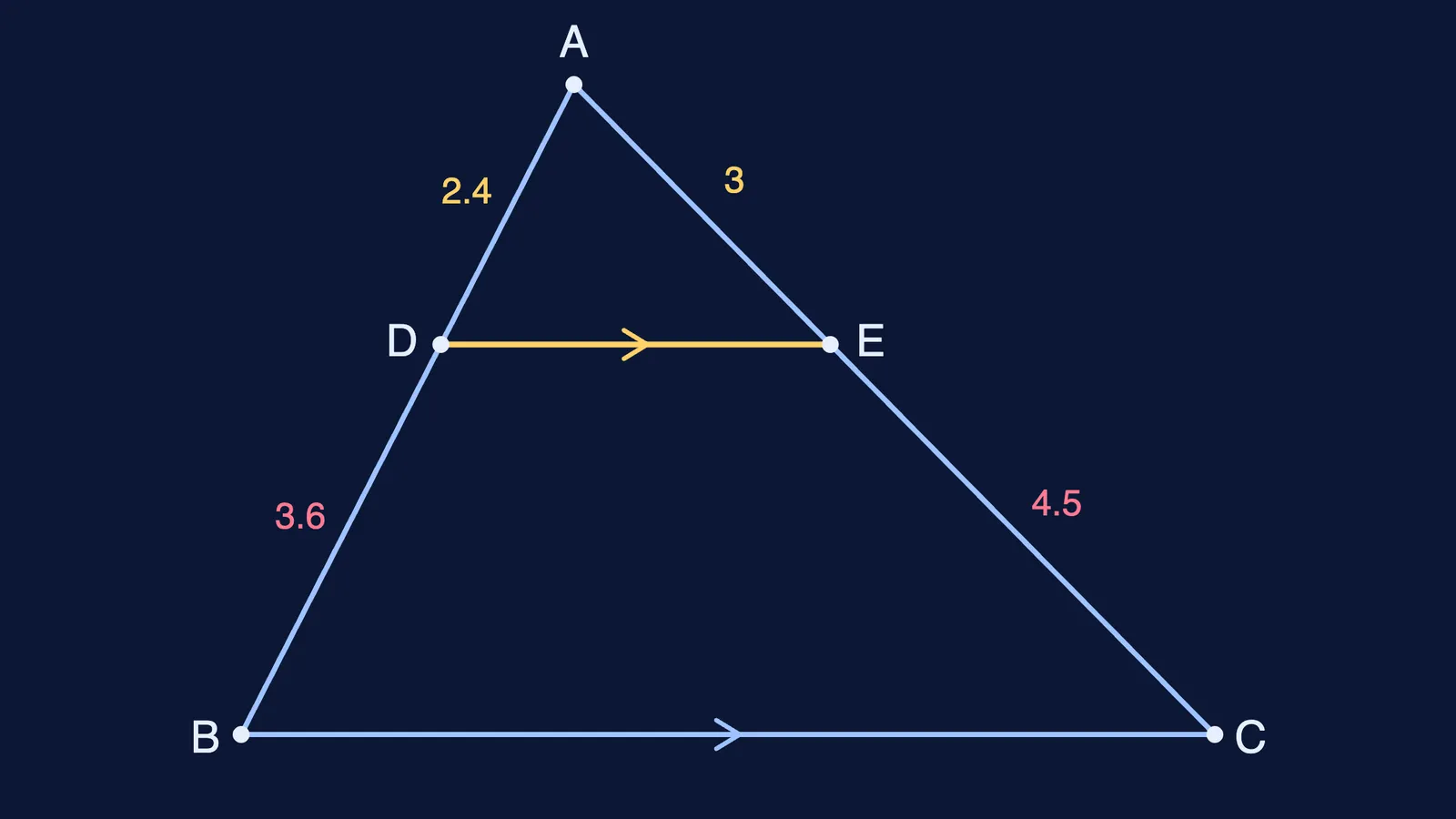
Worked example: DE ∥ BC, AD = 2.4 cm, DB = 3.6 cm and AC = 7.5 cm. Find AE and EC. AD/DB = 2.4/3.6 = 2/3, so AE : EC = 2 : 3. AE = 7.5 × 2/5 = 3 cm and EC = 7.5 × 3/5 = 4.5 cm. Check: 3/4.5 = 2/3. The hero diagram above draws this triangle to scale.
Watch for: mixing the two forms. AD/DB = AE/EC and AD/AB = AE/AC are both correct, but AD/DB = AE/AC is wrong.
Which similarity criteria can you use?
From NCERT Theorems 6.3 to 6.5 and the chapter Summary:
AAA: if corresponding angles are equal, corresponding sides are in the same ratio and the triangles are similar.
AA: two pairs of equal angles are enough, because the third angles are then equal by the angle sum property.
SSS: if AB/DE = BC/EF = CA/FD, then ∠A = ∠D, ∠B = ∠E, ∠C = ∠F and ΔABC ~ ΔDEF.
SAS: if ∠A = ∠D and AB/DE = AC/DF, then ΔABC ~ ΔDEF. Condition: the equal angle must be the one included between the two pairs of sides.
RHS (NCERT's note to the reader): in two right triangles, if the hypotenuse and one side of one are proportional to the hypotenuse and one side of the other, the triangles are similar.
Worked example: ∠B = ∠E = 70°, AB = 4 cm, BC = 6 cm, DE = 6 cm and EF = 9 cm. AB/DE = BC/EF = 2/3 and ∠B, ∠E are included, so ΔABC ~ ΔDEF (SAS). Hence ∠A = ∠D, ∠C = ∠F and AC/DF = 2/3.
Watch for: using a non-included angle. Two proportional sides and an angle that is not between them (an "SSA" pattern) do not prove similarity.
How do you use similar triangles to find lengths?
Once two triangles are similar, corresponding lengths are in the ratio k. NCERT uses this in Examples 7 and 8 and Exercise 6.3:
Shadows at the same time: height of object 1 / its shadow = height of object 2 / its shadow (both vertical, sun's rays at the same angle, so AA).
Lamp-post: a lamp at height H, a person of height h at distance d from its foot, shadow length x: H/h = (d + x)/x.
Medians: if ΔABC ~ ΔPQR and AD, PM are medians, AB/PQ = AD/PM.
If D is on BC with ∠ADC = ∠BAC, then ΔADC ~ ΔBAC and CA² = CB × CD.
Worked example: a lamp is 4.5 m above the ground. A boy 1.5 m tall walks away from its foot at 1 m/s. After 5 s he is d = 5 m away. Then 4.5/1.5 = (5 + x)/x, so 3x = 5 + x and x = 2.5 m.
Watch for: putting the shadow alone in the lamp-post ratio. The big triangle's base is the distance plus the shadow, d + x, not x. If you cannot see which two triangles to compare, the Fermi Problem Library has worked problems with a step-by-step solver that explains the reasoning rather than printing an answer.
How to revise this formula sheet
Write the BPT proof from memory weekly, with figure and construction; the syllabus asks you to prove it.
For each similarity statement, say all three side ratios and angle pairs aloud.
Make a card per criterion with one sketch that fits and one that does not, such as SSA.
Before solving any NCERT figure, first name the two similar triangles.
For the full BPT proof, read our Triangles Class 10 guide to similarity and the BPT, then see the Class 10 maths theorems you need to prove and the common Class 10 maths mistakes.