On this page
Everything below follows NCERT Class 10 Mathematics, Chapter 2 (Reprint 2026-27) and the CBSE 2026-27 Class X Mathematics syllabus, which lists "zeros of a polynomial" and the "relationship between zeros and coefficients of quadratic polynomials". Not included: the division algorithm for polynomials, because the current NCERT chapter has no section on it and the syllabus does not list it.
For the ideas behind each formula, read our Polynomials Class 10 chapter guide.
Degree, value and zero of a polynomial
Degree: the highest power of x in p(x). Degree 1 is linear, degree 2 is quadratic, degree 3 is cubic.
Quadratic polynomial: ax² + bx + c, where a, b, c are real numbers and a ≠ 0.
Cubic polynomial: ax³ + bx² + cx + d, where a, b, c, d are real numbers and a ≠ 0.
Value at k: p(k) is what you get by putting x = k in p(x).
Zero: a real number k is a zero of p(x) if p(k) = 0.
Zero of a linear polynomial ax + b (a ≠ 0): k = −b/a, that is −(constant term) ÷ (coefficient of x).
Worked example: the zero of 5x + 8 is −8/5. For p(x) = x² − 6x + 8, p(2) = 4 − 12 + 8 = 0, so 2 is a zero, while p(0) = 8 is just the constant term.
Watch for: a zero is an x that makes p(x) = 0, not p(0). 1/(x − 1) and √x + 2 are not polynomials.
What do the zeroes of a polynomial mean on a graph?
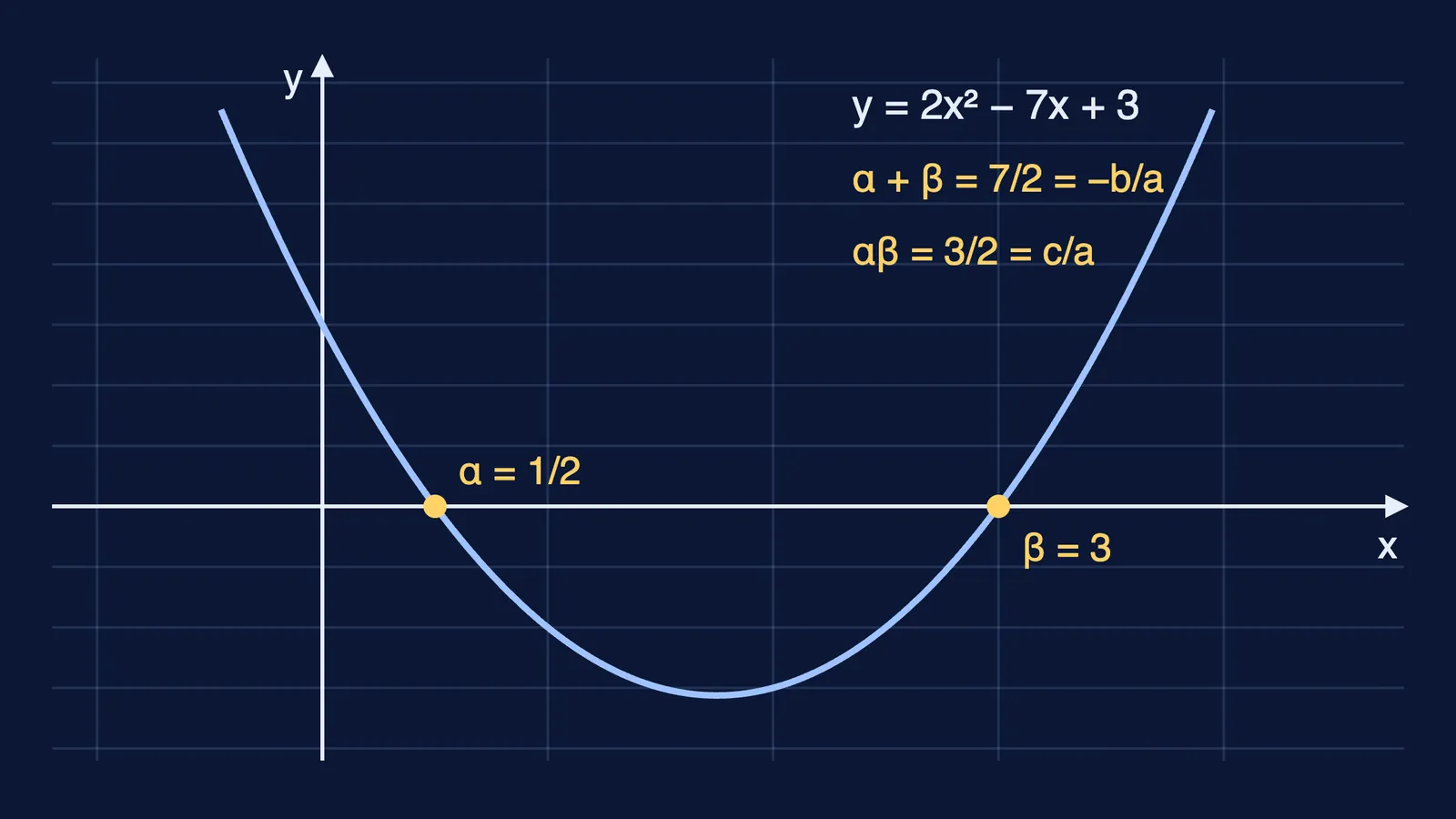
The zeroes of p(x) are exactly the x-coordinates of the points where the graph of y = p(x) meets the x-axis.
y = ax + b (a ≠ 0) is a straight line that meets the x-axis at one point, (−b/a, 0).
y = ax² + bx + c is a parabola, opening upward if a > 0 and downward if a < 0.
A quadratic has two distinct zeroes, two equal zeroes (the graph touches the x-axis), or no zero (the graph stays above or below it).
A polynomial of degree n has at most n zeroes: at most 2 for a quadratic, at most 3 for a cubic.
Worked example: y = x² − 6x + 9 = (x − 3)² touches the x-axis only at (3, 0), so it has two equal zeroes, both 3. y = x² + 2x + 5 has its lowest value 4 at x = −1, so it never meets the x-axis and has no zero.
Watch for: count only the points on the x-axis. Where the graph crosses the y-axis tells you p(0), not a zero. NCERT says students are not expected to plot quadratic or cubic graphs.
What is the relationship between zeroes and coefficients of a quadratic polynomial?
If α and β are the zeroes of ax² + bx + c, with a ≠ 0:
Sum of zeroes: α + β = −b/a = −(coefficient of x) ÷ (coefficient of x²).
Product of zeroes: αβ = c/a = (constant term) ÷ (coefficient of x²).
Useful rearrangements: α² + β² = (α + β)² − 2αβ, and (α − β)² = (α + β)² − 4αβ.
When α and β are not zero (c ≠ 0): 1/α + 1/β = (α + β)/αβ.
If the quadratic has two zeroes, they are reciprocals of each other (αβ = 1) exactly when c = a.
Worked example: for 2x² − 7x + 3, a = 2, b = −7, c = 3. So α + β = 7/2 and αβ = 3/2, and α² + β² = 49/4 − 3 = 37/4. Check by factorising: 2x² − 7x + 3 = (2x − 1)(x − 3), zeroes 1/2 and 3, and 1/4 + 9 = 37/4.
Watch for: the sum is −b/a, so a negative b gives a positive sum. Write the polynomial in the order ax² + bx + c before reading a, b and c; 6 − 5x + x² has a = 1, not 6.
Beyond the syllabus: NCERT also states zero–coefficient relations for cubic polynomials, but marks its cubic example "Not from the examination point of view", and the CBSE 2026-27 syllabus lists only the quadratic relationship.
How do you find a quadratic polynomial from its zeroes?
With sum S = α + β and product P = αβ: p(x) = k[x² − Sx + P], where k is any non-zero real number (k = 1 gives x² − Sx + P).
Worked example: zeroes −2 and 5/3 give S = −1/3 and P = −10/3. So p(x) = k[x² + x/3 − 10/3], and k = 3 clears the fractions: 3x² + x − 10. Check: (x + 2)(3x − 5) = 3x² + x − 10.
Watch for: the sign before S is minus. With S = −1/3, the middle term becomes +x/3.
How to revise this formula sheet
Write the sum, product and α² + β² formulas from memory and test them on 2x² − 7x + 3.
Redo NCERT Exercise 2.2 and check every answer with the sum-and-product test.
Count zeroes from the graphs in Exercise 2.1.
Skim our common Class 10 maths mistakes and carry the sum-and-product idea into the Class 10 quadratic equations guide. If α² + β² questions keep going wrong, the Fermi Problem Library has worked problems with a step-by-step solver that explains the reasoning rather than printing an answer.