On this page
Class 10 probability rests on one definition. The CBSE 2026-27 Class X Mathematics curriculum lists two items under Probability in Unit VII: the classical definition of probability and simple problems on finding the probability of an event. Chapter 14 of the rationalised NCERT Class 10 Mathematics textbook (Reprint 2026-27) builds everything from one definition and a handful of rules that follow from it. This sheet groups them by topic, with a worked example and one common slip for each. For the chapter's ideas explained in full, read our Class 10 probability guide.
Geometric probability (areas and lengths, NCERT Examples 10 and 11) is marked "Not from the examination point of view" in the NCERT chapter, so it is left out here.
What is the probability formula in Class 10?
The NCERT chapter defines theoretical (classical) probability as favourable outcomes divided by all possible outcomes, assuming the outcomes are equally likely.
P(E) = (number of outcomes favourable to E) ÷ (number of all possible outcomes of the experiment)
E is the event; P(E) is its probability.
Condition: every outcome of the experiment is equally likely (a fair coin, a fair die, a well-shuffled deck, drawing "at random"), and the number of outcomes is finite.
For contrast, the chapter recalls experimental (empirical) probability: (number of trials in which E happened) ÷ (total number of trials). It is based on what actually happened, not on equally likely outcomes.
Worked example: tickets numbered 1 to 30 are in a box and one is drawn at random. The primes up to 30 are 2, 3, 5, 7, 11, 13, 17, 19, 23 and 29, so 10 outcomes are favourable. P(prime) = 10/30 = 1/3.
Watch for: 1 is not a prime number. Counting it gives 11/30, which is wrong.
What values can a probability take?
The NCERT chapter summary gives the limits and the two special events.
0 ≤ P(E) ≤ 1 for every event E, because the favourable outcomes can never outnumber all outcomes.
Sure (certain) event: P = 1. Impossible event: P = 0.
An elementary event has exactly one outcome. The probabilities of all the elementary events of an experiment add up to 1.
Worked example: a bag has 5 red, 7 green and 8 yellow marbles, 20 in all. P(red) = 5/20 = 1/4, P(green) = 7/20 and P(yellow) = 8/20 = 2/5. Check: 5/20 + 7/20 + 8/20 = 20/20 = 1. P(blue) = 0/20 = 0 (impossible), and P(red, green or yellow) = 20/20 = 1 (sure).
Watch for: an answer like 7/5 or a negative number is always wrong. If you get one, you have probably put the total on top.
How do you use the complement rule?
The event "not E" is the complement of E, written Ē. The NCERT chapter shows that E and not E together cover every outcome.
P(E) + P(not E) = 1
P(not E) = 1 − P(E)
Use it when "not E" is easier to count than E: "at least one", "not an ace", "different birthdays".
Worked example: a lot of 150 pens has 9 defective pens and one pen is picked at random. P(defective) = 9/150 = 3/50. So P(good) = 1 − 3/50 = 47/50. Counting directly gives the same answer: 141/150 = 47/50.
Watch for: the complement of "at least one head" is "no heads", not "exactly one head".
How many outcomes are there for coins, dice and cards?
The chapter's examples keep returning to a few experiments. Every count below is in the NCERT chapter.
One coin: 2 outcomes (H, T). Two coins: 4 outcomes, (H, H), (H, T), (T, H), (T, T).
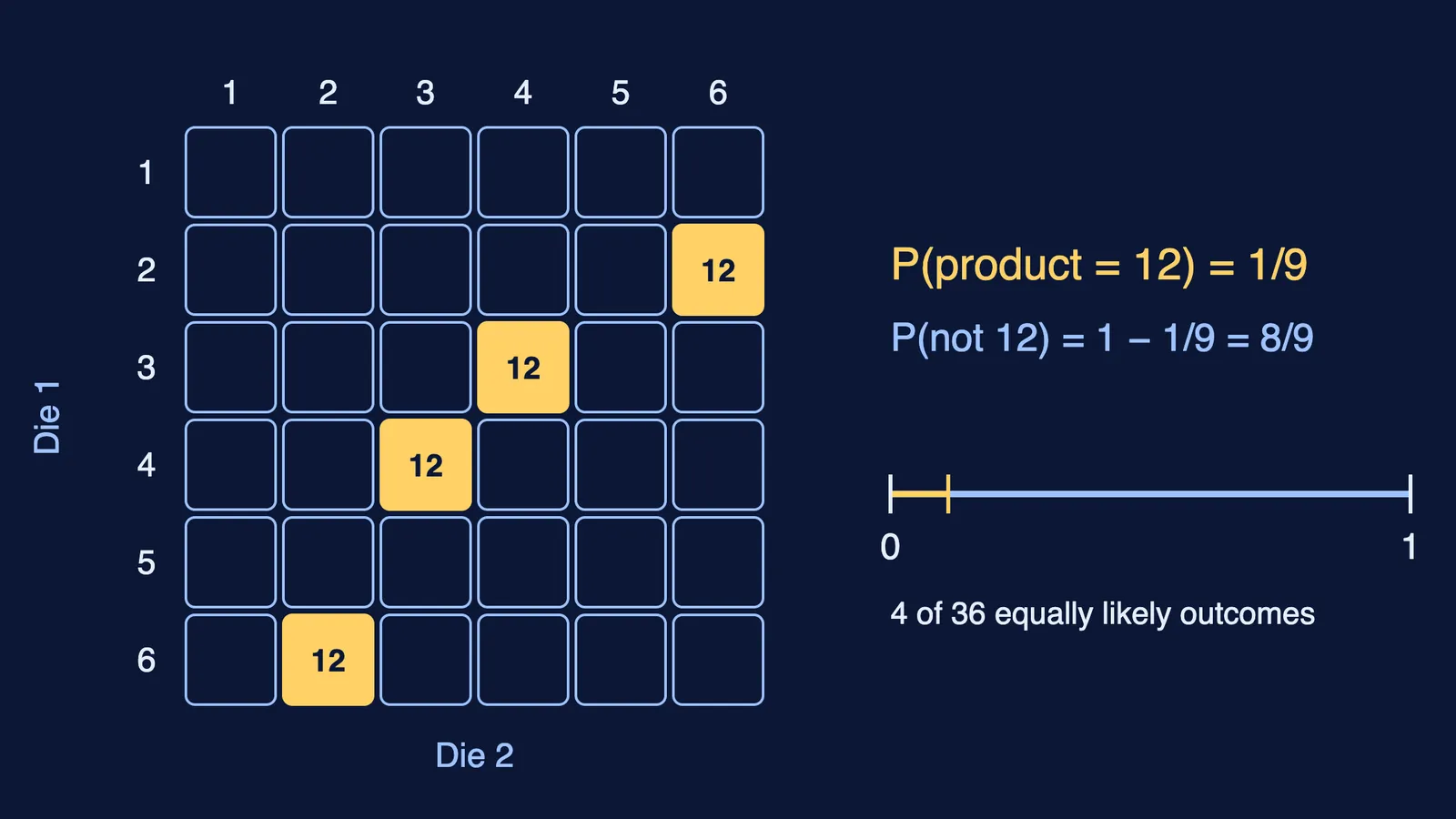
One die: 6 outcomes. Two dice thrown together: 6 × 6 = 36 outcomes, written as ordered pairs.
A deck of cards: 52 cards in 4 suits of 13 (spades, hearts, diamonds, clubs). Hearts and diamonds are red, clubs and spades are black. Kings, queens and jacks are face cards, so there are 12.
Birthdays (ignoring leap years): 365 equally likely days.
Worked example: two dice are thrown. The product is 12 for (2, 6), (3, 4), (4, 3) and (6, 2), so P(product = 12) = 4/36 = 1/9 and P(product is not 12) = 1 − 1/9 = 8/9. Using the complement again, there are 6 doubles, so P(not a double) = 1 − 6/36 = 5/6. For cards, P(a face card of spades) = 3/52.
Watch for: (2, 6) and (6, 2) are different outcomes, and so are (H, T) and (T, H). With two coins, "two heads, two tails, one of each" are not equally likely; NCERT's own exercise asks you to spot this. Aces are not face cards.
How to revise this formula sheet
Write the 36-cell grid for two dice once from memory. Then mark the cells for each sum from 2 to 12 and check that the 11 counts add up to 36.
For every answer, write the total first, then the favourable count. This habit guards against putting the total on top.
Practise each question twice: once by counting E directly, once with 1 − P(not E). If the two answers differ, recount.
Keep a card-deck fact list (52, 4 suits, 13 per suit, 12 face cards, 26 red) and say it aloud before a card question.
Revise this chapter alongside Class 10 Statistics, since the CBSE 2026-27 curriculum places both in Unit VII, and read our list of common Class 10 maths mistakes before a test.
If you keep getting a different answer from the book, the Fermi Problem Library has worked problems with a step-by-step solver that explains the reasoning rather than printing an answer.