On this page
The rationalised NCERT Class 10 Mathematics chapter 1 (Reprint 2026-27) covers two ideas: the Fundamental Theorem of Arithmetic and irrational numbers. The CBSE Class X Mathematics curriculum for 2026-27 lists the same two: the Fundamental Theorem of Arithmetic, and proofs of irrationality of √2, √3, √5.
Euclid's division lemma and the decimal-expansion test were dropped when the chapter was rationalised: the current chapter has no section on either, so neither is on this sheet. For the concepts behind this sheet, read our guide to real numbers in Class 10.
What does the Fundamental Theorem of Arithmetic say?
Theorem 1.1 in the NCERT chapter: every composite number can be expressed as a product of primes, and this factorisation is unique, apart from the order in which the prime factors occur.
x = p₁ × p₂ × ... × pₙ, where x is a composite number and p₁, p₂, ..., pₙ are primes written in ascending order (p₁ ≤ p₂ ≤ ... ≤ pₙ).
In powers: x = p₁^a₁ × p₂^a₂ × ... × pₖ^aₖ, where p₁, ..., pₖ are distinct primes and each exponent a₁, ..., aₖ is a positive integer.
A number ends in the digit 0 only if its prime factorisation contains both 2 and 5 (it must be divisible by 10).
m × k + m = m(k + 1), so for positive integers m > 1 and k ≥ 1 a number written this way is composite.
Worked example: 7560 = 2³ × 3³ × 5 × 7. Can 12ⁿ end in 0 for a natural number n? 12ⁿ = 2²ⁿ × 3ⁿ has no 5, and uniqueness means none can appear, so no. And 3 × 5 × 7 + 7 = 7 × (15 + 1) = 112, which is composite.
Watch for: 1 is neither prime nor composite, so it never appears in a factor tree.
How do you find HCF and LCM by prime factorisation?
Factorise first, then apply the NCERT rules:
HCF = product of the smallest power of each common prime factor in the numbers.
LCM = product of the greatest power of each prime factor involved in the numbers.
HCF(a, b) × LCM(a, b) = a × b, for any two positive integers a and b. This holds for two numbers only.
So LCM(a, b) = (a × b) ÷ HCF(a, b), once the HCF is known.
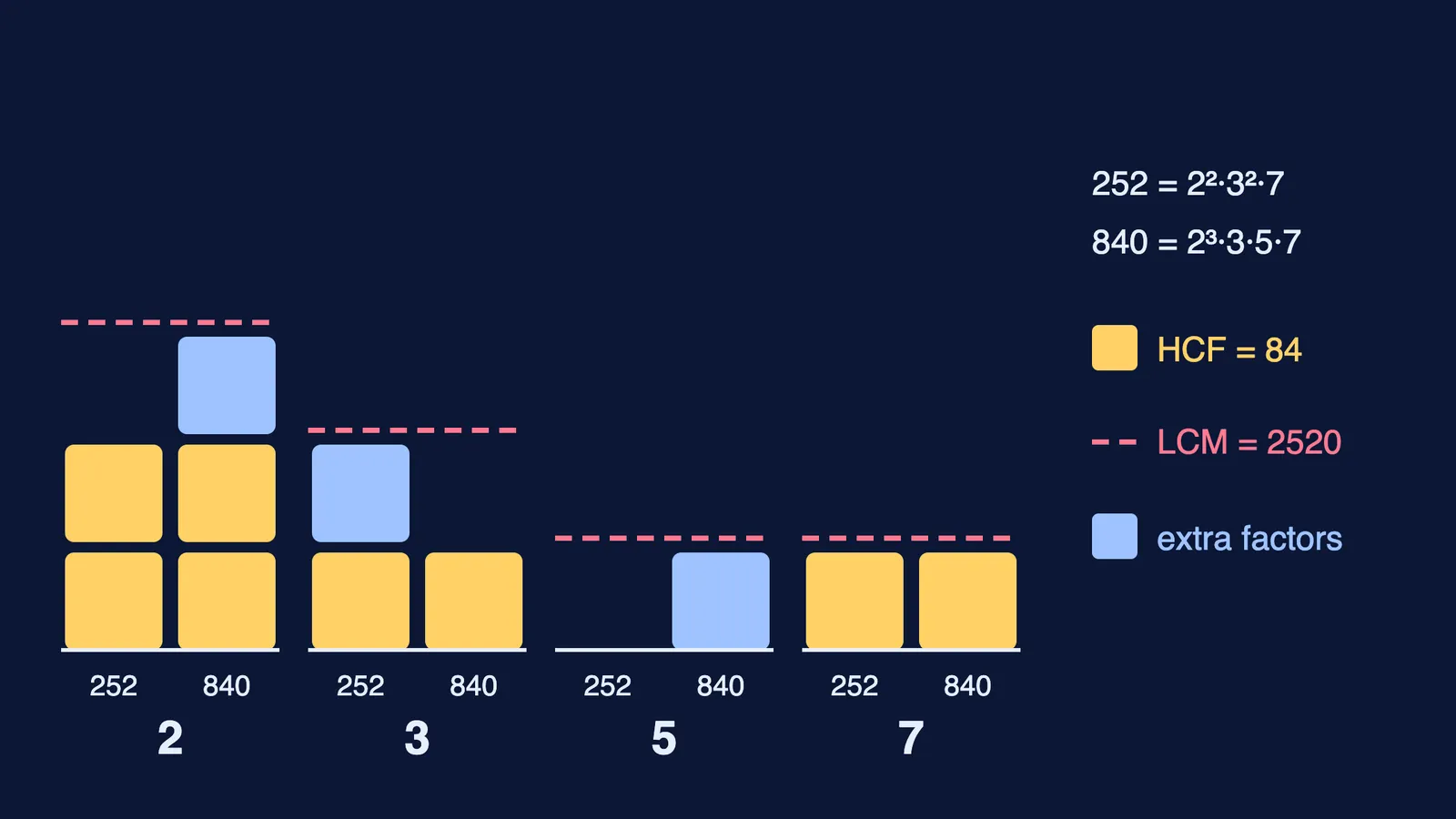
Worked example: 252 = 2² × 3² × 7 and 840 = 2³ × 3 × 5 × 7. Common primes are 2, 3 and 7, with smallest powers 2², 3¹ and 7¹, so HCF = 4 × 3 × 7 = 84. The greatest powers of all primes involved are 2³, 3², 5¹ and 7¹, so LCM = 8 × 9 × 5 × 7 = 2520. Check: 84 × 2520 = 211680 = 252 × 840.
Word problem: buses leave a depot together, one every 15 minutes and one every 25. LCM(3 × 5, 5²) = 75, so they next leave together after 75 minutes.
Watch for: a prime found in only one number (5 in 840) goes into the LCM, not the HCF.
Does HCF × LCM = product work for three numbers?
No. The NCERT chapter says so after Example 4, and its note to the reader gives the results that do hold for positive integers p, q and r:
HCF(p, q, r) × LCM(p, q, r) ≠ p × q × r, as the note writes it: no such rule exists for three numbers (2, 3 and 5 match only by chance).
LCM(p, q, r) = [p × q × r × HCF(p, q, r)] ÷ [HCF(p, q) × HCF(q, r) × HCF(p, r)]
HCF(p, q, r) = [p × q × r × LCM(p, q, r)] ÷ [LCM(p, q) × LCM(q, r) × LCM(p, r)]
Worked example: for 20, 28 and 42, HCF = 2 and LCM = 2² × 3 × 5 × 7 = 420. HCF × LCM = 840, but 20 × 28 × 42 = 23520. With pairwise HCFs 4, 14 and 2, the note gives LCM = (23520 × 2) ÷ (4 × 14 × 2) = 420, which matches.
How do you prove a number is irrational?
A number s is irrational if it cannot be written in the form p/q, where p and q are integers and q ≠ 0. The NCERT proofs rest on:
Theorem 1.2: if p is a prime and p divides a², then p divides a, where a is a positive integer.
√p is irrational for a prime p (the chapter proves √2 and √3; the exercises ask for √5).
Rational ± irrational is irrational.
Non-zero rational × irrational and non-zero rational ÷ irrational are irrational.
The √2 proof: assume √2 = a/b with a, b coprime and b ≠ 0; then 2b² = a², so 2 divides a; write a = 2c; then b² = 2c², so 2 divides b; now 2 is a common factor of a and b, a contradiction.
Worked example: show 7 + 2√3 is irrational. Assume 7 + 2√3 = a/b, with a and b coprime integers and b ≠ 0. Then √3 = (a − 7b) ÷ 2b, a ratio of integers, so √3 would be rational. That is a contradiction, so 7 + 2√3 is irrational.
Watch for: Theorem 1.2 needs a prime. 4 divides 6² = 36, but 4 does not divide 6. Two irrationals can give a rational: √2 × √2 = 2.
If a proof step does not make sense to you, the Fermi Problem Library has worked problems with a step-by-step solver that explains the reasoning rather than printing an answer.
How to revise this formula sheet
Factorise five numbers daily; pair them and check HCF × LCM = a × b.
Write the √2 proof from memory, then adapt it to √5 and √7. See our Class 10 maths theorems you should be able to prove.
For "show that a + b√p is irrational", practise the rearrangement until it takes one line.
Before a test, read our post on Class 10 maths answer mistakes and how to show working.