On this page
Animal Kingdom is Chapter 4 of Class 11 NCERT Biology. Here are the 2026-27 syllabus, the features that sort every phylum, a revision list and practice questions we wrote.
What does the 2026-27 syllabus include for Animal Kingdom?
The CBSE Biology curriculum for 2026-27 puts this chapter in Unit I, Diversity of Living Organisms, which carries 15 marks of the 70-mark Class XI theory paper. Those 15 marks are shared by Chapters 1 to 4; CBSE gives no figure for any single chapter.
It asks for non-chordates up to phylum level and chordates up to class level, with a few examples of each. Its formative-only list for Class XI names only Digestion and Absorption, so all of this chapter counts in the exam.
We followed the current NCERT chapter (Reprint 2026-27). We found no Class XI sample paper, so our questions follow the formats of the Class XII Biology sample paper for 2026-27.
What is the basis of classification in the animal kingdom?
The NCERT chapter sorts animals by shared features:
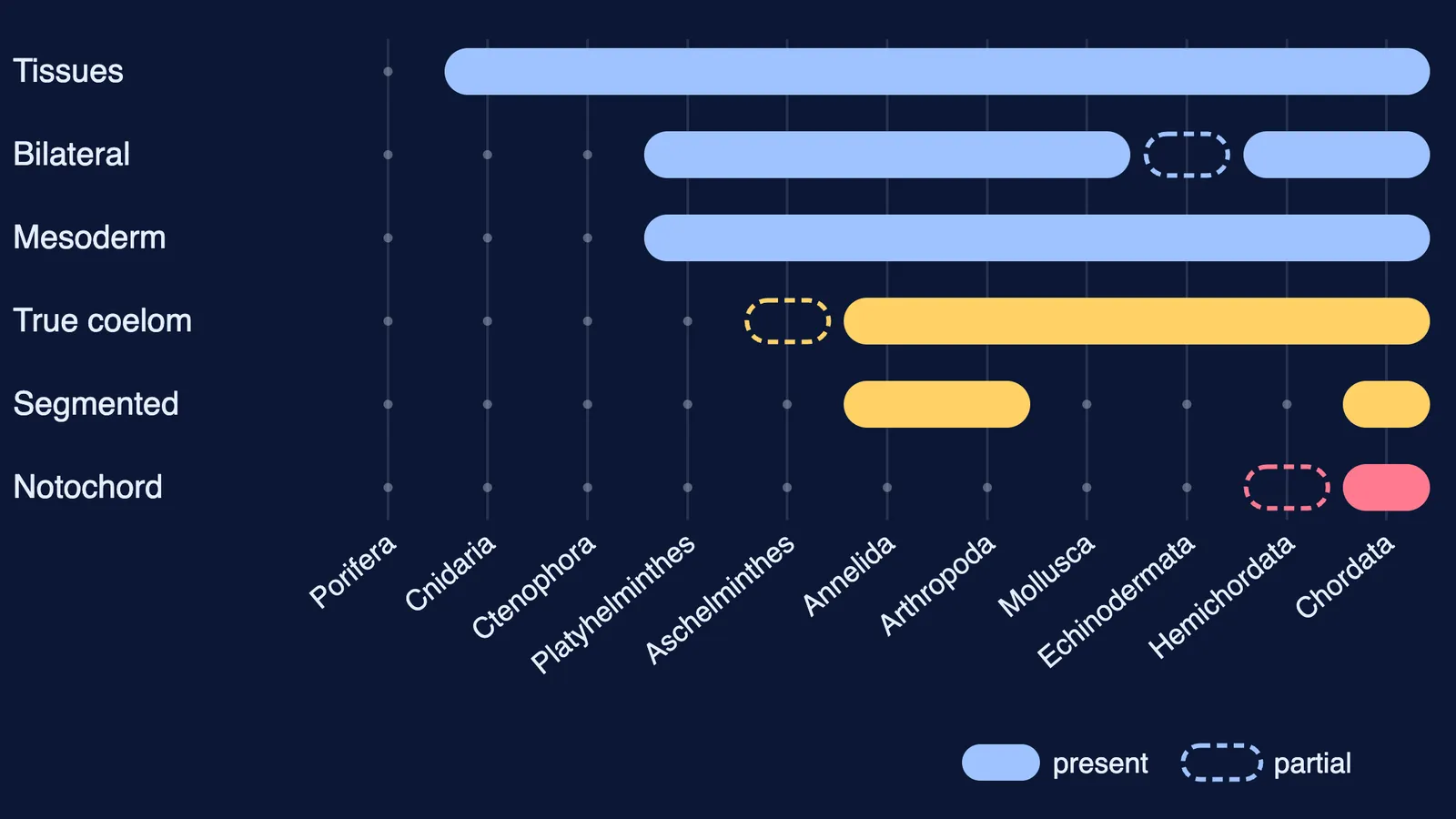
Level of organisation: cellular (sponges), tissue (cnidarians, ctenophores), organ (flatworms), organ system (most other phyla).
Symmetry: asymmetrical (most sponges), radial (cnidarians, ctenophores, adult echinoderms), bilateral (the rest).
Germ layers: diploblastic (ectoderm, endoderm, mesoglea between) or triploblastic, adding mesoderm (flatworms to chordates).
Coelom: a body cavity lined by mesoderm. Flatworms have none (acoelomate); roundworms have a pseudocoelom, with mesoderm only in scattered pouches.
Segmentation: serial repetition of segments and some organs, called metamerism in the earthworm.
Notochord: a rod formed on the dorsal side from mesoderm in the embryo; it separates chordates from non-chordates.
How do the non-chordate phyla compare?
Level, symmetry, coelom, signature feature, examples:
Porifera: cellular, mostly asymmetrical, no coelom; canal system with ostia, spongocoel and osculum, lined by choanocytes. Sycon, Spongilla.
Coelenterata (Cnidaria): tissue, radial, diploblastic; cnidoblasts, polyp and medusa forms. Hydra, Aurelia.
Ctenophora: tissue, radial, diploblastic; eight rows of comb plates, bioluminescence. Pleurobrachia, Ctenoplana.
Platyhelminthes: organ, bilateral, acoelomate; flat body, flame cells, hooks and suckers (parasites). Taenia, Fasciola.
Aschelminthes: organ system, bilateral, pseudocoelomate; round in section, complete gut, separate sexes. Ascaris, Wuchereria.
Annelida: organ system, bilateral, coelomate, metamerically segmented; nephridia, closed circulation. Nereis, Pheretima.
Arthropoda: largest phylum; chitinous exoskeleton, jointed appendages, open circulation, Malpighian tubules. Apis, Limulus.
Mollusca: second largest; calcareous shell, muscular foot, mantle, radula. Pila, Octopus.
Echinodermata: all marine; radial adults with bilateral larvae; water vascular system, no excretory system. Asterias, Antedon.
Hemichordata: worm-like, marine; proboscis, collar, trunk; a stomochord, not a notochord. Balanoglossus, Saccoglossus.
How are chordates classified up to class level?
Chordates have a notochord, dorsal hollow nerve cord, paired pharyngeal gill slits and post-anal tail. In Urochordata (Ascidia) the notochord is only in the larval tail; in Cephalochordata (Branchiostoma) it runs head to tail for life. In adult vertebrates a vertebral column replaces it.
Cyclostomata (Agnatha, no jaws): circular sucking mouth, 6 to 15 pairs of gill slits, ectoparasites on fishes. Petromyzon.
Chondrichthyes: cartilaginous, placoid scales, no operculum, no air bladder. Scoliodon, Trygon.
Osteichthyes: bony, operculum, air bladder for buoyancy. Labeo, Hippocampus.
Amphibia: moist skin without scales, cloaca, three-chambered heart. Rana, Ichthyophis.
Reptilia: dry cornified skin with scales; heart usually three-chambered, four in crocodiles. Naja, Chelone.
Aves: feathers, beak, pneumatic bones, crop and gizzard, four-chambered heart. Columba, Struthio.
Mammalia: mammary glands, hair, pinnae, four-chambered heart; mostly viviparous. Ornithorhynchus lays eggs.
What practice questions should you try?
The mark labels are our suggestion, not a CBSE allocation.
(1 mark) Name the cells that line the spongocoel of a sponge.
(1 mark) In which reptile is the heart four-chambered?
(2 marks) Give two differences between a polyp and a medusa, and name the phenomenon when one species has both.
(2 marks) Compare the notochord of Urochordata and Cephalochordata.
(3 marks) A marine animal has radial adults, bilateral larvae, a water vascular system and no excretory system. Name its phylum, one example and its coelom type.
(3 marks) Compare Chondrichthyes and Osteichthyes on skeleton, gill cover and buoyancy.
(5 marks) Arrange Porifera, Cnidaria, Platyhelminthes, Aschelminthes and Annelida in order of complexity, and state the feature added at each step.
Answers: 1. Choanocytes (collar cells). 2. Crocodiles. 3. Sessile and cylindrical versus umbrella-shaped and free-swimming; metagenesis (Obelia). 4. Larval tail only versus head to tail, for life. 5. Echinodermata, Asterias, coelomate. 6. Cartilage, no operculum, no air bladder versus bone, operculum, air bladder. 7. Cells to tissues; then organs, bilateral symmetry and mesoderm; then a pseudocoelom and complete gut; then a true coelom and metameric segmentation.
How should you revise this chapter?
Redraw the ladder from memory and say each phylum's signature feature aloud. Pair it with Biological Classification for Class 11 and The Living World for Class 11, which share its Unit I marks. Preparing for NEET too? Try placing any phylum with six questions.
Coelom types blurring together? The Fermi Concept Library has every concept in physics, chemistry, biology, mathematics and computing, each with its own lesson and its place in the map.