On this page
Plant Kingdom is Chapter 3 of Class 11 NCERT Biology. Here is what the 2026-27 syllabus keeps, what the current textbook leaves out, a group-by-group comparison and practice questions we wrote.
What does the 2026-27 syllabus include for Plant Kingdom?
The CBSE Biology curriculum for 2026-27 places this chapter in Unit I, Diversity of Living Organisms, which carries 15 marks of the 70-mark Class XI theory paper. Those 15 marks are shared by four chapters (The Living World, Biological Classification, Plant Kingdom and Animal Kingdom); there is no chapter-wise figure.
It asks for the major plant groups, their distinguishing features and a few examples of each. The only Class XI topic on the formative-only list is Digestion and Absorption, so all of Plant Kingdom is examinable. The practical spotting list (7 of the 30 practical marks) includes Spirogyra, a liverwort, a moss, a fern, pine, a monocot and a dicot.
Are plant life cycles and alternation of generations still in the chapter?
No. The current NCERT chapter (Reprint 2026-27) ends at section 3.5, Angiosperms, with no section on plant life cycles or alternation of generations, so haplontic, diplontic and haplo-diplontic patterns are not covered. The angiosperm section is one short paragraph.
What stays is the life history inside each group: which generation is the main plant, where meiosis happens and where water is needed. Double fertilisation belongs to Class XII.
How do the five plant groups compare?
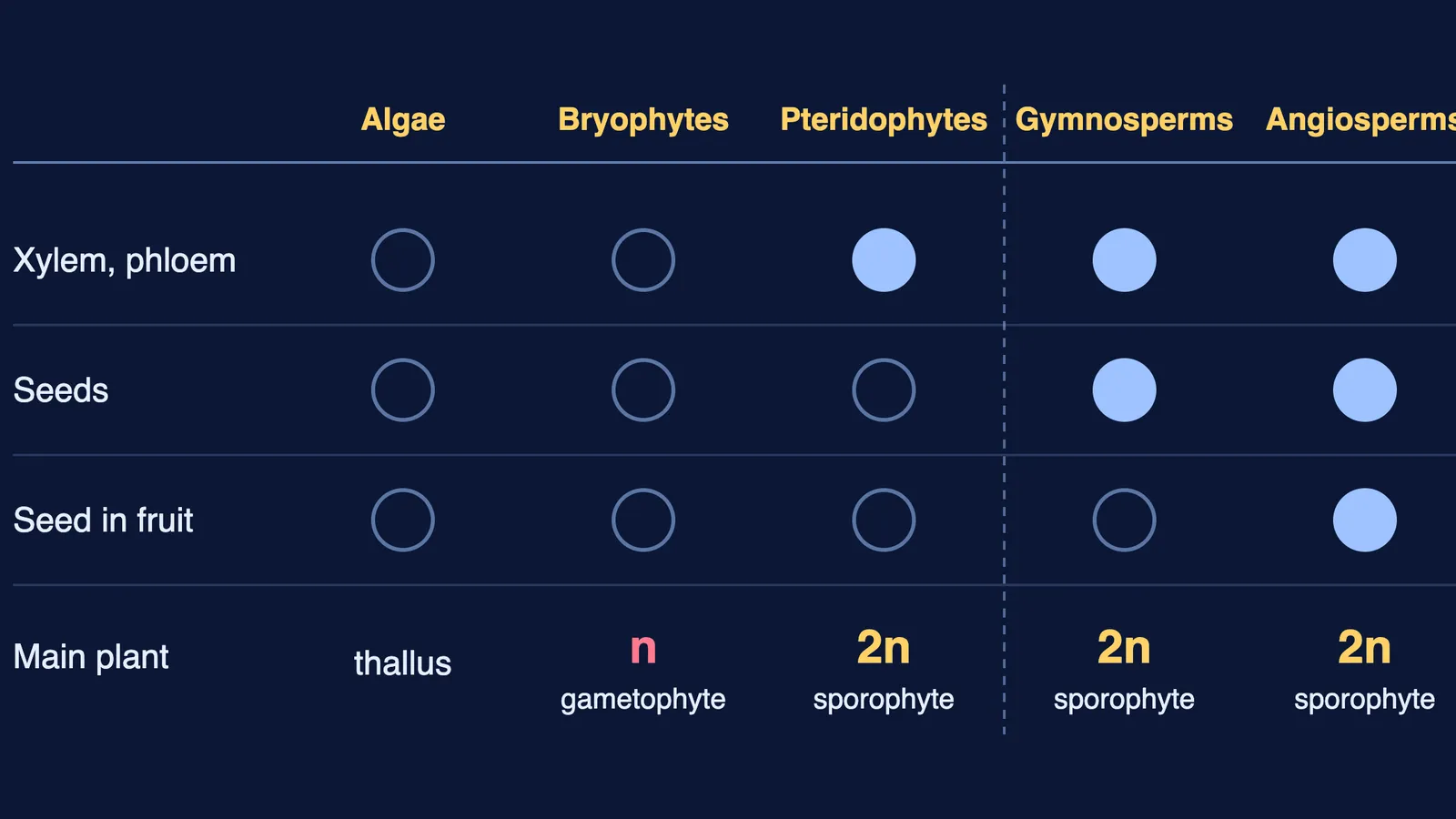
All facts below are from the NCERT chapter.
Algae are simple thalloid autotrophs that carry chlorophyll and live mostly in water, fresh or marine. Sexual reproduction is isogamous (Spirogyra), anisogamous (Eudorina) or oogamous (Volvox, Fucus). The three classes differ by pigment, stored food and flagella:
Chlorophyceae (green): chlorophyll a and b; starch; Chlamydomonas, Ulothrix, Chara.
Phaeophyceae (brown): chlorophyll a, c and fucoxanthin; laminarin or mannitol; two unequal lateral flagella; Laminaria, Sargassum.
Rhodophyceae (red): r-phycoerythrin; floridean starch; flagella absent; Polysiphonia, Gelidium.
Bryophytes (liverworts and mosses) are the "amphibians of the plant kingdom": they live on land but need water for fertilisation. The main plant is a haploid gametophyte with rhizoids, not true roots. The sporophyte (foot, seta, capsule) stays attached to it and draws food from it. Marchantia also spreads by gemmae; mosses such as Funaria pass through a protonema stage.
Pteridophytes (horsetails and ferns) are the first terrestrial plants with xylem and phloem. The sporophyte is now the main plant, with true roots, stems and leaves; the small gametophyte, the prothallus, lives free in cool, damp, shady places. In heterosporous Selaginella and Salvinia, the female gametophyte stays on the parent and the embryo starts there, a precursor to the seed habit. Know one genus per class: Psilotum, Selaginella, Equisetum, Dryopteris.
Gymnosperms have ovules with no ovary wall, so seeds are naked. Gametophytes are not free-living; wind carries pollen, and a pollen tube delivers the male gametes. Cycas has coralloid roots with nitrogen-fixing cyanobacteria and bears male cones and megasporophylls on separate trees; Pinus has mycorrhiza and both cone types on one tree.
Angiosperms form pollen and ovules in flowers and enclose seeds in fruits. They range from tiny Wolffia to Eucalyptus over 100 metres tall, and split into dicotyledons and monocotyledons.
What practice questions should you try?
The mark labels are our suggestion, not a CBSE allocation.
(1 mark) Name the pigment that gives red algae their colour.
(1 mark) What are the green buds in the cups on a Marchantia thallus called?
(2 marks) A moss specimen has a leafy shoot with a stalked capsule at its tip. Which part is the gametophyte, which is the sporophyte, and which one feeds the other?
(2 marks) Give two features of conifer leaves that reduce water loss.
(3 marks) Compare Cycas and Pinus on stem branching, root associations and where the cones are borne.
(3 marks) Pteridophytes have vascular tissue, yet living species occupy only narrow regions. Explain why.
(5 marks) Starting from a spore, trace a moss through to the release of new spores, giving the ploidy (n or 2n) of each stage.
Answers: 1. r-phycoerythrin. 2. Gemmae. 3. The leafy shoot is the gametophyte (n); the foot, seta and capsule form the sporophyte (2n), fed by the gametophyte. 4. Needle shape, thick cuticle, sunken stomata (any two). 5. Cycas: unbranched, coralloid roots, cones on different trees; Pinus: branched, mycorrhiza, both on one tree. 6. The prothallus needs cool, damp, shady places, and fertilisation needs water. 7. Spore (n), protonema (n), leafy gametophyte (n), antherozoids and egg (n), zygote (2n), sporophyte (2n), meiosis in the capsule, spores (n).
How should you revise Plant Kingdom?
Redraw the comparison grid from memory and check it against the diagram above. Make one flashcard per algal class. Sort the spotting specimens into groups with two reasons each. Then connect Unit I: the five kingdoms in Biological Classification, taxonomy and naming rules in The Living World, and why pteridophytes are the first vascular land plants.
Gametophyte or sporophyte? The Fermi Concept Library covers every concept in biology, each with its own lesson and its place in the map.