On this page
Introduction to Three Dimensional Geometry is the shortest chapter of Class 11 coordinate geometry: it adds a third axis to the plane you already know. Here are its 2026-27 marks, coverage and questions.
How many marks is Three Dimensional Geometry in Class 11 for 2026-27?
The CBSE Mathematics curriculum for 2026-27 puts this chapter in Unit III, Coordinate Geometry, which carries 12 of the 80 theory marks. That 12 is shared with Straight Lines and Conic Sections, and the curriculum adds "No chapter/unit-wise weightage", so this chapter has no figure of its own. The syllabus lists axes and coordinate planes, coordinates of a point, and the distance between two points.
The section formula is out of the written paper: the curriculum lists it among Class XI topics that "will be assessed only formatively to reinforce understanding without adding to summative assessments".
The question paper design gives 44 marks to remembering and understanding, 20 to applying and 16 to analysing, evaluating and creating. CBSE publishes no Class XI sample paper, so mark labels below are our suggestion, not CBSE's.
What does the NCERT 2026-27 chapter cover?
The current NCERT Class 11 Mathematics Chapter 11 (Reprint 2026-27) has four sections: 11.1 Introduction, 11.2 Coordinate Axes and Coordinate Planes, 11.3 Coordinates of a Point in Space and 11.4 Distance between Two Points. It has no section on the section formula, which the curriculum keeps for formative assessment only.
Axes and planes. Three mutually perpendicular lines through O are the x, y and z-axes; each pair fixes a coordinate plane (XY, YZ, ZX).
Coordinates as distances. In P(x, y, z), x, y and z are the perpendicular distances of P from the YZ, ZX and XY-planes, with signs. P(2, 6, 3) is 2 units from the YZ-plane, 6 from the ZX-plane and 3 from the XY-plane.
Points on axes and planes. A point on the y-axis is (0, y, 0); a point in the ZX-plane is (x, 0, z).
Distance. Derived from Pythagoras in a box. For P(2, 6, 3), OP = √(4 + 36 + 9) = 7.
For the octant table and worked collinear and right-triangle checks, see our post on the 3D distance formula and the eight octant signs.
What questions come from this chapter in the Class 11 exam?
The chapter's examples and exercises point to four kinds:
Recall (1 mark): a point on an axis or plane, or its octant.
Distance (1-2 marks): between two points, or from the origin.
Proofs (3 marks): collinear points, special triangles, parallelograms.
Locus (3 marks): the set of points meeting a distance condition.
How do you solve a locus question in 3D?
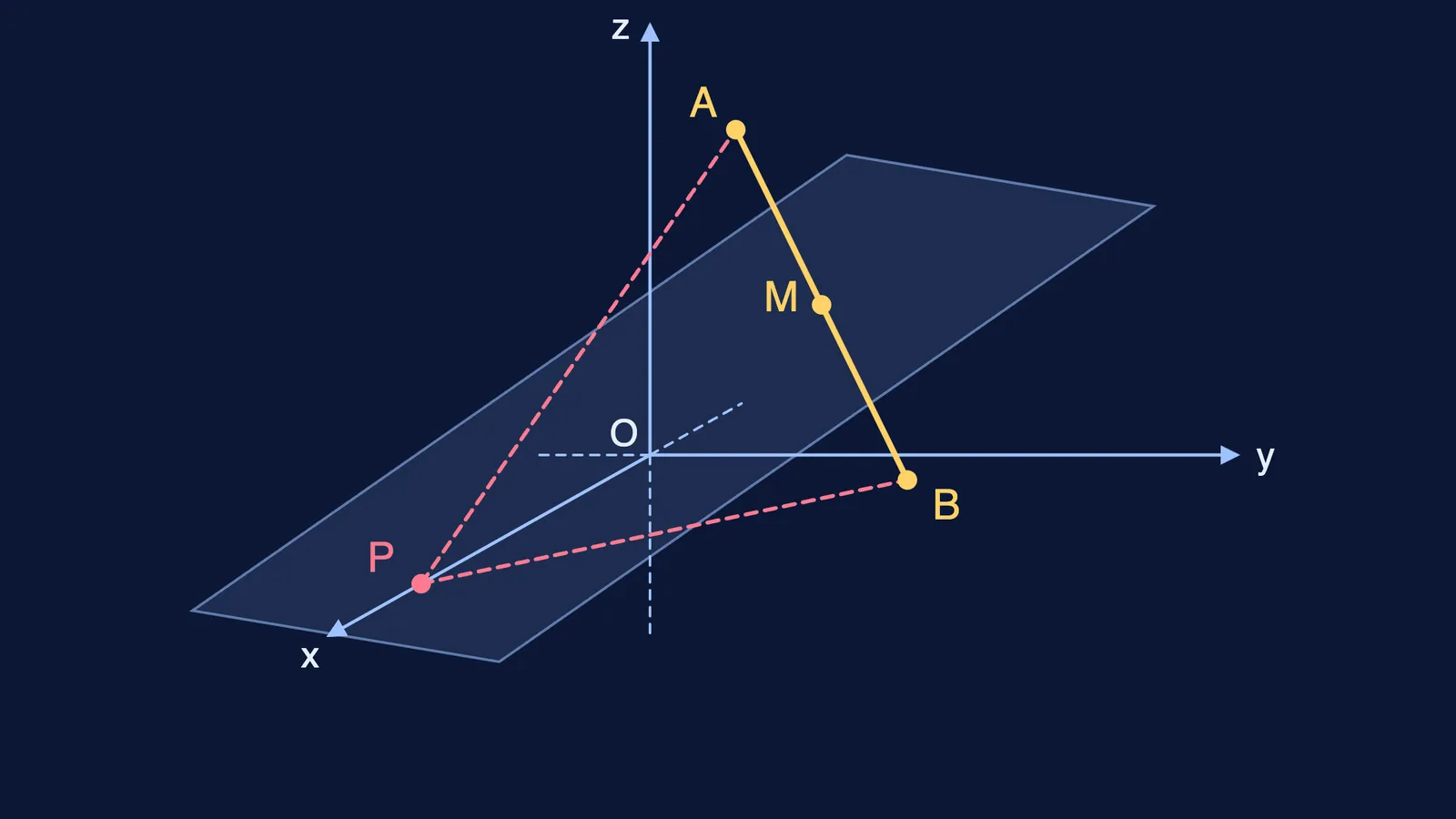
Question (3 marks). A point P is always the same distance from A(1, 2, 5) as from B(3, 6, 1). Find the equation of its locus.
Let P be (x, y, z). PA = PB means PA² = PB².
Write both: (x − 1)² + (y − 2)² + (z − 5)² = (x − 3)² + (y − 6)² + (z − 1)².
Expand; the squared terms cancel, leaving −2x − 4y − 10z + 30 = −6x − 12y − 2z + 46.
Collect terms: 4x + 8y − 8z − 16 = 0.
Divide by 4: x + 2y − 2z − 4 = 0.
Check: the midpoint M(2, 4, 3) gives 2 + 8 − 6 − 4 = 0, as it should. The point P(4, 0, 0) also fits: PA² = 9 + 4 + 25 = 38 and PB² = 1 + 36 + 1 = 38. The diagram above shows this plane through M, meeting the x-axis at P.
What questions can you practise?
The marks are our suggestion.
(1 mark) On which coordinate plane does (0, −4, 7) lie? *x = 0, so the YZ-plane.*
(1 mark) Find the distance of (−3, 4, −12) from the origin. *√(9 + 16 + 144) = √169 = 13.*
(2 marks) The distance between (1, k, 3) and (3, 1, 4) is 3. Find k. *4 + (1 − k)² + 1 = 9, so (1 − k)² = 4 and k = −1 or 3.*
(3 marks) Show that A(1, 0, 2), B(3, 2, 1), C(4, 5, 3) and D(2, 3, 4) form a parallelogram that is not a rectangle. *AB = CD = 3 and BC = DA = √14, but the diagonals AC = √35 and BD = √11 differ.*
How should you revise this chapter?
Sketch the axes with the XY-plane flat and the z-axis vertical, as NCERT describes, and plot a few points by hand: along x, parallel to y, then up or down in z. Then do one sitting of distance proofs and one of locus questions.
The ideas return in Class 12, where Three Dimensional Geometry for the board exam adds lines in space. For the section formula, see the ratio in which the yz-plane divides a segment.
Not sure where to start? Fermi's AI tutor can work out what you already know and build a plan for the session.