On this page
Three Dimensional Geometry is short and mechanical, so it is a dependable source of board marks. This guide is for the CBSE paper, not JEE.
What is in Three Dimensional Geometry for the 2026-27 board exam?
The CBSE Mathematics curriculum for 2026-27 prints Unit IV as "Vectors and Three - Dimensional Geometry" with 14 of the theory paper's 80 marks. Those 14 marks are shared with Vectors, and there is no chapter-wise weightage.
The curriculum lists direction cosines and ratios, vector and Cartesian equations of a line, skew lines, shortest distance, and the angle between two lines. The NCERT chapter (Reprint 2026-27) matches: it ends at shortest distance, with no section on planes, although its introduction still mentions them. For planes, see our 3D geometry for JEE post.
Which results should you know by heart?
All from the NCERT chapter:
Direction cosines satisfy l² + m² + n² = 1. Divide direction ratios a, b, c by √(a² + b² + c²) to get them.
The line through a parallel to b is r = a + λb, or (x − x₁)/a = (y − y₁)/b = (z − z₁)/c.
For the acute angle between lines, cos θ = |b₁·b₂| / (|b₁||b₂|). Perpendicular means b₁·b₂ = 0; parallel means proportional direction ratios.
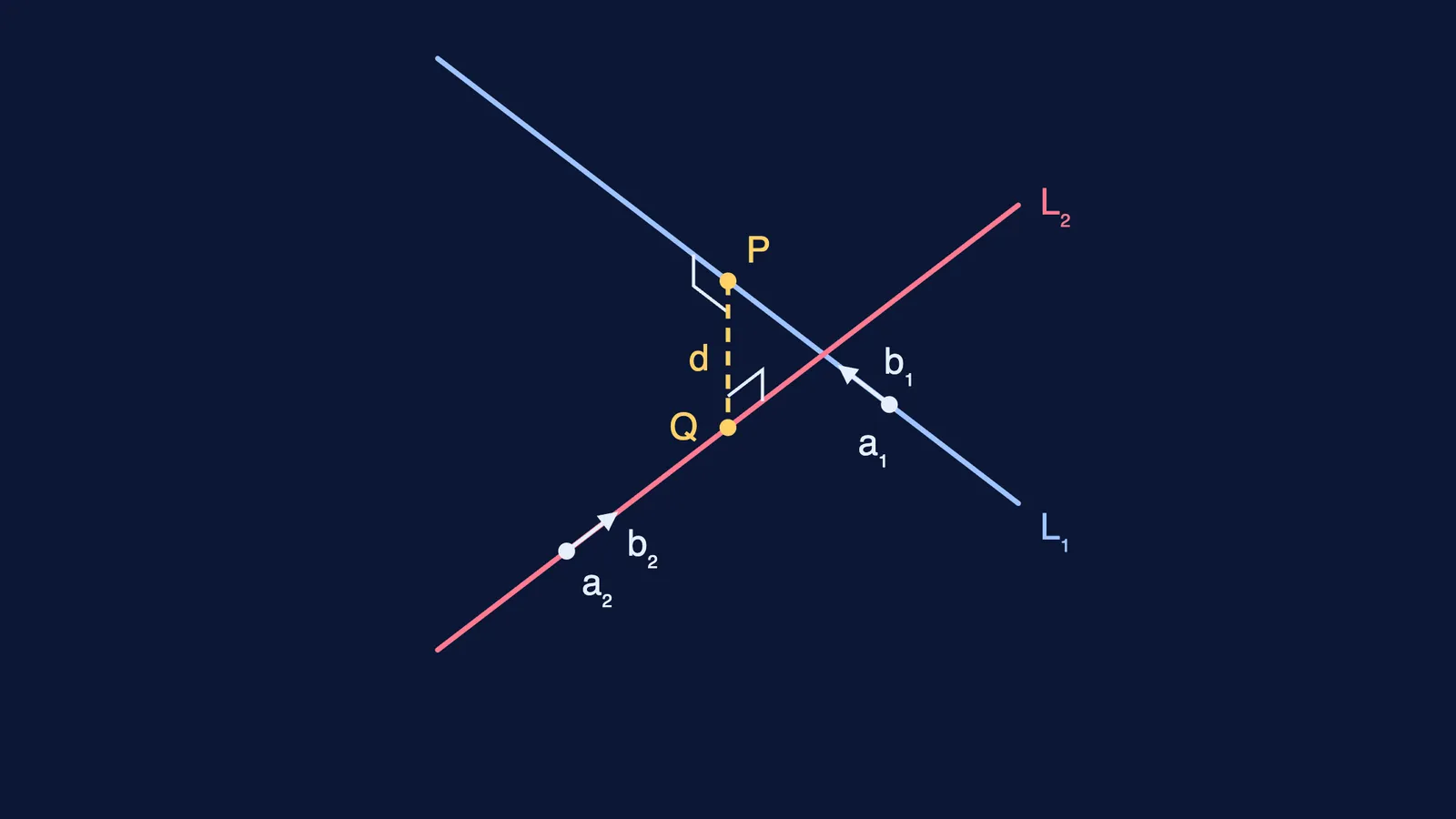
Skew lines are neither parallel nor intersecting. Their shortest distance is d = |(b₁ × b₂)·(a₂ − a₁)| / |b₁ × b₂|.
For parallel lines with direction b, d = |b × (a₂ − a₁)| / |b|.
See also direction cosines from l + m + n = 0.
How do you set out 2-, 3- and 5-mark answers?
The 2026-27 sample paper tests this chapter in a 2-mark question on parallel lines (Q23(A), whose internal choice is on vectors), a 3-mark choice between a foot of perpendicular and an angle between lines (Q30), and a 4-mark case study on laser beams (Q36). The marking scheme splits Q30(A) into six half-marks, one per step, and marks Q36(iii) as two 1-mark steps.
2 marks: direction ratios, the condition, the answer.
3 marks: a general point in k, the condition, k, the answer, each on its own line.
5 marks: the sample paper has none from this chapter. If one comes, write a₁, b₁, a₂, b₂, the cross product as a determinant, the dot product, the substituted formula and the answer in units.
Common errors:
Reading direction ratios from a non-standard form. In Q30(B) the scheme gives half a mark for rewriting the second line in standard form, with (3 − z)/2 as (z − 3)/−2.
Dropping the modulus, so a distance comes out negative.
A sign slip in the middle term of the determinant.
Using the skew-line formula on parallel lines, where b₁ × b₂ = 0.
Worked example: one distance, two methods
Find the shortest distance between L₁: (x − 1)/1 = (y − 1)/2 = (z − 1)/2 and L₂: (x + 2)/2 = (y − 4)/1 = (z − 4)/(−2).
Method 1: formula. a₁ = (1, 1, 1), b₁ = (1, 2, 2), a₂ = (−2, 4, 4), b₂ = (2, 1, −2). b₁ × b₂ = (−6, 6, −3), magnitude 9; a₂ − a₁ = (−3, 3, 3). Their dot product, 27, is not zero and the lines are not parallel, so they are skew. d = 27/9 = 3 units.
Method 2: feet of the common perpendicular. Take P(1 + λ, 1 + 2λ, 1 + 2λ) on L₁ and Q(−2 + 2μ, 4 + μ, 4 − 2μ) on L₂. PQ·b₁ = 0 gives 9 − 9λ = 0; PQ·b₂ = 0 gives 9μ − 9 = 0. So P = (2, 3, 3), Q = (0, 5, 2), PQ = (−2, 2, −1) and |PQ| = 3. Both agree.
What traps hide in assertion-reason and case-study questions?
The sample paper's assertion-reason items (Q19, Q20) are on calculus, not this chapter. If one appears, watch for:
Direction cosines have squares summing to 1; direction ratios need not. "1, 2, 2 are direction cosines" is false.
An undirected line has two sets of direction cosines.
Not parallel does not mean skew: if (b₁ × b₂)·(a₂ − a₁) = 0, the lines meet.
A true reason that does not explain the assertion is option (B), not (A).
Case studies like Q36 write lines as r = (λ + 1)i + (3λ + 2)j + (3 − λ)k. Rewrite each as a + λb first, and reuse earlier sub-part answers. More practice: line through two points, r = a + λ(b − a).
How should you revise this chapter?
Day 1: direction cosines and ratios (Exercise 11.1).
Day 2: line equations in both forms.
Day 3: angles; perpendicular and parallel tests.
Day 4: shortest distance (Exercise 11.2), checking one by the feet method.
Day 5: sample paper Q23, Q30, Q36, timed, then marked with the scheme.
If your answer disagrees with the book, the Fermi Problem Library has worked problems with a step-by-step solver that explains the reasoning rather than printing an answer.