

On this page
If a question gives you two points in space and asks for "the line through them", you need one formula, one conversion and one check. Here are all three, worked on one example.
What does r = a + λ(b − a) mean?
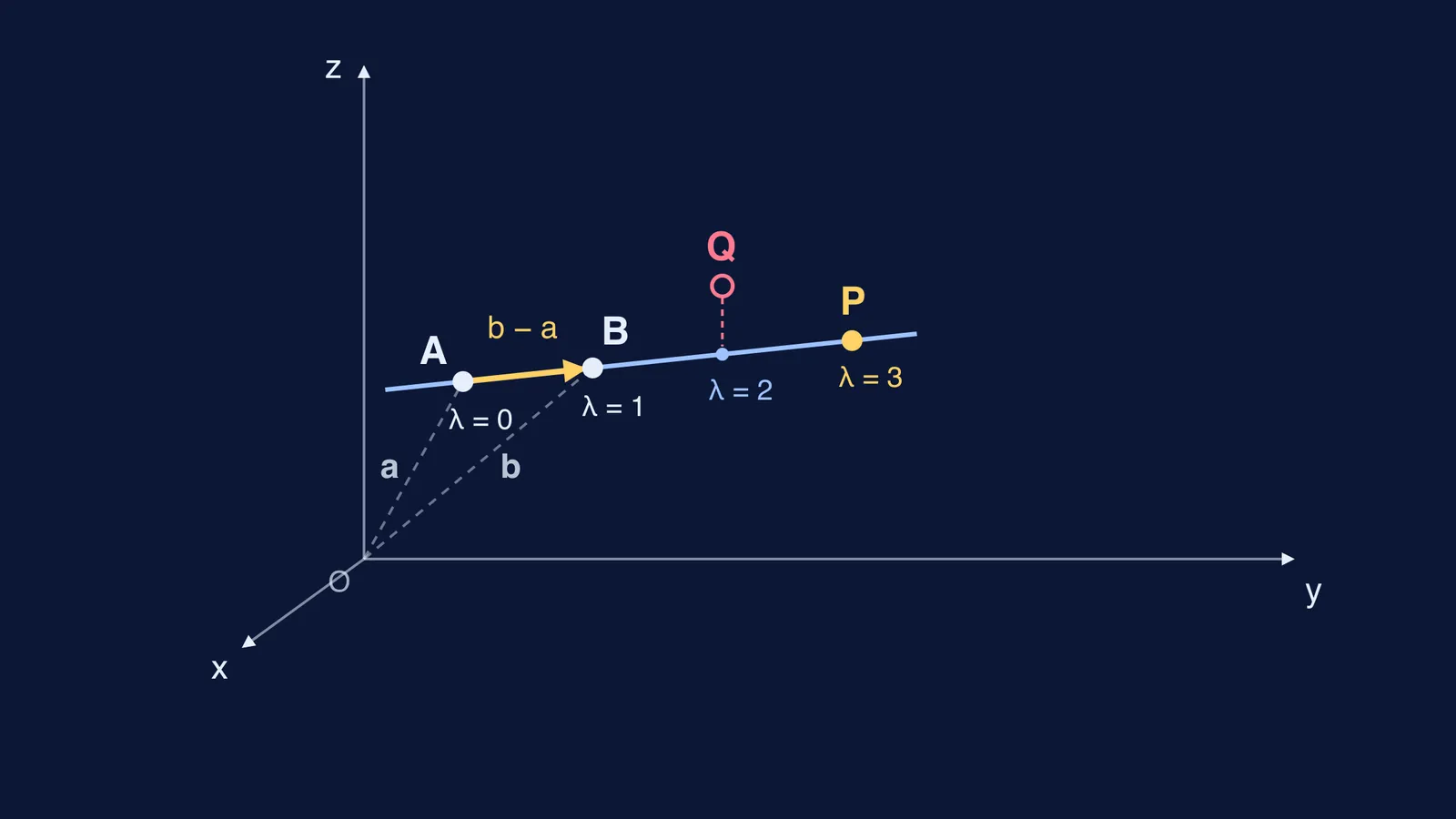
Start at point A (position vector a), then move some multiple λ of the vector from A to B. The vector b − a is the line's direction; each real λ gives a different point on it.
The OpenStax *Calculus Volume 3* textbook states the general rule: a line through a point with direction vector v = ⟨a, b, c⟩ has the vector equation r = r₀ + tv (OpenStax, equation 2.12). For a line through two points P and Q, the same chapter takes the direction vector as Q minus P, coordinate by coordinate (OpenStax, Example 2.45). Our r = a + λ(b − a) is exactly that rule, with λ in place of t.
The value of λ tells you where you are:
λ = 0 gives A itself.
λ = 1 gives B.
λ between 0 and 1 gives a point between A and B. LibreTexts' copy of the chapter writes the segment as r = (1 − t)p + tq with 0 ≤ t ≤ 1 (LibreTexts, Equations of Lines and Planes in Space/12%3A_Vectors_in_Space/12.05%3A_Equations_of_Lines_and_Planes_in_Space)).
λ greater than 1 goes past B; a negative λ goes back behind A.
How do you convert it to Cartesian symmetric form?
Take A(1, 2, 3) and B(3, 5, 4).
Direction: b − a = (3 − 1, 5 − 2, 4 − 3) = (2, 3, 1).
Vector form: r = (i + 2j + 3k) + λ(2i + 3j + k).
Split into coordinates: x = 1 + 2λ, y = 2 + 3λ, z = 3 + λ.
Make λ the subject of each: λ = (x − 1)/2, λ = (y − 2)/3, λ = (z − 3)/1.
Set them equal: (x − 1)/2 = (y − 2)/3 = (z − 3)/1.
Step 5 is the symmetric (Cartesian) form. The numerators use the coordinates of A; the denominators are the direction ratios from b − a. OpenStax works the same steps for the points (1, 4, −2) and (−3, 5, 0), getting direction ⟨−4, 1, 2⟩ and symmetric equations (x − 1)/−4 = y − 4 = (z + 2)/2 (OpenStax, Example 2.45). Note the sign: a coordinate of −2 becomes (z + 2).
What if one direction component is zero?
OpenStax states the symmetric equations only for the case where all three direction components are non-zero (OpenStax, Theorem 2.11). If A is (1, 2, 3) and B is (1, 5, 7), then b − a = (0, 3, 4), so x never changes. Write the line as x = 1 together with (y − 2)/3 = (z − 3)/4. If you see (x − 1)/0 written, read it as a reminder that x stays at 1, never as a division.
How do you check if a point lies on the line?
Substitute the point into every fraction of the symmetric form. It lies on the line only if all three give the same number, and that number is its λ.
Is P(7, 11, 6) on our line?
(7 − 1)/2 = 3
(11 − 2)/3 = 3
(6 − 3)/1 = 3
All three agree, so P is on the line at λ = 3: beyond B, three "A-to-B steps" from A.
Is Q(5, 8, 6) on it?
(5 − 1)/2 = 2
(8 − 2)/3 = 2
(6 − 3)/1 = 3
The first two agree but the third does not, so Q is not on the line. The point on the line at λ = 2 is (5, 8, 5); Q sits one unit above it. This is why you must check all three fractions.
A 60-second checklist before you move on
Direction is b − a, not b.
Numerators use one point's coordinates, with signs flipped correctly.
Denominators are the three direction ratios, in x, y, z order.
A zero direction ratio means that coordinate is fixed.
Point check: all three fractions equal, and note the λ.
Once this is automatic, the same λ idea does most of the work in harder questions, such as finding where a line meets a plane, the angle between two lines from their direction ratios and the shortest distance between skew lines.
If you keep getting the right method but a wrong final line, work a few more in the Fermi Problem Library, where the step-by-step solver explains the reasoning rather than printing an answer. If direction ratios themselves still feel shaky, the Fermi Concept Library gives every mathematics concept its own lesson and its place in the map.


