On this page
Application of Integrals is a short, predictable Class 12 chapter: almost every question asks for an area. The marks come from four habits: sketch the region, find where the curves meet, set up the right integral and evaluate it cleanly.
What does the 2026-27 syllabus keep in Application of Integrals?
The CBSE Mathematics curriculum for 2026-27 lists one line for this chapter: area under simple curves, especially lines, circles, parabolas and ellipses, in standard form only.
The NCERT chapter (Reprint 2026-27) matches that scope: one main section, Area under Simple Curves, using vertical strips (integrate in x) or horizontal strips (integrate in y). It has no separate section on area between two curves.
Do not read that as "only one curve at a time". In the CBSE 2026-27 sample paper, Q34 asks for the region between a semicircle and the line x + y = 2, with an internal choice, Q34(B), for the region between the parabola y² = 2x and the line x − 2y = 0. Practise regions bounded by a curve and a line.
How many marks does Application of Integrals carry?
CBSE does not give this chapter its own mark. Calculus as a unit carries 35 of the 80 theory marks, shared across five chapters: continuity and differentiability, applications of derivatives, integrals, application of integrals and differential equations. The question paper design also states there is no chapter-wise weightage.
The sample paper shows the format: its area question is a 5-mark long answer in Section D, and calculators are not allowed. That is one model paper, not a promise.
How are step marks given for an area question?
The 2026-27 marking scheme splits the Q34(B) parabola-and-line answer into five single marks:
A correct figure.
The points of intersection.
The integral set up with the right limits and integrand.
The integration carried out.
The final answer in square units.
A neat sketch and correct intersection points earn marks before you integrate anything, and a clear setup survives a slip at the end.
Worked example: area between y² = 6x and y = x
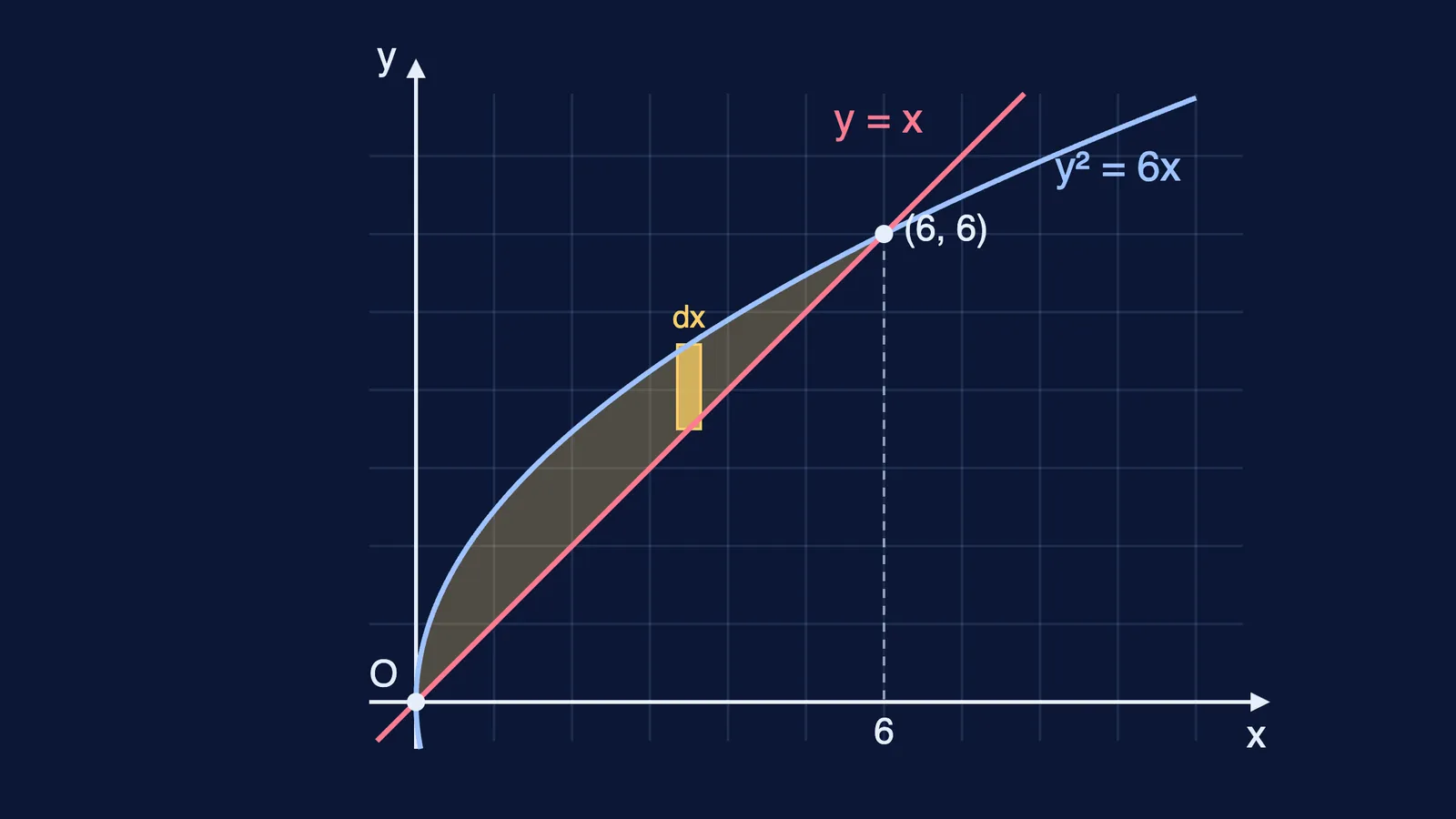
Find the area of the region bounded by the parabola y² = 6x and the line y = x.
Step 1: Sketch. y² = 6x opens to the right from the origin; y = x passes through the origin. The region lies in the first quadrant, parabola on top.
Step 2: Intersection points. Put y = x into y² = 6x: x² = 6x, so x = 0 or x = 6. The points are (0, 0) and (6, 6).
Step 3: Set up. Vertical strips of width dx run from y = x up to y = √(6x). Area = ∫₀⁶ (√(6x) − x) dx.
Step 4: Integrate. ∫√(6x) dx = √6 · (2/3)x^(3/2), and ∫x dx = x²/2. At x = 6: √6 · (2/3) · 6√6 = 24, and 6²/2 = 18. At x = 0 both terms are 0.
Step 5: Answer. Area = 24 − 18 = 6 square units.
Check with horizontal strips. For y from 0 to 6, x runs from y²/6 (parabola, left) to y (line, right). Area = ∫₀⁶ (y − y²/6) dy = 18 − 12 = 6.
Which traps cost marks in area questions?
Negative areas. The NCERT chapter notes that a curve below the x-axis gives a negative integral; take its absolute value. If the curve crosses the axis, split the interval at the root and add the parts.
Wrong limits. Limits come from intersection points or the given lines, not from the sketch's edge.
Top minus bottom reversed. For vertical strips the integrand is upper curve minus lower curve. Check at one x-value inside the region.
Forgetting symmetry. For a full circle or ellipse, find one quadrant and multiply by 4.
No units. Write the units ("sq. units"), as the marking scheme does.
How should you revise Application of Integrals?
This chapter rests on definite integrals and forms like ∫√(a² − x²) dx; our Class 12 integrals board exam guide covers that groundwork. Then a one-week plan:
Days 1-2: Every NCERT example and exercise, sketch first.
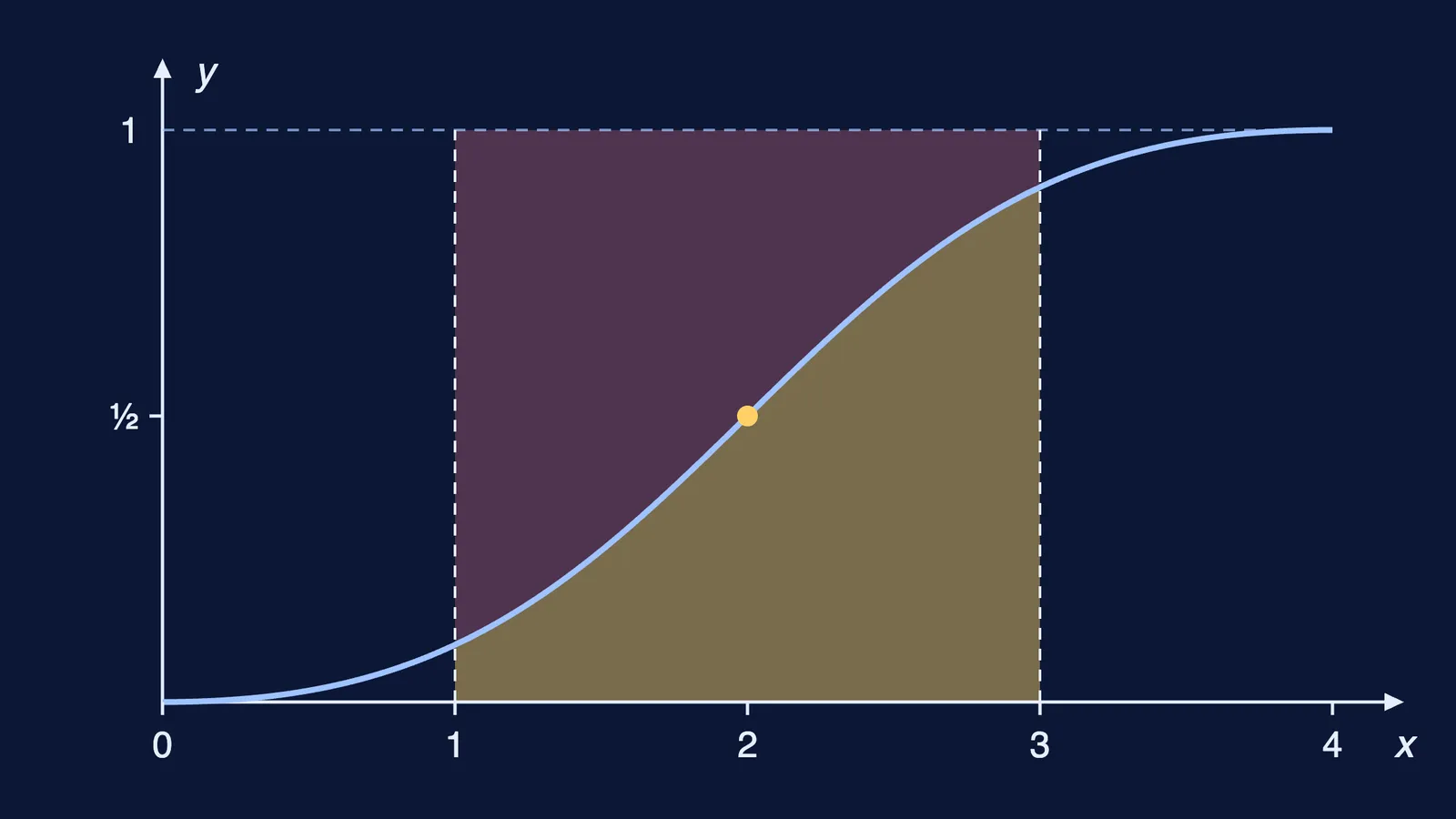
Day 3: Revise the picture behind the method with finding the area under curves.
Day 4: Both versions of the sample paper's area question, scored mark by mark against the marking scheme.
Day 5: Invent three regions (parabola and line, circle and line, ellipse quadrant) and solve each with both strip directions.
Days 6-7: One timed area question a day, then check figure, limits and units.
Preparing for JEE Main too? The definite integrals and area guide for JEE Main goes beyond the board syllabus.
When a setup keeps going wrong, the Fermi Problem Library has worked problems with a step-by-step solver that explains the reasoning rather than printing an answer.