On this page
Definite integrals and area sit together in one unit of JEE Main maths, and they reward a small set of habits more than a long list of formulas. Below: what the official syllabus says, where the NCERT chapters stop, six worked integrals with answers you can check, and the traps that cost marks.
What does the JEE Main syllabus say about definite integrals?
Unit 8, Integral Calculus, of the NTA Syllabus for JEE (Main) - 2027 lists "The fundamental theorem of calculus, properties of definite integrals" and "determining areas of the regions bounded by simple curves", in standard forms. The same unit covers antiderivatives, substitution, parts and partial fractions, so definite integrals lean on your indefinite-integration speed. The syllabus is linked from the official JEE Main website; check it again before your session.
What do the NCERT Class 12 chapters cover, and what is missing?
The 2026-27 reprint of NCERT Class 12 Maths Chapter 7, Integrals states both fundamental theorems and lists properties P0 to P7, including ∫₀ᵃ f(x)dx = ∫₀ᵃ f(a − x)dx and the even and odd rules. It mentions the definite integral as the limit of a sum only in passing and does not work through it.
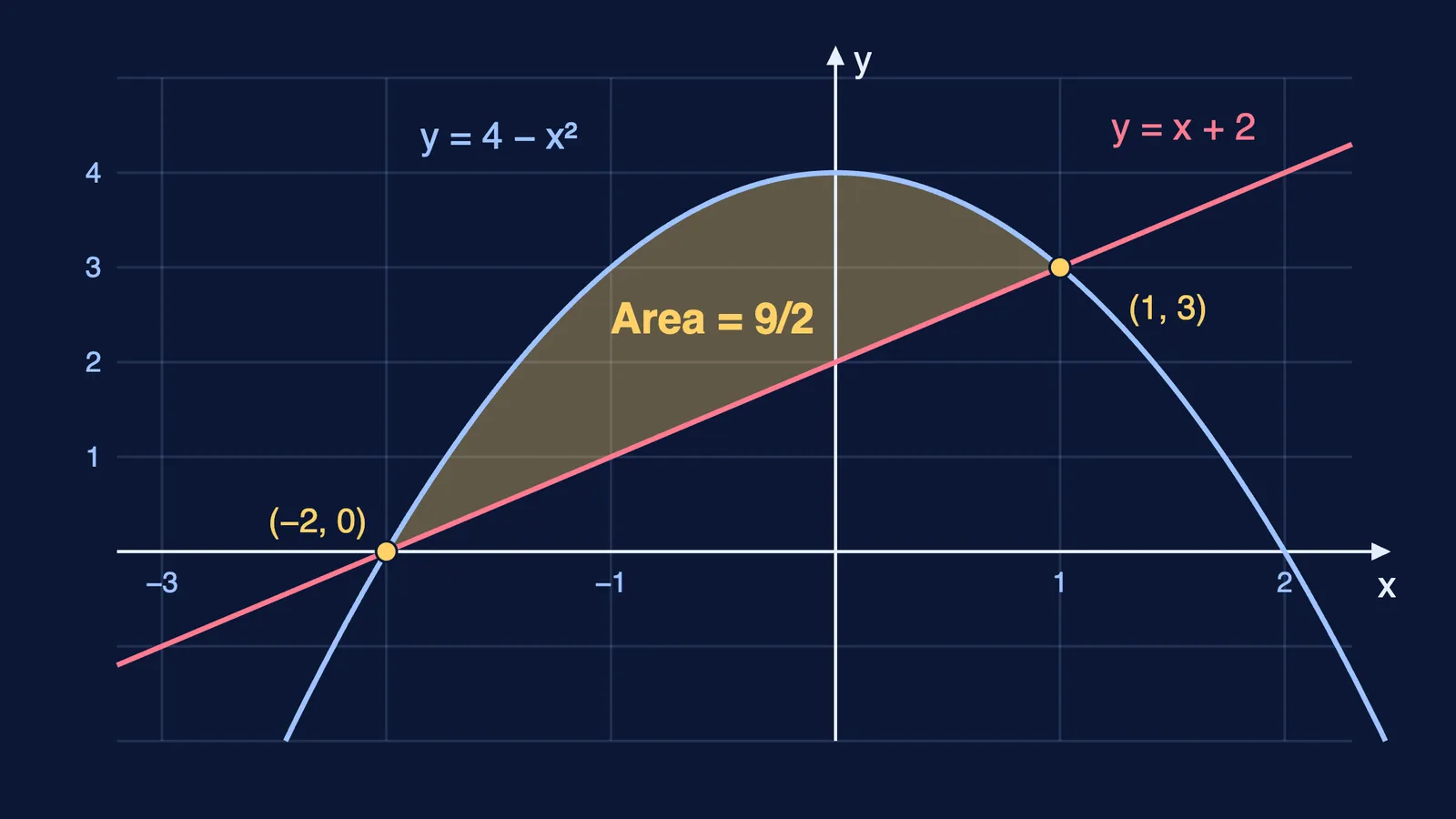
Chapter 8, Application of Integrals in the same reprint covers only areas bounded by a single curve and the axes or ordinates. It has no section on the area between two curves. JEE Main's "regions bounded by simple curves" includes regions like the one in the image above, so you need practice beyond the chapter. If the idea of area as a sum of thin strips feels shaky, read why integration gives area under a curve first.
Which properties of definite integrals should you practise?
Work each of these by hand, then compare with the answer.
Fundamental theorem. ∫₁ᵉ (2x + 1/x) dx. An antiderivative is x² + ln x, so the value is (e² + 1) − (1 + 0) = e².
The a − x swap. Let I = ∫₀² eˣ/(eˣ + e²⁻ˣ) dx. Replacing x by 2 − x gives I = ∫₀² e²⁻ˣ/(e²⁻ˣ + eˣ) dx. Add the two forms: the integrands sum to 1, so 2I = 2 and I = 1. No antiderivative needed.
Even and odd parts. ∫₋₁¹ (x⁵ cos x + x²) dx. x⁵ cos x is odd, so its part is 0. x² is even, so its part is 2 × ∫₀¹ x² dx = 2/3. Answer: 2/3.
Splitting a modulus. ∫₀³ |x² − 3x + 2| dx. The quadratic is zero at x = 1 and x = 2 and negative between them. With F(x) = x³/3 − 3x²/2 + 2x, the three pieces are 5/6, 1/6 (sign flipped) and 5/6, so the answer is 11/6. Without the modulus you would get 3/2.
The swap in item 2 has a cousin for limits 0 to 2a; see the 0 to 2a property and three uses.
How do you find the area between two curves?
Take y = 4 − x² and y = x + 2.
Find where they meet. 4 − x² = x + 2 gives x² + x − 2 = 0, so x = −2 or x = 1. The points are (−2, 0) and (1, 3).
Decide which is on top. At x = 0 the parabola gives 4 and the line gives 2, so the parabola is above on the whole interval.
Integrate top minus bottom. ∫₋₂¹ (2 − x − x²) dx = [2x − x²/2 − x³/3] from −2 to 1 = 7/6 − (−10/3) = 9/2.
Sketch first, every time. The sketch tells you the limits, which curve is on top, and whether the region needs splitting where the curves cross again.
What are the common traps in area questions?
Signed area. ∫₋₂² (x³ − 4x) dx = 0, because the function is odd. The area enclosed with the x-axis is not 0: it is 2 × ∫₀² (4x − x³) dx = 8. When a question asks for area, find the zeros and add absolute values.
Wrong top curve. If curves cross inside your interval, top and bottom swap. Split at the crossing.
Dropping the modulus in integrands like |x − a| or √(1 − sin 2x) changes the answer, as item 4 shows.
Forgetting the a − x check. If an integrand looks impossible, test what f(a − x) does before reaching for substitution.
How should you plan your practice?
Our four-week integration practice plan with mixed sets already sets out the schedule, so use it and slot this unit in as follows.
Do one property integral, one modulus integral and one area question in each session, mixed rather than in blocks.
For every area question, write the intersection points and the top curve before integrating.
Check each answer a second way: a sketch, a symmetry argument, or a rough numerical estimate.
When you keep choosing the wrong method, the Fermi Problem Library has worked problems with a step-by-step solver that explains the reasoning rather than printing an answer.