On this page
This property saves a page of working whenever a JEE or board question integrates from 0 to 2a, such as π or 2π. Check what f does when x becomes 2a − x: the integral either halves into something easier or collapses to 0.
What does the 0 to 2a property say?
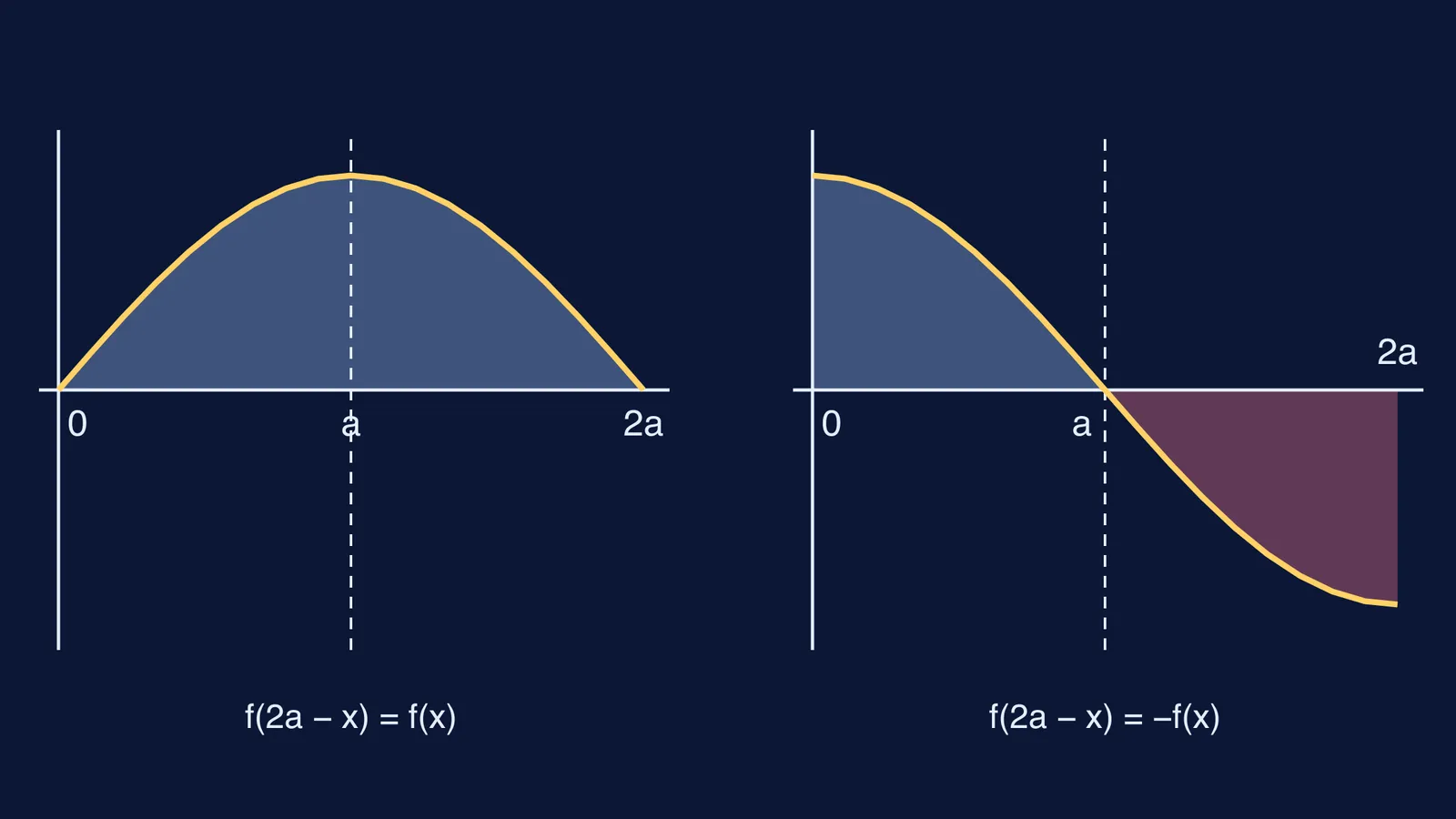
The NCERT Class 12 Mathematics textbook (Part II, Chapter 7, section 7.10) states it as property P6: ∫₀^2a f(x) dx = 2∫₀^a f(x) dx if f(2a − x) = f(x), and 0 if f(2a − x) = −f(x) (NCERT, Integrals).
Picture the graph on [0, 2a] folded along the line x = a. If f(2a − x) = f(x), the right half mirrors the left, so the two halves enclose equal areas. If f(2a − x) = −f(x), the right half is the left half flipped upside down, and the signed areas cancel.
How do you prove it from f(2a − x)?
The proof in the same NCERT chapter goes through a general result, P5, which needs no condition on f (NCERT, Integrals). Here it is in four steps.
Split at a: ∫₀^2a f(x) dx = ∫₀^a f(x) dx + ∫ₐ^2a f(x) dx.
In the second integral put t = 2a − x, so dx = −dt. When x = a, t = a; when x = 2a, t = 0.
Then ∫ₐ^2a f(x) dx = −∫ₐ^0 f(2a − t) dt = ∫₀^a f(2a − t) dt = ∫₀^a f(2a − x) dx. This gives P5: ∫₀^2a f(x) dx = ∫₀^a [f(x) + f(2a − x)] dx.
If f(2a − x) = f(x), the bracket is 2f(x) and the integral is 2∫₀^a f(x) dx. If f(2a − x) = −f(x), the bracket is 0 and so is the integral.
Step 3 is the one to remember: P5 works even when neither condition holds.
How does it work on ∫₀^π sin x dx?
Here 2a = π, so a = π/2, and sin(π − x) = sin x. The property gives ∫₀^π sin x dx = 2∫₀^(π/2) sin x dx = 2[−cos x]₀^(π/2) = 2(0 + 1) = 2. Direct integration agrees: [−cos x]₀^π = 1 + 1 = 2.
Swap in cos x and the answer changes: cos(π − x) = −cos x, so ∫₀^π cos x dx = 0, which matches sin π − sin 0 = 0.
The property earns its keep when you apply it twice. NCERT Exercise 7.10, question 14 asks for ∫₀^2π cos⁵x dx (NCERT, Integrals).
With 2a = 2π: cos⁵(2π − x) = cos⁵x, so the integral is 2∫₀^π cos⁵x dx.
With 2a = π: cos⁵(π − x) = −cos⁵x, so ∫₀^π cos⁵x dx = 0.
The answer is 2 × 0 = 0, with no reduction formula needed.
How do you get ∫₀^π log sin x dx?
NCERT's Example 34 finds ∫₀^(π/2) log sin x dx = −(π/2) log 2, and it uses P6 halfway through (NCERT, Integrals). The outline:
Let I = ∫₀^(π/2) log sin x dx. By P4 (x → π/2 − x), I also equals ∫₀^(π/2) log cos x dx.
Add them: 2I = ∫₀^(π/2) log(sin x cos x) dx = ∫₀^(π/2) log sin 2x dx − (π/2) log 2.
Put t = 2x: the first integral becomes (1/2)∫₀^π log sin t dt.
Now P6 with 2a = π, because sin(π − t) = sin t: (1/2)∫₀^π log sin t dt = ∫₀^(π/2) log sin t dt = I.
So 2I = I − (π/2) log 2, and I = −(π/2) log 2.
The integral from 0 to π then follows from P6: ∫₀^π log sin x dx = 2I = −π log 2. Logarithms here are natural, as in NCERT. For more practice, the x sin x/(1 + cos²x) integral from 0 to π uses the closely related a + b − x property, and the 1/(1 + tan x) integral from 0 to π/2 shows the add-two-copies trick from step 2 on its own.
When does the 0 to 2a property not apply?
The lower limit is not 0. For ∫ from π/2 to 3π/2, shift first with x = t + π/2, or use the a + b − x property.
The condition holds only at some points. f(2a − x) = f(x) must hold for every x in [0, 2a].
You tested f(a − x) by mistake. For ∫₀^π the test is sin(π − x), not sin(π/2 − x), which gives cos x and tells you nothing here.
Neither condition holds. For x sin x on [0, π], go back to P5 or integrate by parts, as in integrating x tan⁻¹x by parts.
To practise, take any ∫₀^π or ∫₀^2π question, run the ten-second test first, then integrate directly to check. If you keep picking the wrong property, the Fermi Problem Library has worked problems with a step-by-step solver that explains the reasoning rather than printing an answer. If the substitution t = 2a − x still feels shaky, the Fermi Concept Library gives each mathematics concept its own lesson and its place in the map.