On this page
If you searched for the integral of x arctan x, here is the answer first: ∫x tan⁻¹x dx = ((x² + 1)/2) tan⁻¹x − x/2 + C. It is question 8 of Exercise 7.6 in the NCERT Class 12 Mathematics chapter on integrals, and it tests three small decisions in a row: which function to differentiate, how to integrate the other, and how to tidy the fraction that is left. Below is each decision, a shortcut that removes the fraction altogether, and a quick way to check your answer.
Which function should be u in x tan⁻¹x?
Integration by parts is the rule ∫u dv = uv − ∫v du, as stated in OpenStax Calculus Volume 2, section 3.1. You differentiate one factor and integrate the other, so the factor you cannot easily integrate should be the one you differentiate.
NCERT's rule in section 7.6 is that a power of x is usually taken as the first function, but when the other factor is an inverse trigonometric or logarithmic function, that one goes first (NCERT Class 12 Mathematics, Integrals). The LIATE order in the OpenStax section says the same thing: inverse trigonometric comes before algebraic. So u = tan⁻¹x and dv = x dx.
The choice pays off because the derivative of tan⁻¹x is 1/(1 + x²), a plain fraction with no inverse trigonometry left in it. Choose the other way round and you would first need ∫tan⁻¹x dx, which is its own by-parts problem. Our guide on how to choose the first function in integration by parts covers the rule in more cases.
How do you integrate x arctan x step by step?
Let u = tan⁻¹x, so du = dx/(1 + x²).
Let dv = x dx, so v = x²/2.
Apply the formula: ∫x tan⁻¹x dx = (x²/2) tan⁻¹x − (1/2) ∫x²/(1 + x²) dx.
Split the fraction: x²/(1 + x²) = (1 + x² − 1)/(1 + x²) = 1 − 1/(1 + x²).
Integrate the pieces: ∫(1 − 1/(1 + x²)) dx = x − tan⁻¹x.
Put it back: (x²/2) tan⁻¹x − (1/2)(x − tan⁻¹x) + C.
Collect the tan⁻¹x terms: ((x² + 1)/2) tan⁻¹x − x/2 + C.
Step 4 is the one worth practising on its own. The top and bottom of x²/(1 + x²) have the same degree, so no standard formula fits until you divide.
Is there a shortcut that skips the split?
Yes. In Remark (ii) of section 7.6, NCERT shows that adding a constant to the integral of the second function does not change the final result (NCERT Class 12 Mathematics, Integrals). Any antiderivative of x will do, so pick v = (x² + 1)/2 instead of x²/2.
Now v du = ((x² + 1)/2) × 1/(1 + x²) dx = (1/2) dx. The whole integral becomes ((x² + 1)/2) tan⁻¹x − ∫(1/2) dx = ((x² + 1)/2) tan⁻¹x − x/2 + C. Same answer, two lines, no fraction to split.
Know why it works before you rely on it: 1 + x² is the denominator of du, and x² + 1 happens to be twice an antiderivative of x. For x² tan⁻¹x the trick fails, because no constant k makes x³/3 + k divisible by 1 + x². There you are back to dividing, which is why step 4 still matters.
How do you check the answer?
Differentiate it. The product rule gives d/dx[((x² + 1)/2) tan⁻¹x] = x tan⁻¹x + ((x² + 1)/2) × 1/(1 + x²) = x tan⁻¹x + 1/2. The derivative of −x/2 is −1/2. They add to x tan⁻¹x, the integrand you started with.
The slips this check catches most often:
Dropping the 1/2 in front of the second integral when you distribute it.
Writing ∫x²/(1 + x²) dx as a logarithm; that is the answer for x/(1 + x²), not x²/(1 + x²).
A sign error in −(1/2)(x − tan⁻¹x), which should give + (1/2) tan⁻¹x.
Forgetting + C on an indefinite integral.
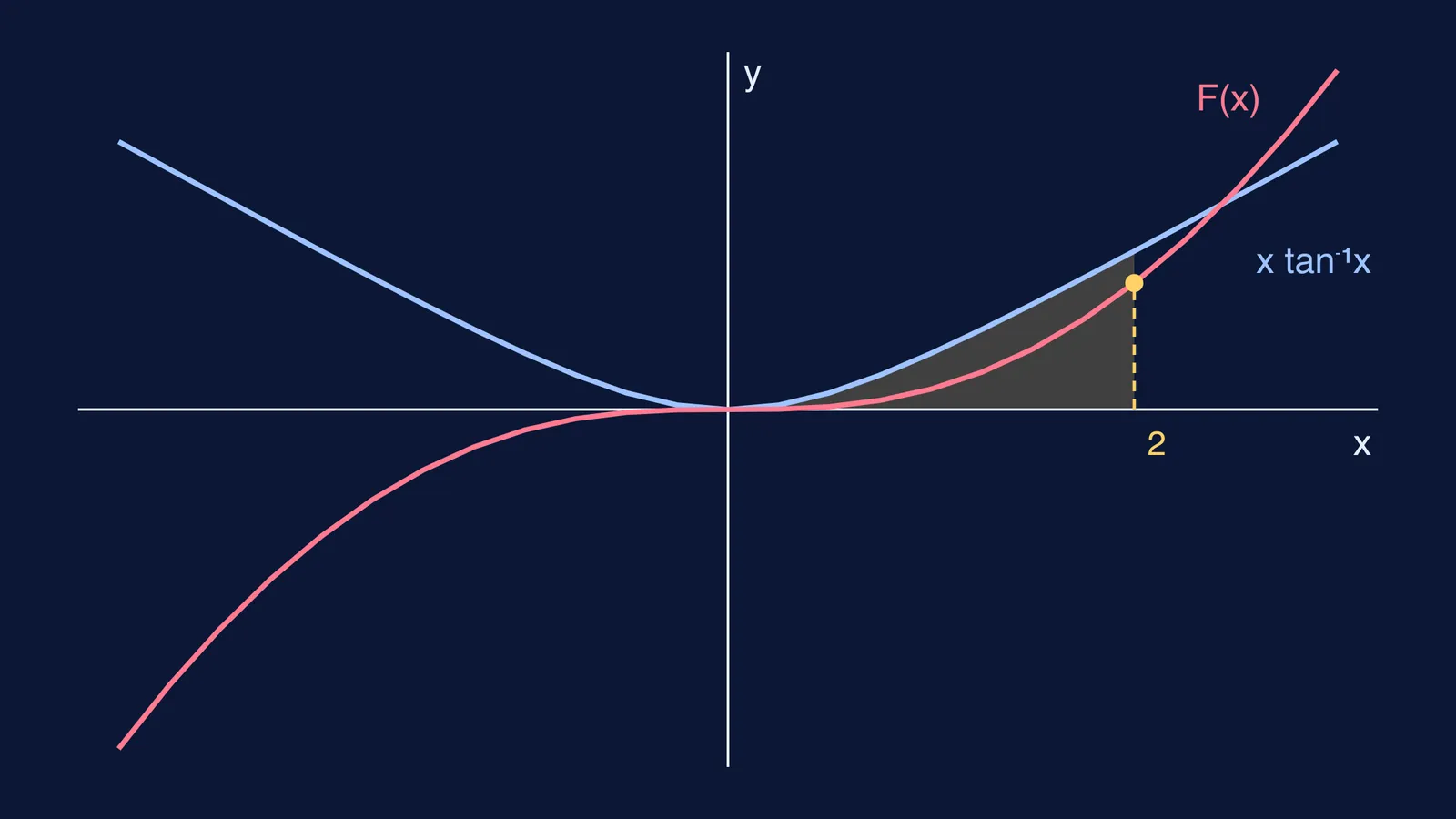
For a definite version, the same antiderivative gives ∫₀² x tan⁻¹x dx = (5/2) tan⁻¹2 − 1, about 1.77; the hero diagram shades that area.
Two close relatives are worth doing next: the antiderivative of arcsin x by parts, and the integral of log x using the log x × 1 trick. Both follow the same idea of differentiating the function you cannot integrate.
If a variant stops you, the Fermi Problem Library has worked problems with a step-by-step solver that explains the reasoning rather than printing an answer, so you can see why each choice was made. If the derivative of tan⁻¹x itself feels shaky, the Fermi Concept Library gives every concept in mathematics its own lesson.
Work x tan⁻¹x once each way, long and short, and then check both by differentiating.