On this page
Most marks in this short chapter depend on one habit: checking that every answer sits inside the principal value branch. This guide is about CBSE board answers. For speed and harder identities, read our guide to inverse trigonometric functions for JEE Main.
How many marks is inverse trigonometric functions worth in the 2026-27 board exam?
The CBSE Mathematics curriculum for 2026-27 prints Unit I, Relations and Functions, at 08 of 80 marks. That unit has two chapters, Relations and Functions and Inverse Trigonometric Functions, and CBSE gives no separate figure for either, so treat the 8 marks as shared. The same document says there is no chapter-wise weightage.
The syllabus line for this chapter is short: definition, range, domain, principal value branch, and graphs of inverse trigonometric functions.
In the 2026-27 sample question paper, this chapter supplied Q1 to Q3, all 1-mark MCQs: identify the graph of π + cos⁻¹x, find the domain of sec⁻¹(2x), and evaluate a nested expression that ends at cot⁻¹(√3) = π/6. The marking scheme says Section A MCQs carry no part marks.
What does the 2026-27 NCERT chapter keep?
NCERT Chapter 2 (Reprint 2026-27) defines all six principal value branches, works six examples, and sets Exercise 2.1, Exercise 2.2 and a Miscellaneous Exercise. Its section on properties is brief: sin(sin⁻¹x) = x for x in [−1, 1], and sin⁻¹(sin x) = x only for x in [−π/2, π/2]. Exercise 2.2 and the Miscellaneous Exercise still ask you to prove and simplify expressions, so practise them even though the curriculum names only definitions, branches and graphs.
Learn NCERT's summary table cold:
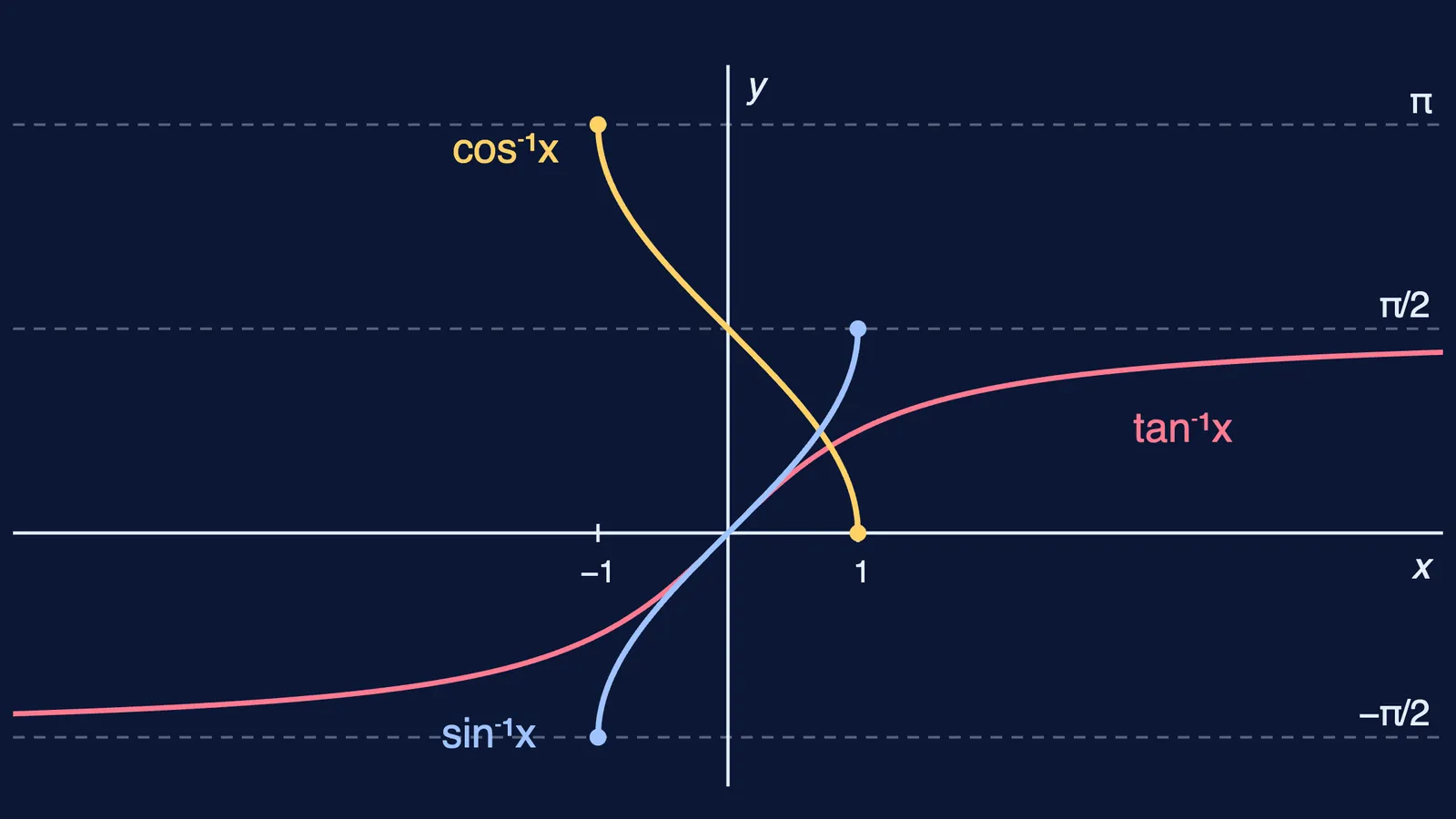
sin⁻¹x: domain [−1, 1], range [−π/2, π/2]
cos⁻¹x: domain [−1, 1], range [0, π]
tan⁻¹x: domain R, range (−π/2, π/2)
cot⁻¹x: domain R, range (0, π)
sec⁻¹x: domain R − (−1, 1), range [0, π] − {π/2}
cosec⁻¹x: domain R − (−1, 1), range [−π/2, π/2] − {0}
NCERT also warns that sin⁻¹x is not (sin x)⁻¹, which equals 1/sin x.
How do you write a principal-value answer that earns full marks?
This layout is our suggestion, not CBSE's:
Let the expression equal y and write the plain trig equation, such as sin y = −√3/2.
Write the principal range of that function.
Pick the one angle in that range and state it: "principal value = −π/3".
The MCQs carry no part marks, so the working is for you. It is what stops you ticking the option that sits outside the branch.
Worked example: when tan⁻¹(tan x) is not x
Our own question: find tan⁻¹(tan 5π/6) + cos⁻¹(cos 5π/3).
The trap answer is 5π/6 + 5π/3 = 5π/2. Neither angle lies in its branch, so both terms are wrong.
Step 1. 5π/6 is outside (−π/2, π/2). Tan repeats every π, so tan(5π/6) = tan(5π/6 − π) = tan(−π/6). Since −π/6 is inside the branch, tan⁻¹(tan 5π/6) = −π/6.
Step 2. 5π/3 is outside [0, π]. Cos(5π/3) = cos(2π − 5π/3) = cos(π/3), and π/3 is inside [0, π], so cos⁻¹(cos 5π/3) = π/3.
Step 3. −π/6 + π/3 = π/6.
Check by values. tan(5π/6) = −1/√3, whose principal value is −π/6. cos(5π/3) = 1/2, whose principal value is π/3. A Python check with math.atan and math.acos returned 0.5236 for the sum, which is π/6.
If you keep landing outside the branch, the Fermi Problem Library has worked problems with a step-by-step solver that explains the reasoning rather than printing an answer.
Which traps cost marks in this chapter?
Negative inputs to cot⁻¹ and cos⁻¹. Their range is in [0, π], so the answer is never negative: cot⁻¹(−1) = 3π/4, not −π/4.
Domains of sec⁻¹ and cosec⁻¹. The argument must be at least 1 in size. For sec⁻¹(3x), that means x ≤ −1/3 or x ≥ 1/3.
Shifted graphs. π + cos⁻¹x is cos⁻¹x lifted by π, so its range is [π, 2π]. Check one point, such as x = 0, against each option.
Degrees in the answer. Write radians, as NCERT does.
Forgetting the chapter in calculus. In the same sample paper, Q7 asks for the derivative of cos⁻¹(2x² − 1) with respect to cos⁻¹x, and the marking scheme's answer to the integral in Q21(A) ends in tan⁻¹. Our continuity and differentiability board guide covers derivatives like the one in Q7.
What should your revision plan be?
Day 1: write the six-branch table from memory, check it against NCERT, and sketch sin⁻¹x, cos⁻¹x and tan⁻¹x.
Day 2: Exercise 2.1, writing all three steps every time.
Day 3: Exercise 2.2, questions 10 to 15, then Miscellaneous questions 1 and 2.
Day 4: sample-paper Q1 to Q3 against a 3-minute timer, then check the marking scheme.
Day 5: redo the worked example with 4π/3 and 7π/4 in place of 5π/6 and 5π/3, then revise the unit's other chapter with our relations and functions board guide.