On this page
Continuity and Differentiability opens the Calculus unit, and the calculus chapters after it build on its derivatives. Here is what the 2026-27 syllabus asks, how to collect each step mark, and a two-week plan.
How many marks is Continuity and Differentiability in Class 12?
CBSE does not print a mark for this chapter alone. In the CBSE Mathematics curriculum 2026-27, Unit III Calculus carries 35 of the 80 theory marks, and that 35 is shared by five chapters: Continuity and Differentiability, Applications of Derivatives, Integrals, Application of the Integrals and Differential Equations. The same document's question paper design says there is no chapter-wise weightage.
Rolle's theorem and the Mean Value Theorem appear in neither the syllabus nor the NCERT chapter, Reprint 2026-27, so skip them.
The 2026-27 sample paper tests this chapter in two 1-mark MCQs (Q7, Q8), a 2-mark implicit-differentiation proof (Q22) and a 3-mark question (Q28) offering a parametric second derivative or a logarithmic derivative.
What results should you know cold?
Continuity at c: NCERT defines f as continuous at c when the limit as x tends to c equals f(c); in practice, LHL = RHL = f(c).
Differentiability at c: the left-hand and right-hand derivatives at c are finite and equal.
Differentiable implies continuous, not the reverse. NCERT proves this (Theorem 3) and uses |x| at 0 as the counter-example; see our post on why continuity does not imply differentiability.
Chain rule: if t = u(x) and f = v(t), then df/dx = (dv/dt)(dt/dx).
Logarithmic: for [u(x)]^v(x), take log first; NCERT notes both f(x) and u(x) must be positive.
Parametric: dy/dx = (dy/dt)/(dx/dt), with dx/dt ≠ 0.
Second derivative: for parametric forms, d²y/dx² = d/dt(dy/dx) × dt/dx.
How do you set out 2-, 3- and 5-mark answers?
The 2026-27 marking scheme gives Q22 two marks of 1 each: one for differentiating y = sin(x + y) implicitly, one for using dy/dx = 0 to reach y = ±1. Q28(A) gives 1 for dy/dx = −cot t, 1 for d²y/dx² in terms of t, and 1 for the value at t = π/4. Q28(B) splits x^(log x) + (log x)^x into u + v and gives 1 for taking logs and differentiating both parts, 1 for du/dx and dv/dx, and 1 for the final dy/dx.
2 marks: one line of setup, one line of result.
3 marks: three visible steps, as in Q28: the first derivative or log step, the second derivative or second term, then the final answer (with the point substituted where asked).
5 marks: the sample paper has none from this chapter, but if one comes, use five visible blocks: given, method, working, check, conclusion.
Worked example: find k so the function is continuous
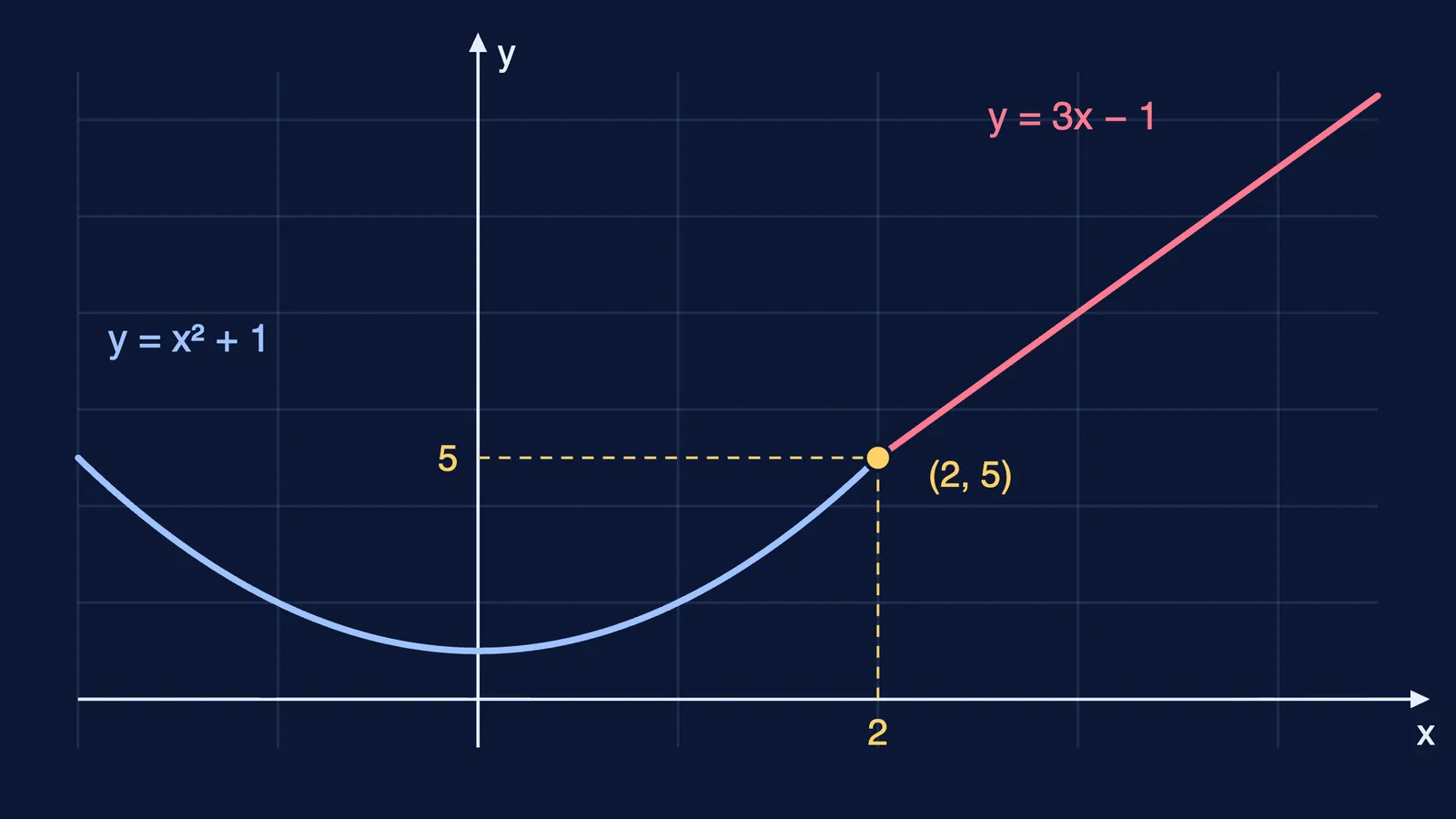
Let f(x) = kx² + 1 for x ≤ 2 and f(x) = 3x − k for x > 2. Find k so that f is continuous at x = 2.
Method 1 (equate the limits). LHL = lim(x→2⁻) (kx² + 1) = 4k + 1, and f(2) = 4k + 1. RHL = lim(x→2⁺) (3x − k) = 6 − k. Continuity needs 4k + 1 = 6 − k, so 5k = 5 and k = 1.
Method 2 (check by substituting back). With k = 1, f(2) = 2² + 1 = 5. The right piece approaches 3(2) − 1 = 5. LHL = RHL = f(2) = 5, so f is continuous at 2. We checked both methods in sympy.
Bonus: the left derivative at 2 is 4 and the right derivative is 3, so f is continuous but not differentiable there.
What are the common errors and traps?
Finding only LHL and RHL and forgetting to state f(c).
Dropping dy/dx on a y term in implicit differentiation.
Taking log of a quantity that can be negative.
Writing d²y/dx² = (d²y/dt²)/(d²x/dt²) in parametric questions.
Assertion-reason traps. Both statements can be true while R does not explain A. And "continuous, so differentiable" is false: think of |x| at 0. For exponent-type functions like x^x, see our guide to logarithmic and implicit differentiation.
Case-study traps. The sample paper splits two case studies 1, 1, 2, and a later part may reuse an earlier answer. Rewrite that value before using it, so your method still shows if it was wrong.
What is a good two-week revision plan?
Days 1-2: continuity questions, including k-values, with LHL, RHL and f(c) written out every time. See removable vs jump discontinuity.
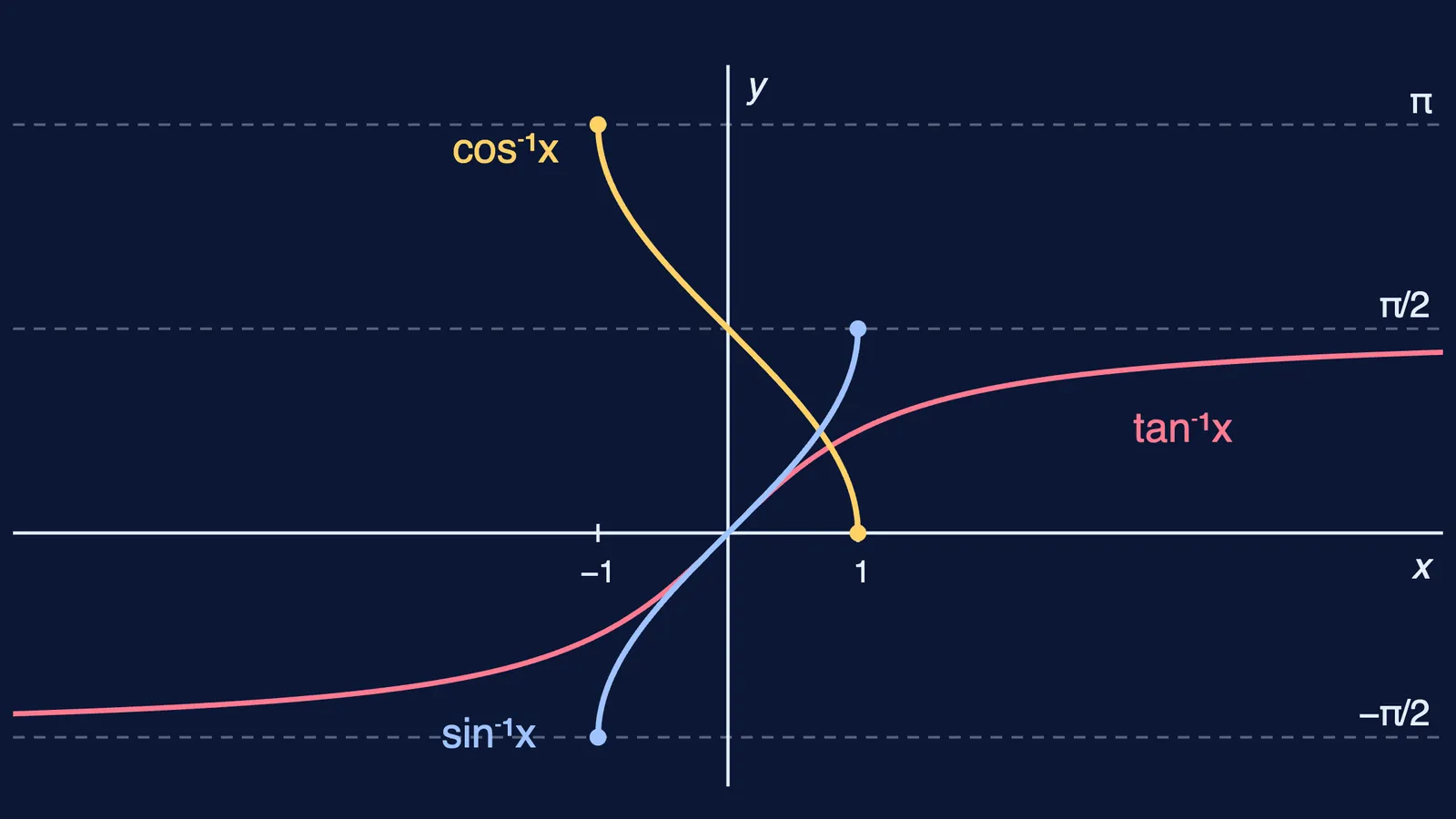
Days 3-4: chain rule and inverse trigonometric derivatives.
Days 5-6: implicit and logarithmic differentiation.
Days 7-8: parametric forms and second derivatives.
Days 9-10: sample paper Q7, Q8, Q22 and Q28, marked against the scheme.
Days 11-12: a timed mixed set.
Days 13-14: redo every question you got wrong, without notes.
If you keep picking the wrong method, the Fermi Problem Library has worked problems with a step-by-step solver that explains the reasoning rather than printing an answer.