On this page
Class 12 and JEE Main questions on continuity often ask what kind of break a function has at a point, or how to repair it. The answer comes from three numbers: the left-hand limit (LHL), the right-hand limit (RHL) and the value f(a).
What makes a function continuous at a point?
OpenStax Calculus Volume 1 gives three conditions: f(a) is defined, the limit of f(x) as x approaches a exists, and that limit equals f(a).
In LHL and RHL language, f is continuous at a when LHL = RHL = f(a). If any part of that chain fails, f is discontinuous at a, and which part fails tells you the type.
What is the difference between removable and jump discontinuity?
Using the definitions in OpenStax Calculus Volume 1, section 2.4:
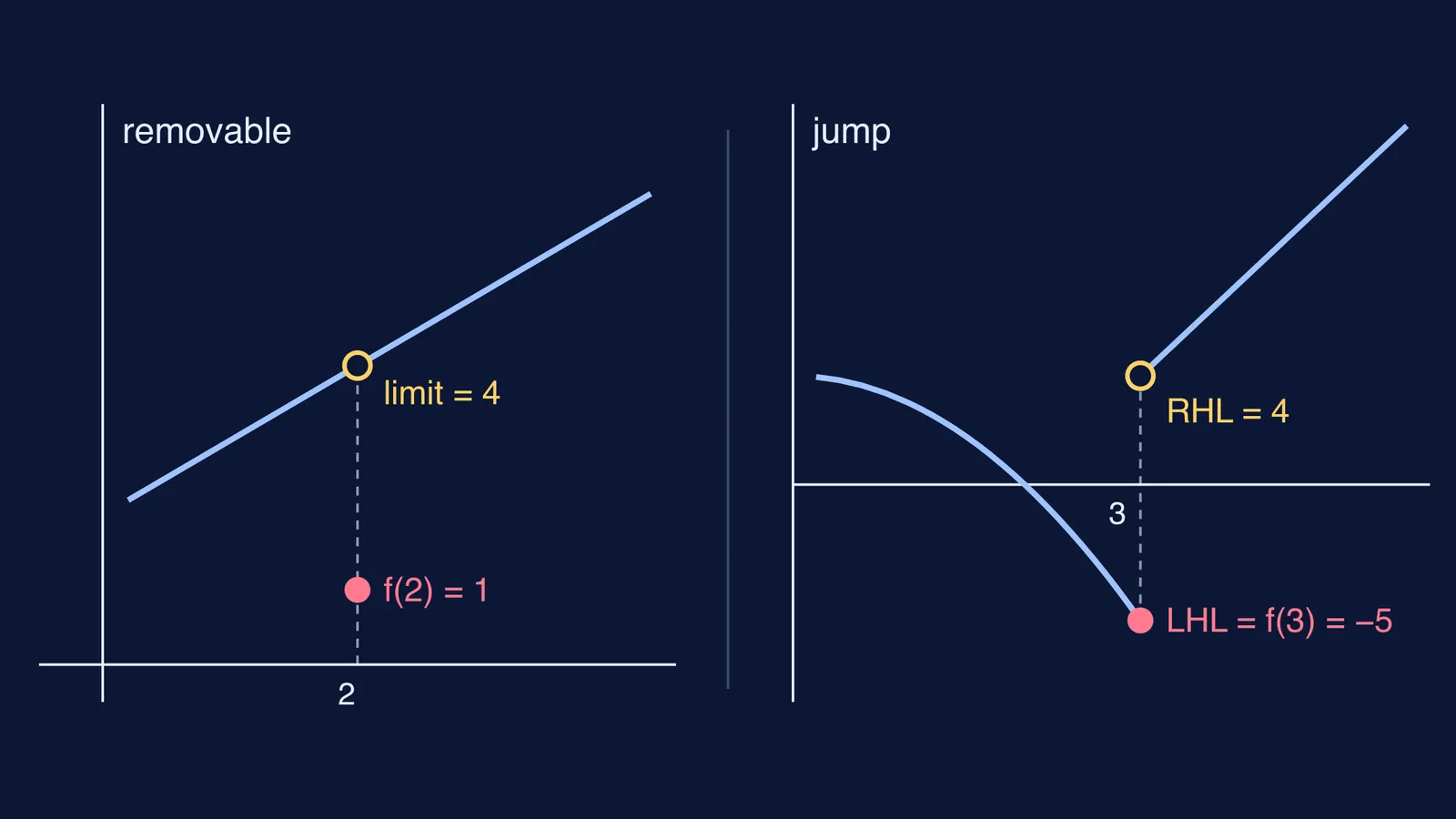
Removable: f is discontinuous at a, but the limit at a exists. So LHL = RHL = L, while f(a) is undefined or not equal to L.
Jump: both one-sided limits exist, but LHL ≠ RHL.
Infinite: at least one one-sided limit is +∞ or −∞, as with (x + 2)/(x + 1) at x = −1.
Wolfram MathWorld describes the removable case the same way: the limit L exists, but f at that point is undefined or has a different value.
On a graph, a removable discontinuity is a hole, sometimes with a stray dot. A jump is a step. A hole is about one point; a jump is about the two sides disagreeing.
How do you classify a discontinuity step by step?
Find the LHL, the value f(x) approaches from below a.
Find the RHL, the value f(x) approaches from above a.
If either is infinite, it is an infinite discontinuity. Stop.
If LHL ≠ RHL, it is a jump. f(a) does not change this.
If LHL = RHL = L, look at f(a). If f(a) = L, f is continuous. If f(a) is undefined or different from L, the discontinuity is removable.
Our post on left and right limits of a piecewise function explains why the value at the point is ignored.
Which type is it? Four worked examples
Example 1: a hole with a stray dot
Let f(x) = (x² − 4)/(x − 2) for x ≠ 2, and f(2) = 1. OpenStax uses this fraction as its removable example; we added the value f(2) = 1. For x ≠ 2, factor: (x − 2)(x + 2)/(x − 2) = x + 2. So LHL = RHL = 4, but f(2) = 1. Equal limits, wrong value: removable.
Example 2: a step
OpenStax's jump example is f(x) = −x² + 4 for x ≤ 3 and f(x) = 4x − 8 for x > 3. LHL = −9 + 4 = −5. RHL = 12 − 8 = 4. The limits differ, so it is a jump of 9 units. Here f(3) = −5 matches the LHL, but the two sides still disagree.
Example 3: the greatest integer function
Take f(x) = [x] at x = 1. Just below 1, [x] = 0, so LHL = 0. Just above 1, [x] = 1, so RHL = 1. Unequal limits: a jump, and the same happens at every integer. Our post on the limit of the greatest integer function works through more of these.
Example 4: sin x / x at 0
The function is undefined at 0, but its limit there is 1, so MathWorld classes x = 0 as a removable discontinuity.
For more piecewise and greatest-integer questions to practise on, the Fermi Problem Library has worked problems with a step-by-step solver that explains the reasoning rather than printing an answer.
How do you redefine f to remove a discontinuity?
Set f(a) equal to the common limit L and leave every other value alone. MathWorld describes this as defining a function that is identical except at that point, where its value is L; for sin x / x, setting f(0) = 1 gives the sinc function.
For Example 1, define g(x) = (x² − 4)/(x − 2) for x ≠ 2 and g(2) = 4. Now LHL = RHL = g(2) = 4, so g is continuous at 2: the line y = x + 2 with the hole filled in.
A jump cannot be fixed this way. In Example 2, any value you give f(3) can match at most one of −5 and 4, and the limit at 3 still does not exist. Picking the average, −0.5, is a common trap: it changes one point and leaves the jump where it was.
For a full walk-through, read how to find k so a piecewise function is continuous. If one-sided limits are the weak spot, the Fermi Concept Library gives every concept in mathematics its own lesson.
Next time you meet a break in a graph, write down LHL, RHL and f(a) in that order before you name it.