

On this page
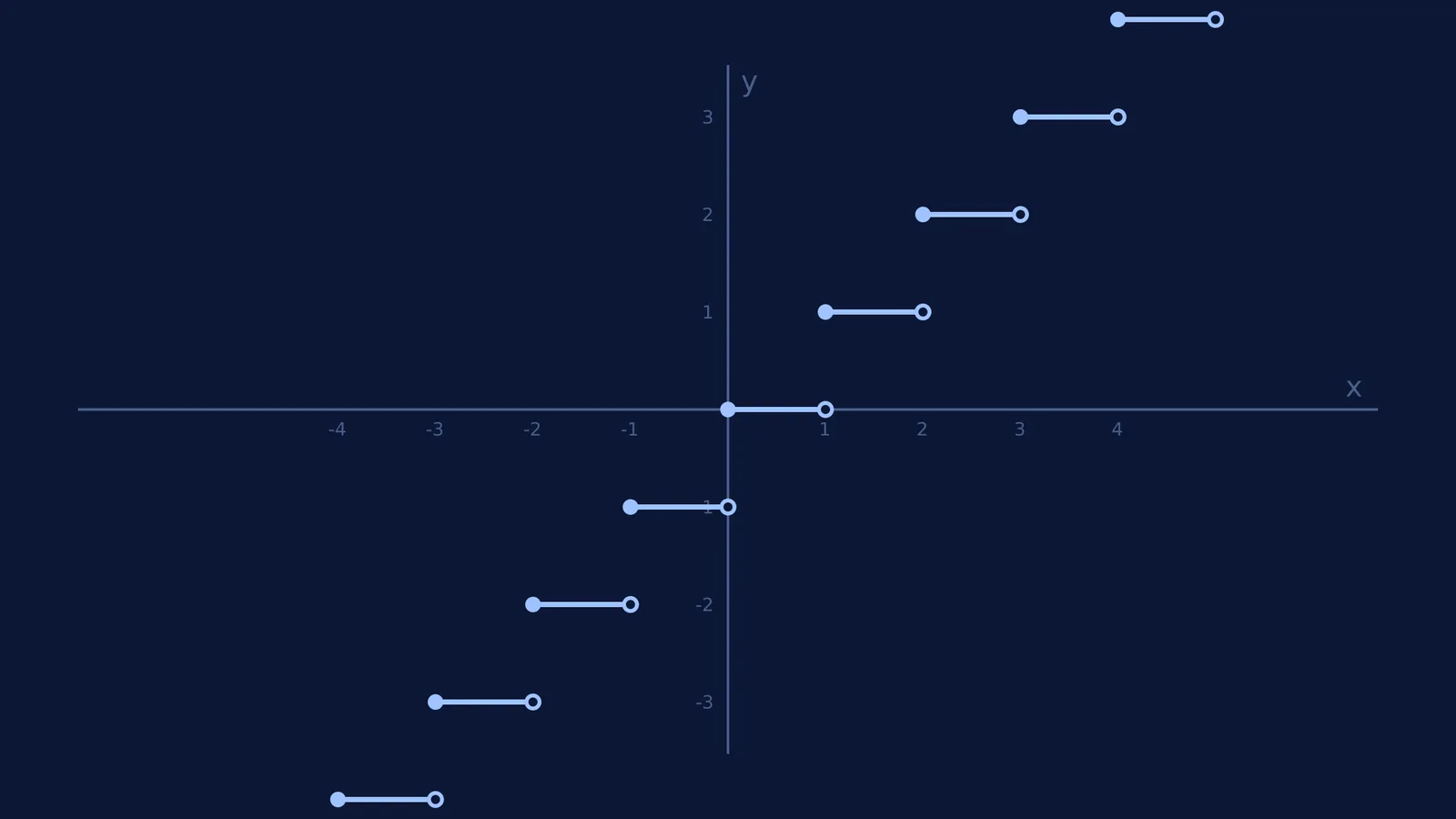
The limit of the greatest integer function at an integer does not exist because the function abruptly steps up to a new value at every whole number. The greatest integer function, written as [x] or ⌊x⌋, gives the largest integer that is less than or equal to x. When you graph it, it looks like a series of steps, which is why it is often called the step function.
If you are preparing for exams like JEE Main, you will often find this function in limit and continuity problems, alongside topics like limits of the form 1^∞. The most common question is what happens to the limit of [x] as x approaches an integer.
Why does the limit not exist at an integer?
To find the limit of a function as x approaches a number n, the left-hand limit (LHL) and right-hand limit (RHL) must be equal. For the greatest integer function, they are not.
If n is an integer (like 2):
Right-hand limit (RHL): As x approaches 2 from the right (x → 2⁺), x is slightly greater than 2 (for example, 2.01). The greatest integer less than or equal to 2.01 is 2. So, the RHL is 2.
Left-hand limit (LHL): As x approaches 2 from the left (x → 2⁻), x is slightly less than 2 (for example, 1.99). The greatest integer less than or equal to 1.99 is 1. So, the LHL is 1.
Because 1 ≠ 2, the limit as x → 2 does not exist. According to Wikipedia, the floor function has a jump discontinuity (you can read more about telling removable and jump discontinuities apart) at every integer n.
When does the limit exist?
The limit of [x] exists at all non-integer points.
If x approaches a non-integer like 2.5:
From the right (e.g. 2.51), [2.51] = 2.
From the left (e.g. 2.49), [2.49] = 2.
Since both the LHL and RHL are 2, the limit exists and is equal to [2.5].
How do you solve limits with [x]/x and x[1/x]?
Many exam questions combine [x] with 1/x or x. According to BYJU'S, the function is constant at an integer n for every interval [n, n+1). From this, we get the basic inequality [x] ≤ x < [x] + 1, which can also be rearranged to x - 1 < [x] ≤ x.
Example 1: The limit of [x]/x as x approaches 0
Let us check the LHL and RHL for the limit of [x]/x as x approaches 0.
RHL (x → 0⁺): x is a small positive number (like 0.1). Here, [x] = 0. So, [x]/x = 0/x = 0. The right limit is 0.
LHL (x → 0⁻): x is a small negative number (like -0.1). Here, [x] = -1. So, [x]/x = -1/x. As x gets closer to 0 from the negative side, -1/x grows to positive infinity (+∞).
Since the two sides do not match (and one side diverges), the limit does not exist.
Example 2: The limit of x[1/x] as x approaches 0
This is a classic problem where the Fermi Problem Library step-by-step solver can help you check your work when you get stuck.
We want to find the limit of x[1/x] as x approaches 0. Let t = 1/x. As x → 0⁺, t goes to positive infinity. The limit becomes the limit of [t]/t as t → ∞.
Using the inequality t - 1 < [t] ≤ t, divide everything by t (assuming t > 0): 1 - 1/t < [t]/t ≤ 1.
As t → ∞, 1/t goes to 0. Both the lower bound (1 - 0) and the upper bound (1) approach 1. By the Squeeze Theorem, the limit is 1. The same holds true when x → 0⁻ and t → -∞.
So, the limit of x[1/x] as x approaches 0 is 1.
What is the checklist for solving greatest integer limits?
When you face a limit problem involving the greatest integer function in an exam, follow these steps to avoid common traps:
Identify the approach point: Check if x is approaching an integer or a non-integer. If it is a non-integer, you can usually substitute the value directly.
Split into LHL and RHL: If x is approaching an integer, you must evaluate the left-hand limit and right-hand limit separately. Never assume they are equal.
Use the inequality for infinity limits: For limits where x goes to infinity (or when the argument inside the bracket goes to infinity), replace [f(x)] using the rule f(x) - 1 < [f(x)] ≤ f(x) and apply the Squeeze Theorem.
Watch out for negative numbers: Remember that for negative non-integers, the function steps down to the next most negative integer. For instance, [-2.1] is -3, not -2.
How do you picture the function?
The best way to understand these limits is to look at the graph. If you find it hard to picture step functions and their limits, you can review the lesson in the Fermi Concept Library.
For y = [x], the graph consists of horizontal lines. Between x = 1 and x = 2, the line sits at y = 1. At x = 2, it jumps up to y = 2. The closed circle is on the left of each step (because [2] = 2), and the open circle is on the right. This jump is exactly why the LHL and RHL do not meet at integers.


