

On this page
One sentence from Class 12 Chapter 5 settles many MCQs: differentiability implies continuity, but not the reverse. Here is why, and how to use it in the exam hall.
Why does differentiability force continuity?
The NCERT Class 12 Mathematics textbook, Chapter 5 states it as Theorem 3: if a function f is differentiable at a point c, then it is also continuous at that point.
The proof is one trick. For x ≠ c, write f(x) − f(c) as [(f(x) − f(c))/(x − c)] × (x − c). Now let x tend to c:
The bracket tends to f′(c), a finite number, because f is differentiable at c.
The factor (x − c) tends to 0.
So f(x) − f(c) tends to f′(c) × 0 = 0, which means the limit of f(x) is f(c). That is exactly continuity.
The key word is finite: if the difference quotient settles on a real number, the gap must close. The OpenStax Calculus Volume 1 text proves the same result as Theorem 3.1, "Differentiability Implies Continuity".
Does continuity imply differentiability?
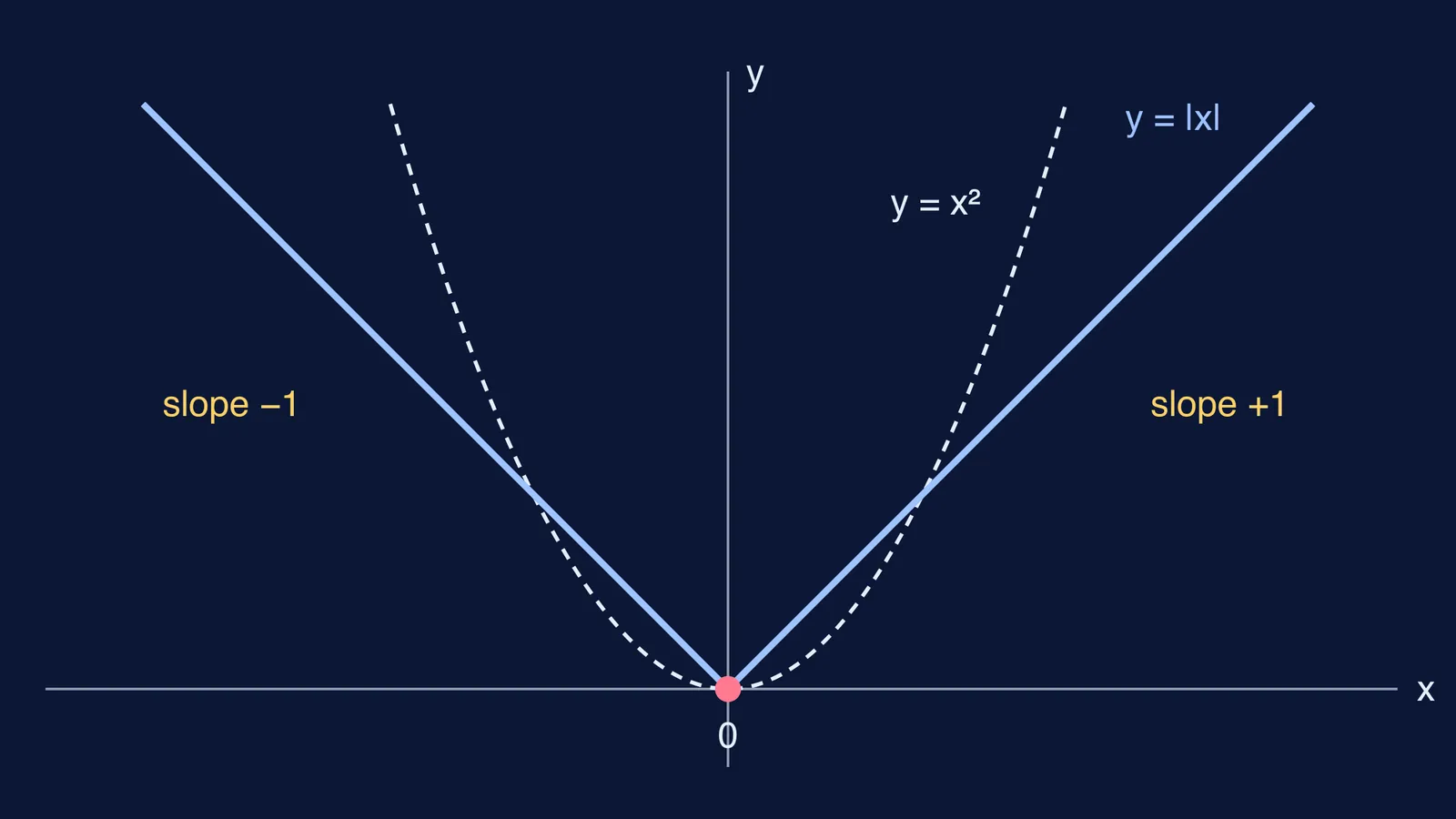
No. NCERT gives the standard counterexample right after Theorem 3 in the same chapter: f(x) = |x| is continuous everywhere, but it is not differentiable at 0.
Check it with one-sided derivatives at 0:
Left-hand derivative: for h < 0, (|0 + h| − 0)/h = −h/h = −1.
Right-hand derivative: for h > 0, (|0 + h| − 0)/h = h/h = +1.
The two limits are finite but unequal, so the derivative at 0 does not exist. On the graph this is a corner: the left arm has slope −1, the right arm slope +1, and no single tangent line fits both.
Corners are not the only way a continuous function can fail. OpenStax lists two more: the cube root of x has a vertical tangent at 0, and x sin(1/x) (with value 0 at 0) wiggles so fast near 0 that its difference quotient never settles. At the extreme, Karl Weierstrass found a function in 1872 that is continuous everywhere yet has no derivative at any point, according to the MacTutor History of Mathematics biography.
How do you use this in an MCQ?
The middle line of that callout is the contrapositive, and it saves the most time. Run this order at any suspicious point x = a:
Check continuity first: left limit, right limit and f(a). If any differ, stop. The function is not differentiable at a.
If it is continuous, compute the left-hand and right-hand derivatives from the definition, or from the slope of each piece as x approaches a.
Both finite and equal: differentiable. Finite but unequal: a corner. Infinite or non-existent: no derivative.
Here is a worked example with three piecewise functions, each checked at x = 1:
f(x) = x² for x < 1, and 2x − 1 for x ≥ 1. Both pieces give 1 at x = 1, so f is continuous. Slopes: 2x gives 2 on the left, and the right piece has slope 2. Equal, so f is differentiable at 1.
g(x) = x² for x < 1, and x for x ≥ 1. Continuous (both give 1), but the slopes are 2 and 1. A corner, so not differentiable.
k(x) = x² for x < 1, and 2x for x ≥ 1. The piece formulas give slope 2 on both sides, which tempts you to say "differentiable". But the left limit is 1 and k(1) = 2, so k is not even continuous. Not differentiable, and step 1 catches it at once.
The k trap is a classic: matching slopes mean nothing if the pieces do not meet. NCERT's own Exercise 5.2 uses the same two ideas: it asks you to show |x − 1| is not differentiable at 1 (a corner) and that the greatest integer function [x] is not differentiable at 1 and 2, where it jumps and so is not even continuous (NCERT Chapter 5).
Watch for the reverse trap too. Multiplying by x can smooth a corner: x|x| is differentiable at 0, as we show in why x|x| is differentiable at zero.
What should you practise next?
Try five piecewise functions from past papers and, before touching a derivative, write "continuous?" next to each one. Then move on to questions that hide the unknowns, like finding a and b so a piecewise function is differentiable, where continuity gives one equation and matching slopes give the other. For a harder case, see whether x sin(1/x) is continuous and differentiable at 0.
If you get the right answer for the wrong reason, the Fermi Problem Library has worked problems with a step-by-step solver that explains the reasoning rather than printing an answer. If the definitions themselves feel shaky, the lessons on limits, continuity and derivatives in the Fermi Concept Library show where each idea sits in the map.


