On this page
The CBSE sample paper tests Integrals from a 1-mark MCQ up to a 5-mark definite integral. Below: the methods, the step marks and the sample paper's traps.
How many marks are integrals worth in the CBSE Class 12 board exam?
CBSE prints no separate weight for Integrals. In the official CBSE Mathematics curriculum 2026-27, Unit III, Calculus, carries 35 of the 80 theory marks, shared by five chapters: Continuity and Differentiability, Applications of Derivatives, Integrals, Application of the Integrals and Differential Equations.
The same document lists substitution, partial fractions and by parts, standard forms such as ∫ dx/(x² ± a²), the Fundamental Theorem of Calculus without proof, and basic properties of definite integrals.
In the CBSE 2026-27 sample paper, Integrals appears as a 1-mark MCQ (Q12), an assertion-reason question (Q19), a 2-mark question (Q21) and a 5-mark definite integral (Q33).
Which methods and properties does NCERT expect?
From the NCERT Integrals chapter (Reprint 2026-27), in our words:
Substitution. In a definite integral, either change the limits to the new variable or substitute back before using the old ones. Never mix the two.
By parts. ∫ f(x) g(x) dx = f(x) ∫ g(x) dx − ∫ [f′(x) ∫ g(x) dx] dx. A poor choice of first function makes the integral harder.
Partial fractions. Only for proper rational functions; if the numerator's degree is not lower, divide first. A repeated factor (x − a)² needs both A/(x − a) and B/(x − a)².
Fundamental theorem. If f is continuous on [a, b] and F is an antiderivative of f, the integral from a to b is F(b) − F(a).
Properties P0 to P7. The workhorses are P3, ∫ₐᵇ f(x) dx = ∫ₐᵇ f(a + b − x) dx; P4, its case with limits 0 and a; and P7: an even function's integral from −a to a is twice that from 0 to a, and an odd function's is 0.
Check indefinite answers by differentiating; our Continuity and differentiability board guide covers the rules.
How do you set out a 5-mark integrals answer?
The marking scheme splits Q33's 5 marks as ½ + 1 + 1 + 1 + 1 + ½: rewrite the integrand, split it, apply the even-function property, evaluate, apply the odd-function property, state the answer. Each property is named beside the line using it.
So name properties, keep one integral per line, and box the answer.
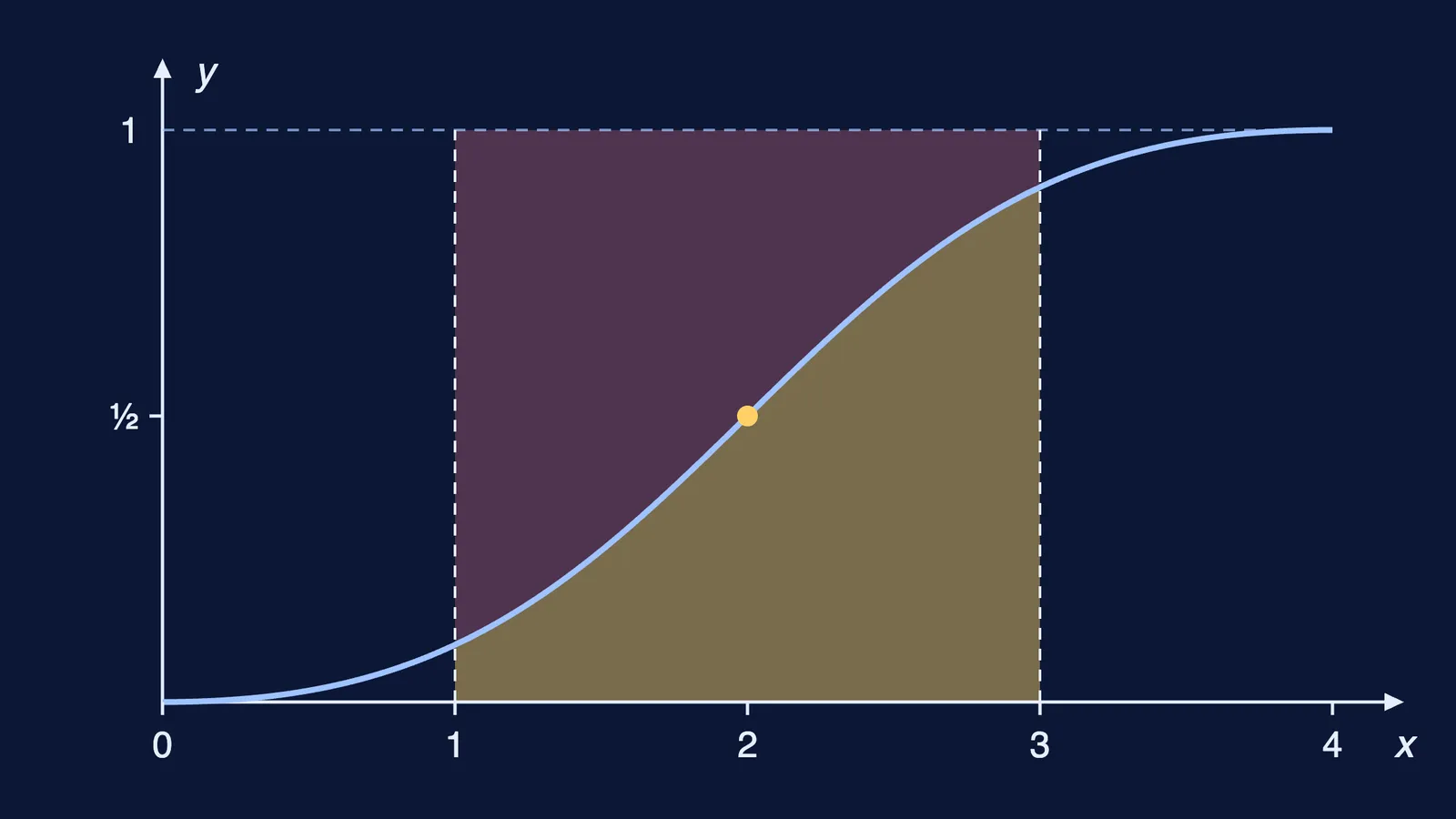
Example (our own). Evaluate I = ∫₁³ x²/(x² + (4 − x)²) dx.
Method 1: property P3. Here a + b = 4. Replacing x by 4 − x gives I = ∫₁³ (4 − x)²/((4 − x)² + x²) dx. Adding the two forms, the integrands sum to 1, so 2I = ∫₁³ 1 dx = 2 and I = 1.
Method 2: direct. The denominator is 2(x² − 4x + 8), and x²/(2(x² − 4x + 8)) = ½ + (2x − 4)/(x² − 4x + 8). The second numerator is the derivative of its denominator, so an antiderivative is x/2 + log(x² − 4x + 8). From 1 to 3: (3/2 + log 5) − (1/2 + log 5) = 1.
Independent check. The integrand is 1/10, 1/2 and 9/10 at x = 1, 2 and 3. The trapezium estimate ½(1/10 + 1/2) + ½(1/2 + 9/10) = 1 agrees, and SymPy, a computer algebra system, returns exactly 1.
Which assertion-reason and case-study traps cost marks?
From the sample paper and marking scheme:
Q19, a true reason that does not apply. ∫₋₁¹ |x − 2| dx = 4 is true, and so is the even-function property given as the reason. But |x − 2| is not even, so the answer is (B), not (A).
Q12, sign of the constant. The form is x − P log(1 + e²ˣ) + C. The working gives x − ½ log(1 + e²ˣ), so P = ½; the minus is already in the form.
Q33, odd part. The piece x/√(a² − x²) is odd; the marking scheme gives 1 mark for the line writing it as 0 with the odd-function property named beside it.
The sample paper's case studies (Q36 to Q38) cover lines, derivatives and matrices, not integrals. Still, the format bites: Q37's last part needs the maximum found in part (ii), so check any early answer before building on it.
A two-week revision plan for integrals
Days 1-3: standard forms and substitution.
Days 4-6: by parts and partial fractions, including an improper fraction and a repeated factor.
Days 7-9: changed limits, then P0 to P7 through NCERT Exercise 7.10 and the Miscellaneous Exercise.
Days 10-12: two 5-mark definite integrals a day in the layout above, each solved two ways.
Days 13-14: sample paper Q12, Q19, Q21 and Q33, timed, marked against the scheme.
Integration returns in differential equations for the board exam. Also sitting JEE Main? See definite integrals and area for JEE Main.
When your working goes wrong and you cannot see where, the Fermi Problem Library has worked problems with a step-by-step solver that explains the reasoning rather than printing an answer.