On this page
Differential equations sit inside the Calculus unit, which carries 35 of the 80 theory marks in the CBSE Mathematics curriculum for 2026-27. The same document sets no chapter-wise weightage, but it fixes the scope: order and degree, general and particular solutions, variables separable, homogeneous equations, and linear equations dy/dx + py = q or dx/dy + px = q.
This guide is for board answers; for the multiple-choice side, see our differential equations guide for JEE.
What is in the NCERT chapter for 2026-27?
Use the NCERT Class 12 chapter on differential equations (Reprint 2026-27). It has no section on forming a differential equation from a family of curves, and the syllabus does not list it, so skip it.
Order is the order of the highest derivative in the equation.
Degree is defined only when the equation is a polynomial in its derivatives; it is then the highest power of the highest-order derivative.
A general solution has as many arbitrary constants as the order; a particular solution has none.
The 2026-27 sample paper tests this in a 1-mark MCQ, where the degree comes from the power of the second derivative, not the larger power on dy/dx. More practice: order and degree of a differential equation.
How do you pick the method?
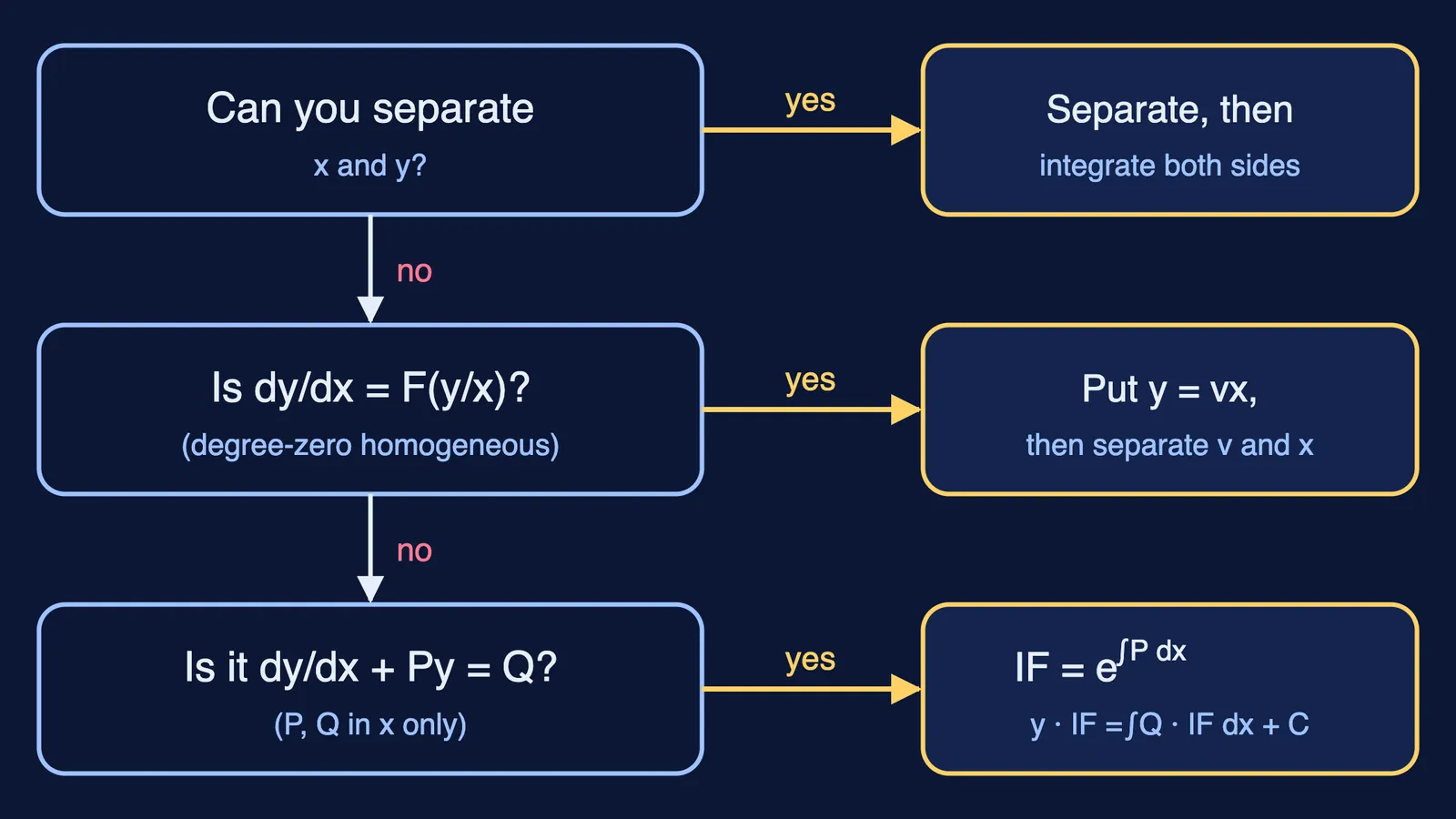
Check in this order:
Variables separable: if every y term can go with dy and every x term with dx, integrate both sides.
Homogeneous: if dy/dx = F(x, y) with F(λx, λy) = F(x, y), put y = vx so dy/dx = v + x dv/dx, then separate v and x. For dx/dy = F(x, y), put x = vy.
Linear: if it can be written dy/dx + Py = Q, with P and Q in x only, then IF = e^(∫P dx) and y · IF = ∫Q · IF dx + C. For dx/dy + P₁x = Q₁, swap x and y.
How do you set out 2-, 3- and 5-mark answers?
In the sample paper, differential equations come as a 1-mark order-and-degree MCQ, a 1-mark assertion-reason item and a 3-mark particular solution, with a choice between a linear and a homogeneous equation.
The marking scheme splits that 3-mark linear answer into six half-marks, from the standard form and the integrating factor through each integration to the constant and the final answer. So the early steps can earn marks even if the final answer is wrong.
2 marks: name the type, separate or substitute, integrate, write + C.
3 marks: add the given condition. Find C on its own line, then write the particular solution.
5 marks: the sample paper has no differential equation in its 5-mark section, but with no fixed chapter weightage, be ready. Use the 3-mark layout, then substitute your answer back.
Worked example: a linear equation, solved and checked
Find the particular solution of dy/dx + 3y/x = 5x (x > 0), given that y = 2 when x = 1.
Type: linear, with P = 3/x and Q = 5x.
IF = e^(∫3/x dx) = e^(3 log x) = x³.
y · x³ = ∫5x⁴ dx = x⁵ + C.
Put x = 1, y = 2: 2 = 1 + C, so C = 1.
Particular solution: y = x² + 1/x³.
Check: dy/dx = 2x − 3/x⁴ and 3y/x = 3x + 3/x⁴. They add to 5x, and y(1) = 2, so both conditions hold. SymPy confirms it.
If a step keeps going wrong, the Fermi Problem Library has worked problems with a step-by-step solver that explains the reasoning rather than printing an answer.
What are the common errors and traps?
Taking P before dividing by the coefficient of dy/dx. In x dy/dx + 3y = 5x², P is 3/x, not 3.
Writing e^(log x) as log x instead of x.
Adding C too late: y = x² + C instead of y = x² + C/x³.
Giving a degree to an equation whose degree is not defined.
Assertion-reason: judge each statement alone, then ask if the reason explains the assertion. The sample paper's item asserts that a general solution stands for a family of curves, with a reason about arbitrary constants; its marking scheme says both are true and the reason explains it.
Case studies: the sample paper's case studies skip this chapter. If one uses it, turn the words into dy/dx first: "slope of the tangent" means dy/dx.
A two-week revision plan
Days 1-2: order and degree; NCERT Exercise 9.1.
Days 3-4: solutions and separable equations; Exercises 9.2 and 9.3.
Days 5-7: homogeneous equations; Exercise 9.4, writing y = vx out every time.
Days 8-10: linear equations; Exercise 9.5, including the dx/dy form.
Days 11-12: the sample paper's questions, timed and marked against the half-marks.
Days 13-14: a mixed set, checking each answer by substitution.
To fit this into the whole paper, see our section-wise CBSE Class 12 maths plan.