On this page
In this chapter the marking scheme gives marks for each property you check, so a clear layout matters. This guide is about CBSE board answers, not JEE speed tricks.
How many marks is Relations and Functions in the 2026-27 board exam?
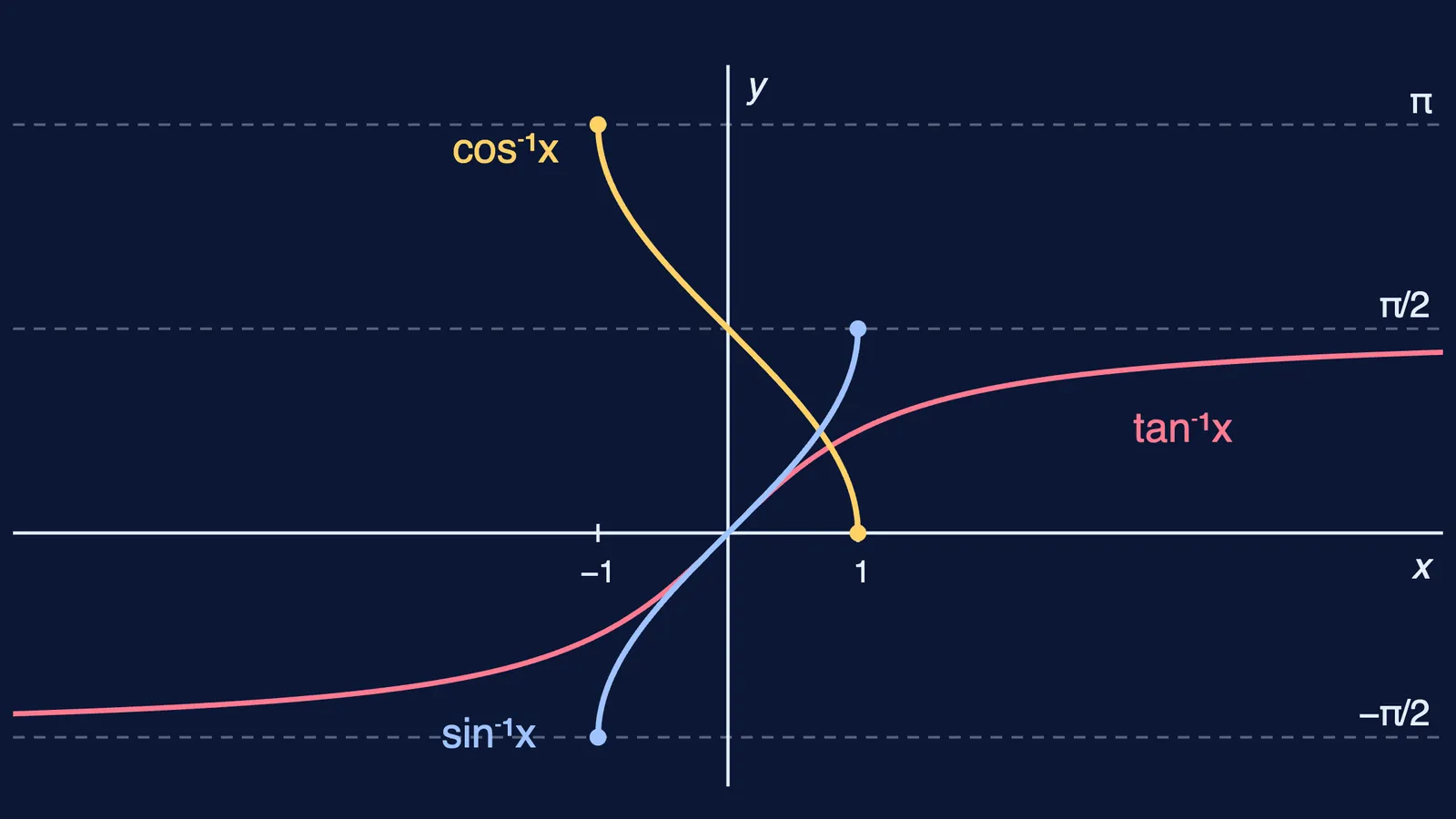
The CBSE Mathematics curriculum for 2026-27 prints Unit I, Relations and Functions, at 08 of 80 marks. The unit has two chapters, Relations and Functions and Inverse Trigonometric Functions, so they share those 8 marks.
The syllabus lists types of relations (reflexive, symmetric, transitive, equivalence) and one-one and onto functions. Composition and invertible functions remain in section 1.4 of NCERT Chapter 1 (Reprint 2026-27), but the curriculum does not name them.
In the 2026-27 sample paper, Unit I fills Q1 to Q3 (inverse trig MCQs) and Q32, a 5-mark question with an internal choice: check whether a relation is an equivalence relation, or show a relation is a function and test it for one-one and onto.
What must you be able to prove?
Every proof is an NCERT definition checked line by line:
Reflexive: (a, a) ∈ R for every a in A.
Symmetric: (a, b) ∈ R implies (b, a) ∈ R.
Transitive: (a, b) ∈ R and (b, c) ∈ R imply (a, c) ∈ R.
Equivalence: all three. It splits the set into disjoint equivalence classes; [a] holds everything related to a.
One-one: f(x₁) = f(x₂) implies x₁ = x₂.
Onto: every y in the codomain has an x with f(x) = y, so the range equals the codomain.
For f: R → R, f(x) = 7x − 2: one-one, since 7x₁ − 2 = 7x₂ − 2 gives x₁ = x₂. Onto: for any real y, x = (y + 2)/7 is real and f(x) = y. Write that substitution out.
Practise more with our guides to equivalence relations in Class 12 and one-one and onto functions.
How do you set out 2-, 3- and 5-mark answers?
The marking scheme gives Q32(A) 1½ each for reflexive, symmetric and transitive, plus ½ for the conclusion. Q32(B) gets 1 for the graph, 1 for showing it is a function, and 1½ each for the injective and surjective checks.
The sample paper has no 2- or 3-mark question from this chapter, so these layouts are our suggestion:
2 marks: one property. Definition, algebra, one-line verdict.
3 marks: one-one and onto, each under its own heading, ending "hence bijective" or naming the test that fails.
5 marks: three headed blocks, each with its own verdict, then a line naming the relation.
To show a property fails, one numerical counterexample is enough.
A worked example, checked twice
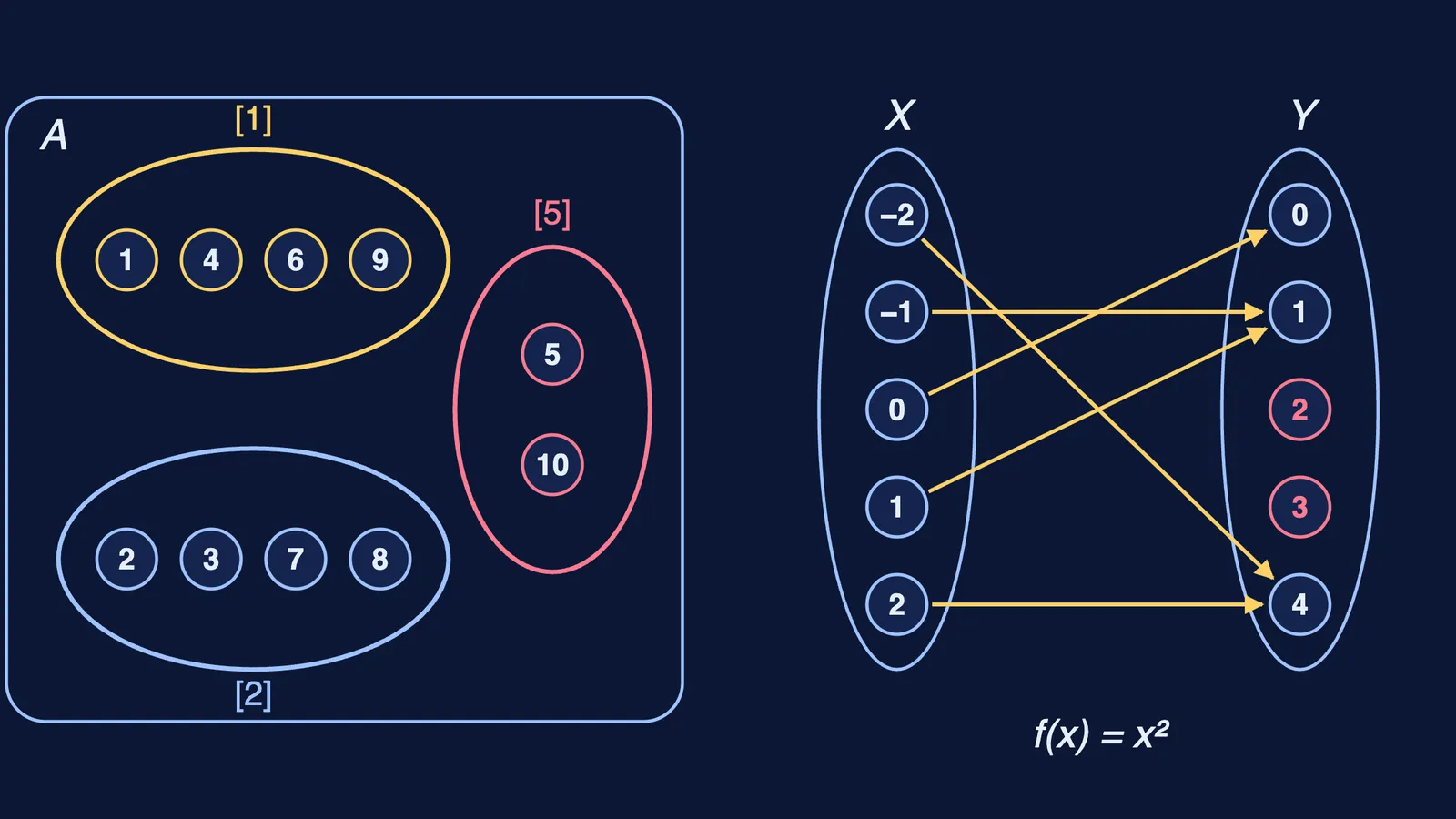
Our own question: on A = {1, 2, ..., 10}, a R b means 5 divides a² − b². Show R is an equivalence relation and find [1].
Method 1: the definitions. a² − a² = 0, so R is reflexive. If 5 divides a² − b², it divides b² − a², so R is symmetric. If 5 divides a² − b² and b² − c², it divides their sum a² − c², so R is transitive. Only 1, 4, 6 and 9 give b² − 1 divisible by 5 (0, 15, 35, 80). So [1] = {1, 4, 6, 9}.
Method 2: an independent check. a² − b² = (a − b)(a + b), and 5 is prime, so 5 divides it exactly when it divides a − b or a + b. For a = 1, b leaves remainder 1 or 4 on division by 5: again 1, 4, 6, 9. The other classes are {2, 3, 7, 8} and {5, 10}.
A brute-force Python check agreed: R has 36 ordered pairs and passes all three tests.
If your method keeps slipping, the Fermi Problem Library has worked problems with a step-by-step solver that explains the reasoning rather than printing an answer.
Where do assertion-reason and case-study questions trip students?
The sample paper has no assertion-reason or case study from this chapter. If one appears, watch for:
The swapped codomain. f: R → R, f(x) = x² + 1 is not onto, since 0 has no pre-image. With codomain [1, ∞) it is onto.
True but not the explanation. Assertion: x² on R → R is not one-one. Reason: x² ≥ 0. Both are true, but the real cause is f(−1) = f(1), so choose (B).
Symmetric plus transitive does not give reflexive; Exercise 1.1 asks for such a relation.
Case-study sets (roll numbers, seats): write the domain and codomain first.
What should your revision plan be?
Day 1: write every definition from memory, then check NCERT.
Day 2: Exercise 1.1, writing all three property blocks each time.
Day 3: Exercise 1.2, naming the domain and codomain before each part.
Day 4: sample-paper Q32 (A) and (B) under time, marked against the scheme.
Day 5: redo the worked example with 3 in place of 5, then revise inverse trig.
Next unit: Matrices and determinants for the Class 12 board.