On this page
Matrices and Determinants make up Unit II, Algebra, in the CBSE Mathematics curriculum for 2026-27. The Class XII marks table gives Algebra 10 of 80 marks, shared by both chapters.
What is in the 2026-27 syllabus?
The curriculum covers matrix types and operations (non-commutativity and zero products for order 2 only), transpose, symmetric and skew-symmetric matrices, invertible matrices, determinants up to 3×3, cofactors, area of a triangle, adjoint, inverse, and solving systems with a unique solution.
Work from the Reprint 2026-27 of NCERT Chapter 3 and NCERT Chapter 4. Chapter 4 has no section on properties of determinants, and Chapter 3 has no elementary row operations, so expand along a row or column. Ignore a leftover line in Chapter 4's Miscellaneous Exercises citing properties of determinants.
Results to know:
(AB)′ = B′A′ and (AB)⁻¹ = B⁻¹A⁻¹.
A = ½(A + A′) + ½(A − A′): a symmetric part plus a skew-symmetric part.
A skew-symmetric matrix has zeros on its diagonal (see why a skew-symmetric matrix of odd order has determinant zero).
A(adj A) = (adj A)A = |A|I, and |adj A| = |A|ⁿ⁻¹ for order n.
Area of a triangle is ½ times the determinant with rows (x, y, 1), taken as an absolute value; collinear points give zero.
A square matrix is invertible if and only if |A| ≠ 0, and its inverse is unique.
How does the marking scheme award step marks?
The 2026-27 sample paper has 38 questions, with MCQs and assertion-reason in Section A and 4-mark case studies in Section E. Matrices appear in Q4-Q6 (MCQs), Q26 (3 marks) and the Q38 case study: 10 marks in all.
In the marking scheme, Q26 (3 marks) gives 1 for PQ, 1 for QP, ½ for the inverse of the non-singular product, and ½ for showing the other product has determinant 0. The case study Q38 gives 1 for AX = B, 1 for adj A after |A| ≠ 0, 1 for X = A⁻¹B with numbers, and 1 for the values.
The paper has no 2- or 5-mark matrix question; those layouts are ours.
2 marks: formula, one working line, answer.
3 marks: each product or determinant on its own line, then a conclusion in words ("|A| ≠ 0, so A⁻¹ exists").
5 marks (3×3 system): AX = B; |A| ≠ 0 stated; all nine cofactors; adj A; A⁻¹ = (1/|A|) adj A; X = A⁻¹B and the values.
A worked example, done twice
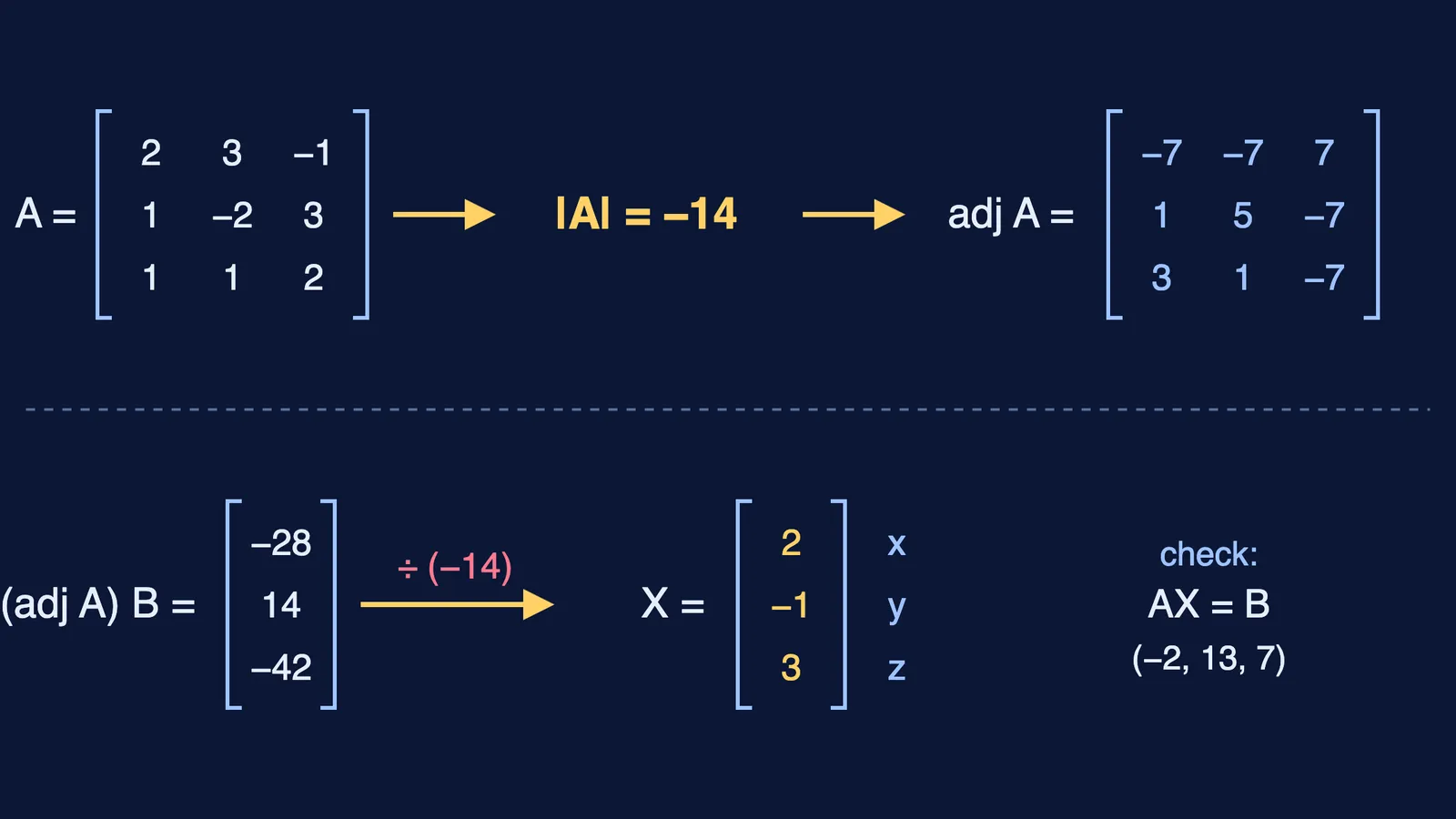
Solve by the matrix method: 2x + 3y − z = −2, x − 2y + 3z = 13, x + y + 2z = 7.
AX = B, with A = [2 3 −1; 1 −2 3; 1 1 2] and B = [−2; 13; 7].
|A| = 2(−4 − 3) − 3(2 − 3) + (−1)(1 + 2) = −14 + 3 − 3 = −14. Non-zero, so the solution is unique.
Cofactors: A₁₁ = −7, A₁₂ = 1, A₁₃ = 3; A₂₁ = −7, A₂₂ = 5, A₂₃ = 1; A₃₁ = 7, A₃₂ = −7, A₃₃ = −7.
adj A, the transpose of the cofactor matrix, is [−7 −7 7; 1 5 −7; 3 1 −7].
(adj A)B = [−28; 14; −42], so X = (1/−14)(adj A)B = [2; −1; 3]: x = 2, y = −1, z = 3.
Check by substitution: 4 − 3 − 3 = −2, 2 + 2 + 9 = 13, 2 − 1 + 6 = 7. Adjoint check: A(adj A) has −14 down the diagonal and 0 elsewhere, which is |A|I.
Which errors and traps cost the most marks?
Not transposing the cofactor matrix to get adj A.
Wrong cofactor signs: Aᵢⱼ = (−1)ⁱ⁺ʲ Mᵢⱼ.
Writing X = BA⁻¹ instead of A⁻¹B, or (AB)′ = A′B′.
Dropping the absolute value in area, or using one sign when area is given (use both).
Saying |A| = 0 means no solution. In NCERT Chapter 4, (adj A)B ≠ O then means no solution; (adj A)B = O means infinitely many solutions or none.
In assertion-reason, judge each statement alone first. "AB = O, so A = O or B = O" is false: the curriculum lists non-zero order-2 matrices whose product is zero. In case studies, write AX = B first; it earns a mark even if the arithmetic stalls. For an unknown matrix in AX = B, see how to find matrix X from AX = B or XA = B.
A 10-day revision plan
Days 1-2: Chapter 3 examples; transpose and the symmetric plus skew-symmetric split.
Days 3-4: determinants by expansion; area of a triangle, including "find k".
Days 5-6: cofactors, adjoint, inverse; check each with A(adj A) = |A|I.
Days 7-8: Exercise 4.5 on consistency and the matrix method.
Day 9: sample paper Q4-Q6, Q26 and Q38, timed and self-marked.
Day 10: redo every wrong question.
If cofactor signs keep slipping, the Fermi Problem Library has worked problems with a step-by-step solver that explains the reasoning rather than printing an answer. If time runs short, use our 20-minute triage plan for a board paper.