On this page
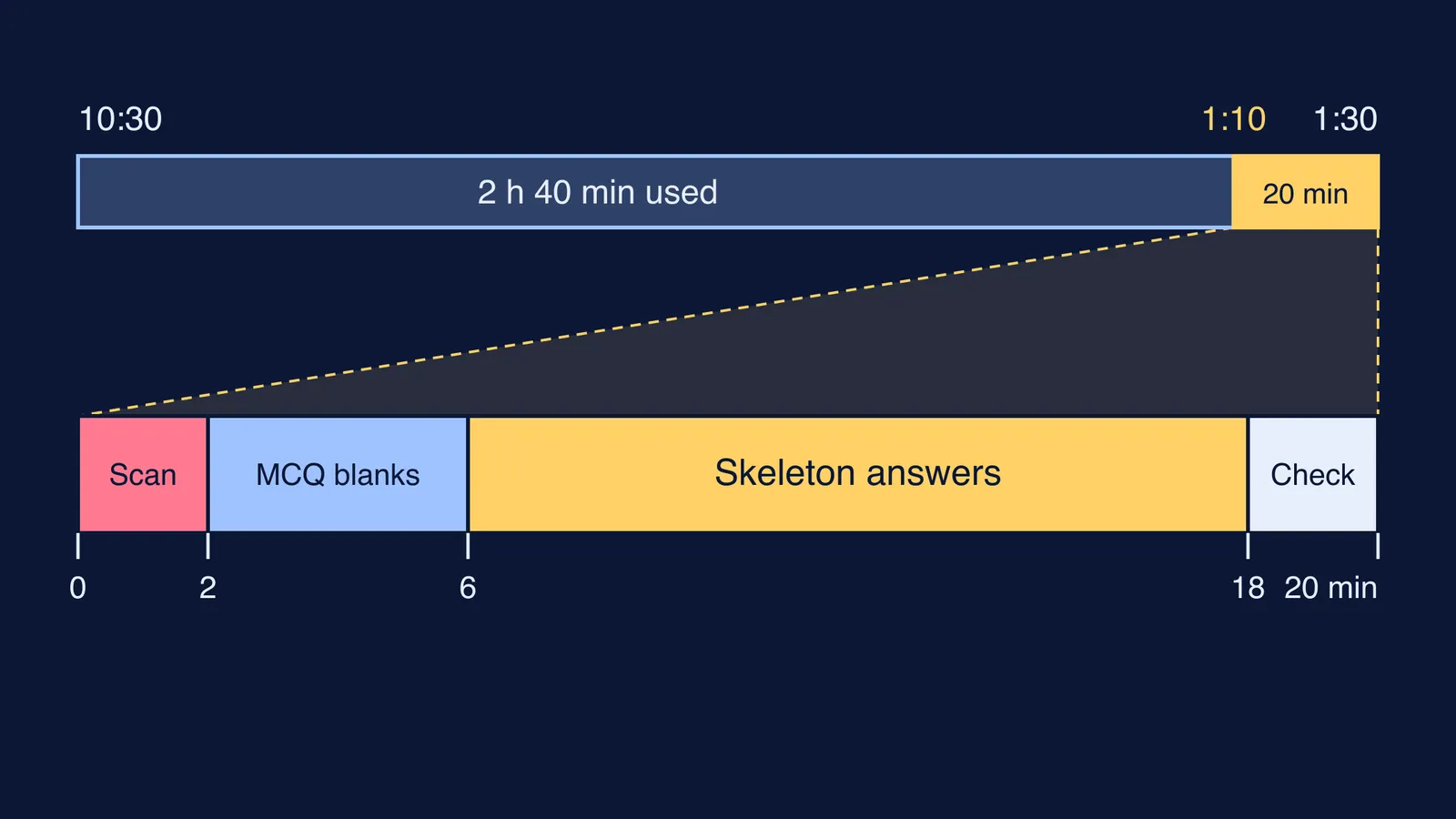
You look up at the clock and it is 1:10 pm. Since 2005, CBSE has handed out board papers at 10:15 am, with writing from 10:30 am after 15 minutes of reading time (CBSE Circular 29/2005). With 3 hours allowed (CBSE Physics sample paper 2026-27), you have about 20 minutes left and a few questions still blank.
CBSE described this pressure in the same circular: “a fear of paucity of time forces them to relentlessly engage themselves in writing the answers without sufficient reflection.” The fix is not to write faster. It is to choose what to write.
What should you do first when you're running out of time?
Spend two minutes planning, so you don't spend ten on the wrong question.
Tick every question you have not attempted or left half-done.
Write the marks next to each one.
Number them in the order below, then start, and don't look at the clock again until you reach the last block.
Here is how the 20 minutes split:
Minutes 0 to 2: scan and number the remaining questions.
Minutes 2 to 6: fill every blank 1-mark question.
Minutes 6 to 18: skeleton answers for unstarted 3, 4 and 5-mark questions.
Minutes 18 to 20: box final answers and check question numbers match.
Which questions should you finish in the last 20 minutes?
Use marks per minute. CBSE's 2026-27 Class 12 Physics sample paper has 70 marks and 3 hours, which works out to about 2.6 minutes per mark (CBSE sample paper, Physics 2026-27). Our minute-per-mark plan for board exams shows how to set those checkpoints from the start.
Blank MCQs and assertion-reason questions. Each should take about a minute. The general instructions in that sample paper mention no deduction for wrong answers, so leave none blank. Our two-pass plan for the MCQ section explains how.
Unstarted long answers. A skeleton takes three to four minutes and collects the first steps, which are often the easiest marks.
Half-finished answers. Add the last line only if you know it.
Never: rereading or decorating answers you have already written.
With an internal choice, pick the option you can start in ten seconds.
How do you write a skeleton answer that still gets step marks?
A skeleton answer is the shortest version of a full answer that still shows every step an examiner can award: the principle or formula, the given values substituted, a labelled sketch if one is asked for, and a final line with units.
This works because CBSE's marking schemes split long answers into small parts. In the official 2026-27 Physics marking scheme, Question 31(A), worth 5 marks, is broken into half marks. Here is the question and a skeleton answer that hits those points:
I. Why can't an isolated conductor have a large capacitance? (2 marks) C = 4πε₀R. ε₀ is constant, so C grows only with R. A large C needs an impossibly large sphere.
II. Connect 6, 9 and 18 μF for minimum and maximum capacitance (2 marks) Minimum: series, 1/C = 1/6 + 1/9 + 1/18 = 1/3, so C = 3 μF. Maximum: parallel, C = 6 + 9 + 18 = 33 μF.
III. Two other factors (1 mark) Distance between plates (C ∝ 1/d). Permittivity of the medium (C ∝ ε).
In part II, the marking scheme sets a half mark against the line saying “series” and another against “parallel”, separate from the half marks for the calculations. Other numericals in the scheme, such as 31(B), follow the same pattern: formula and substitution lines carry marks of their own.
Three habits make skeletons pay:
Write the formula first, even if you are unsure you can finish.
Keep units on every number.
If you run out mid-way, leave the working; do not cross it out.
For the layout examiners expect, see how to write numericals for full step marks.
A 20-minute drill to practise before the boards
Triage is a skill, so rehearse it once a week.
Download a sample paper and its marking scheme from CBSE Academic.
Pick one 5-mark question, two 3-mark questions and four 1-mark questions you have not seen.
Set a 20-minute timer and follow the 2-4-12-2 split above.
Mark yourself strictly against the marking scheme, in half marks.
Write down which step you could not start. That is your revision list for the week.
If the same kind of step keeps stopping you, such as choosing the formula, work through a few similar problems in the Fermi Problem Library, where a step-by-step solver explains the reasoning rather than printing an answer.
What if you freeze when you see the clock?
Put the pen down, breathe out slowly twice, and write just the question number and one formula. If exam fear stays with you for weeks or affects sleep and eating, talk to a parent, teacher or school counsellor, or call Tele MANAS on 14416, a free 24x7 national mental-health helpline (IIT Kanpur counselling service).
This week, try one 20-minute drill on a sample paper and count your half marks.