On this page
You have seen it at weddings, school annual days and science fairs: a lump of dry ice goes into water, and a thick white cloud spills over the rim and rolls across the floor. Most people call it smoke, or "CO₂ gas". It is neither.
What is dry ice, and at what temperature does it sublime?
Dry ice is solid carbon dioxide. At normal air pressure it never melts into a liquid; it sublimes, turning straight from solid to gas.
The sublimation point of dry ice at normal atmospheric pressure is −78.464 °C, usually rounded to −78.5 °C, according to the CRC Handbook value listed on PubChem's carbon dioxide record.
Liquid CO₂ can only exist above its triple point of 5.185 bar, about five times normal air pressure, according to the NIST Chemistry WebBook. That is why a block on your table never leaves a puddle. Our explainer on which substances undergo sublimation has more examples.
Why does dry ice make white smoke?
Carbon dioxide gas is invisible. You breathe it out all day and your breath stays clear, a point the UC Santa Barbara chemistry outreach notes use with students. As the solid sublimes it absorbs heat, the nearby gas becomes very cold, and water vapour condenses into tiny liquid droplets, the same way a cloud forms. Those droplets scatter light, so you see white.
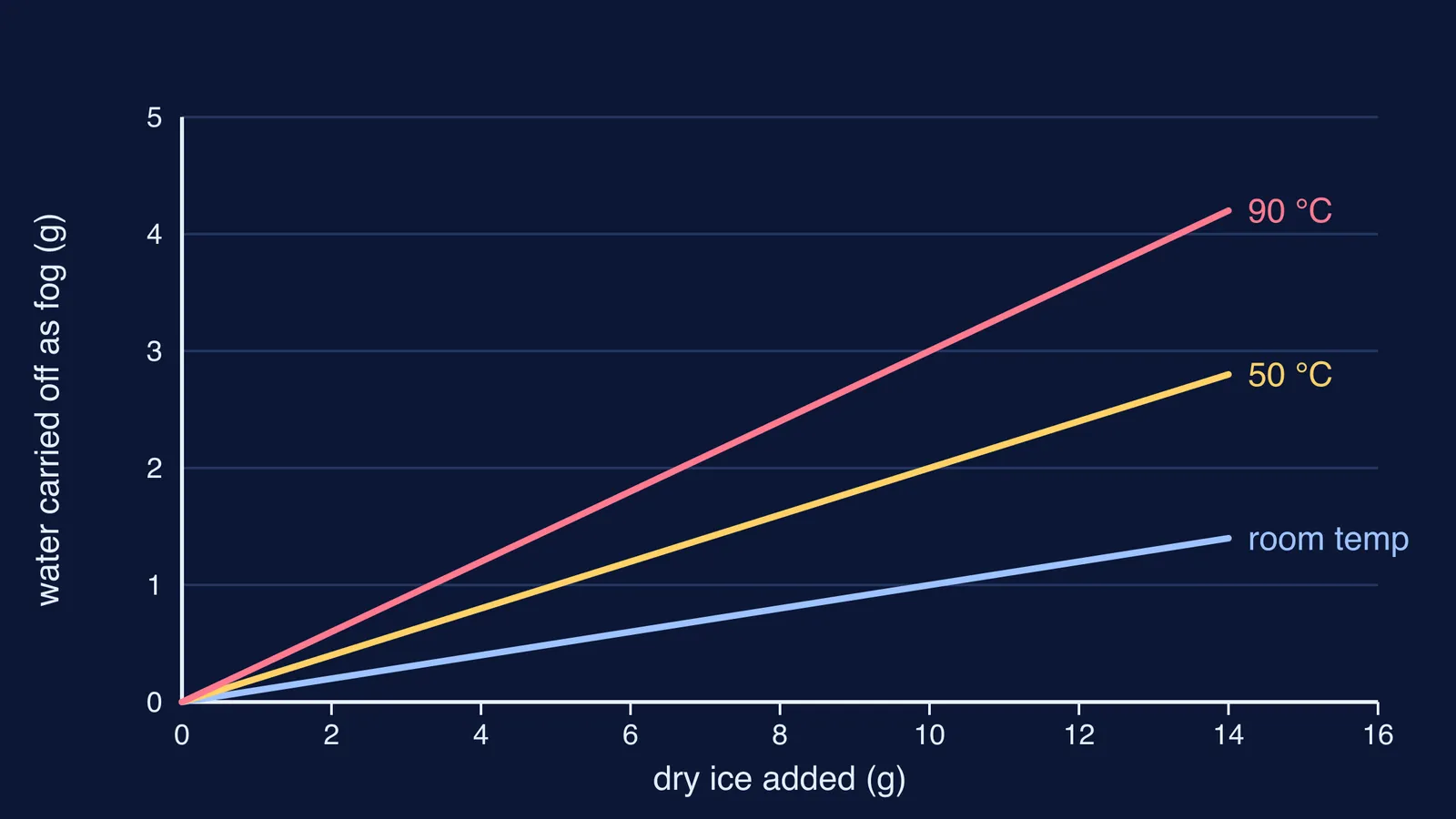
Where does that water come from? Many teachers say the room's air. Chemists at Spring Arbor University and Jackson College, building on earlier work, reported in the Journal of Chemical Education that when dry ice is dropped into water, the water in the fog comes from the water in the glass, not from the air (Kuntzleman and colleagues, 2015). They weighed the water before and after: about 0.1 g of water left as fog for every gram of dry ice at room temperature, about 0.2 g with water at 50 °C, and around 0.3 g at 90 °C. Hotter water has a higher vapour pressure, and it gave a thicker fog. In ethanol, the thin fog was made of ethanol, not water.
A lump on a dry plate makes much less fog, because the only water it can use is the vapour already in the air. It is the same condensation that clouds your bathroom mirror after a hot shower.
Why does dry ice fog sink to the floor?
Two effects pull the same way. First, carbon dioxide is heavier than air: its vapour density is 1.53 relative to air, per NIOSH data on PubChem. Second, the gas is extremely cold, and cold gas is denser than warm gas at the same pressure. The droplets ride along in this cold, heavy layer, so the fog pours over the rim and spreads across the floor until it warms and the droplets evaporate.
That sinking is also the hidden hazard. The white fog soon fades, but the invisible CO₂ can linger near the floor, and the University of Utah's dry ice guidance warns that it can displace oxygen and cause difficulty breathing, loss of consciousness and death, especially in non-ventilated or confined spaces.
Why must dry ice never go in a sealed bottle?
Because a small solid becomes a lot of gas. The University of Utah's rule of thumb is that 1 pound of dry ice (about 454 g) gives 250 litres of CO₂ gas, as stated in its dry ice safety page.
Work it through for 100 g:
Gas produced: 250 × 100 ÷ 454 ≈ 55 litres at room pressure.
Squeeze that into a sealed 1-litre bottle and, by the ideal-gas law, the pressure heads towards about 55 times normal air pressure.
Bottles and screw-top jars are not built for that. Utah warns that a closed container of dry ice may explode if the gas cannot escape.
How do you handle dry ice safely?
This checklist follows the University of Utah's guidance:
Never touch it with bare hands. At about −79 °C, skin contact can cause severe frostbite. Use tongs where you can, or loose-fitting insulated gloves; thin nitrile gloves are not enough.
Never seal it in: no plastic or glass bottles, no screw-top jars that cannot vent. A Styrofoam box works because it is insulated but not airtight.
Use and store it in a well-ventilated place, never in a confined space such as a cold room or walk-in refrigerator.
To get rid of leftovers, leave them to sublime at room temperature somewhere well ventilated.
See also chemistry lab safety rules and the accident each one prevents.
For ideas like sublimation that are easier to see than to read, the Fermi Simulation Lab has interactive simulations. The Fermi Concept Library gives every concept in physics and chemistry its own lesson, so you can follow vapour pressure and condensation further.