

On this page
When you leave mothballs in a wardrobe, they slowly disappear over months without leaving a wet patch. This is sublimation: the direct transition of a substance from the solid phase to the gas phase, entirely bypassing the liquid state. Sublimation is an endothermic process, meaning it requires the absorption of heat energy from the surroundings to break the bonds holding the solid matrix together.
But why do some materials do this while everyday ice melts into liquid water? It comes down to temperature, atmospheric pressure, and the specific intermolecular forces holding the solid together.
Which substances undergo sublimation?
Many substances sublime under the right conditions in a vacuum, but a few are famous for doing it at everyday room temperatures and pressures. These are heavily tested in chemistry exams because they demonstrate phase equilibria:
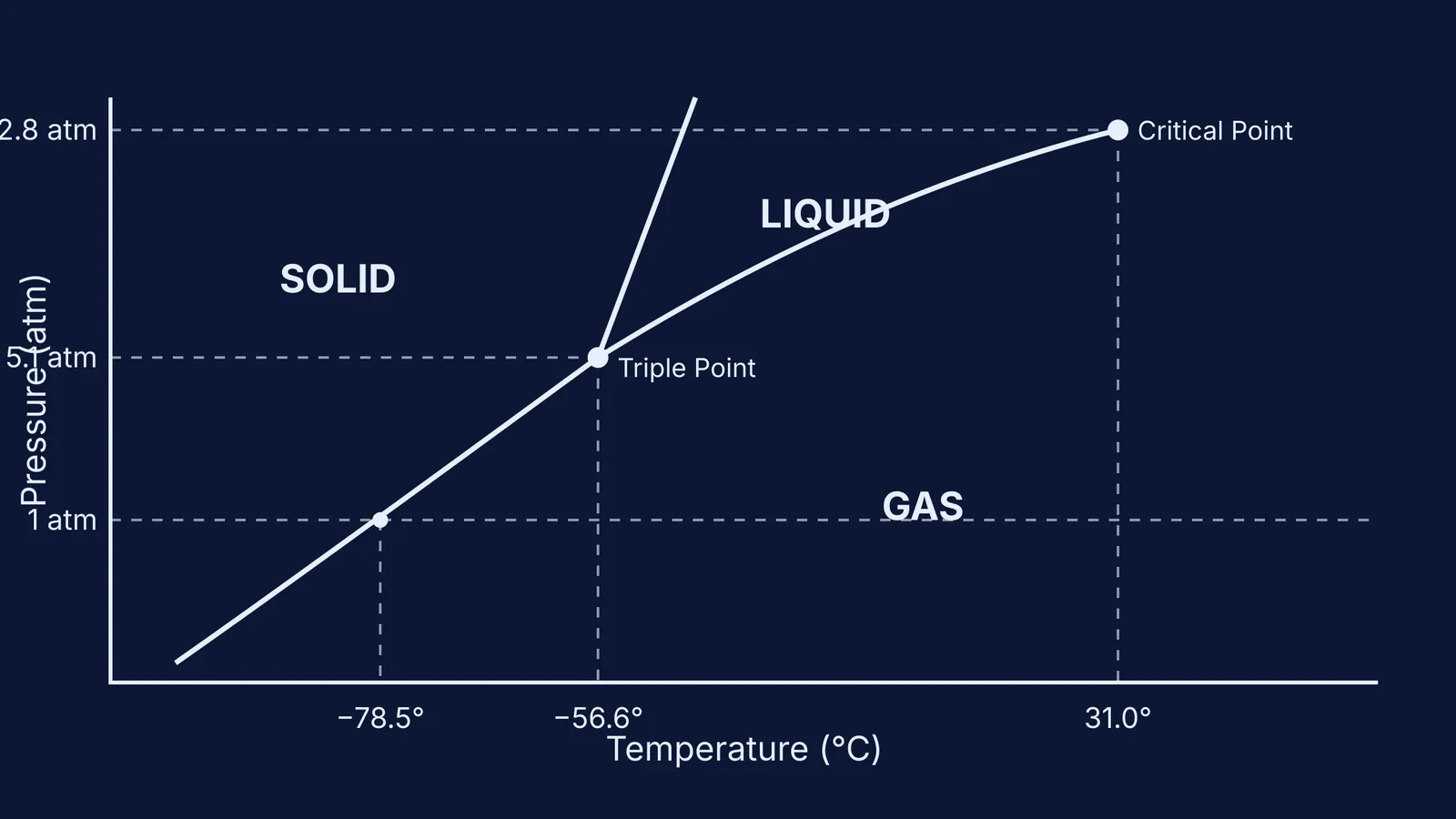
Dry ice (solid carbon dioxide): This is the classic example used in shipping and theatrical fog. A block of dry ice sublimes rapidly into cold CO₂ gas at −78.5 °C at standard atmospheric pressure (Wikipedia)).
Naphthalene: The main ingredient in traditional mothballs. It consists of non-polar molecules held together only by weak van der Waals forces. This weak bonding gives it a high enough vapour pressure (1 mmHg at 53 °C, according to Wikipedia)) to turn into gas at a noticeable rate indoors.
Camphor: This waxy, strong-smelling solid is traditionally purified through sublimation. It has a vapour pressure of 4 mmHg at 70 °C (Wikipedia). Interestingly, mechanics sometimes place a camphor block in their toolboxes; as it slowly evaporates over several months, the fumes deposit a microscopic rust-inhibiting film on metal tools.
Does iodine actually sublime?
Iodine is a staple of classroom sublimation demonstrations. When heated gently in a beaker, it gives off a thick, beautiful purple vapour, leaving students with the impression that it cannot melt.
However, there is a catch: iodine does have a liquid state at normal atmospheric pressure. According to standard thermodynamic data, solid iodine melts at 113.7 °C to form a deep violet liquid (Wikipedia).
The misconception that it only sublimes comes from its high volatility. Because its vapour pressure is relatively high even as a solid, it gives off visible fumes well before it reaches its melting point. If you heat it slowly and carefully in a test tube, you will clearly see the liquid form at the bottom. The reverse process—when the purple gas hits a cold surface and turns directly back into solid crystals—is called deposition.
Why do some solids skip the liquid state?
The answer lies in a thermodynamic property called the "triple point". A substance's triple point is the exact temperature and pressure where its solid, liquid, and gas phases can exist simultaneously in thermal equilibrium.
For a liquid state to physically exist, the surrounding atmospheric pressure must be higher than the substance's triple point pressure.
Water's triple point pressure is a tiny 0.006 atm (Wikipedia)). Since the atmosphere around us is 1 atm, which is much higher, water can easily exist as a liquid.
Carbon dioxide's triple point is at 5.1 atm and −56.6 °C (Wikipedia)). Because our atmospheric pressure (1 atm) is far below 5.1 atm, liquid CO₂ is impossible in an open room. When you heat solid dry ice, the molecules gain kinetic energy but cannot form a stable liquid, so they have no choice but to break free directly into the gas phase.
If you have concept gaps when dealing with phase equilibria, the Fermi Concept Library holds every concept in physics, chemistry, biology, mathematics and computing, each with its own lesson and its place in the map. This foundational knowledge is crucial when Converting PV, PT and VT graphs of ideal gas processes.
The Triple Point Test for Students
If you are looking at a phase diagram and need to know whether a solid will melt or sublime when heated in an open room (at 1 atm), simply look at the y-axis for the triple point pressure (Wikipedia)). Use this framework:
Locate the exact pressure where the three phase boundaries meet (the Triple Point).
If the Triple Point is greater than 1 atm, the substance will sublime (e.g., carbon dioxide, where the triple point is 5.1 atm).
If the Triple Point is less than 1 atm, the substance will melt into a liquid when heated (e.g., iodine, where the triple point is 0.12 atm, according to Wikipedia).
The same logic applies to changes in pressure. Understanding how pressure dictates states of matter is also necessary for problems involving the Free expansion of an ideal gas: why work and ΔU are both zero.


