

On this page
"Why should we conserve biodiversity?" is a classic Class 12 Biology long answer, and it is easy to lose marks on. Students often know the examples but put them under the wrong heading. This guide sorts each example under the right reason and gives you a plan for writing the full answer.
The source is section 13.2.1 of NCERT Class 12 Biology, Chapter 13, Biodiversity and Conservation. CBSE's Biology sample question paper for 2026-27 has a Section E with 3 questions of 5 marks each, so a long answer like this one is worth practising.
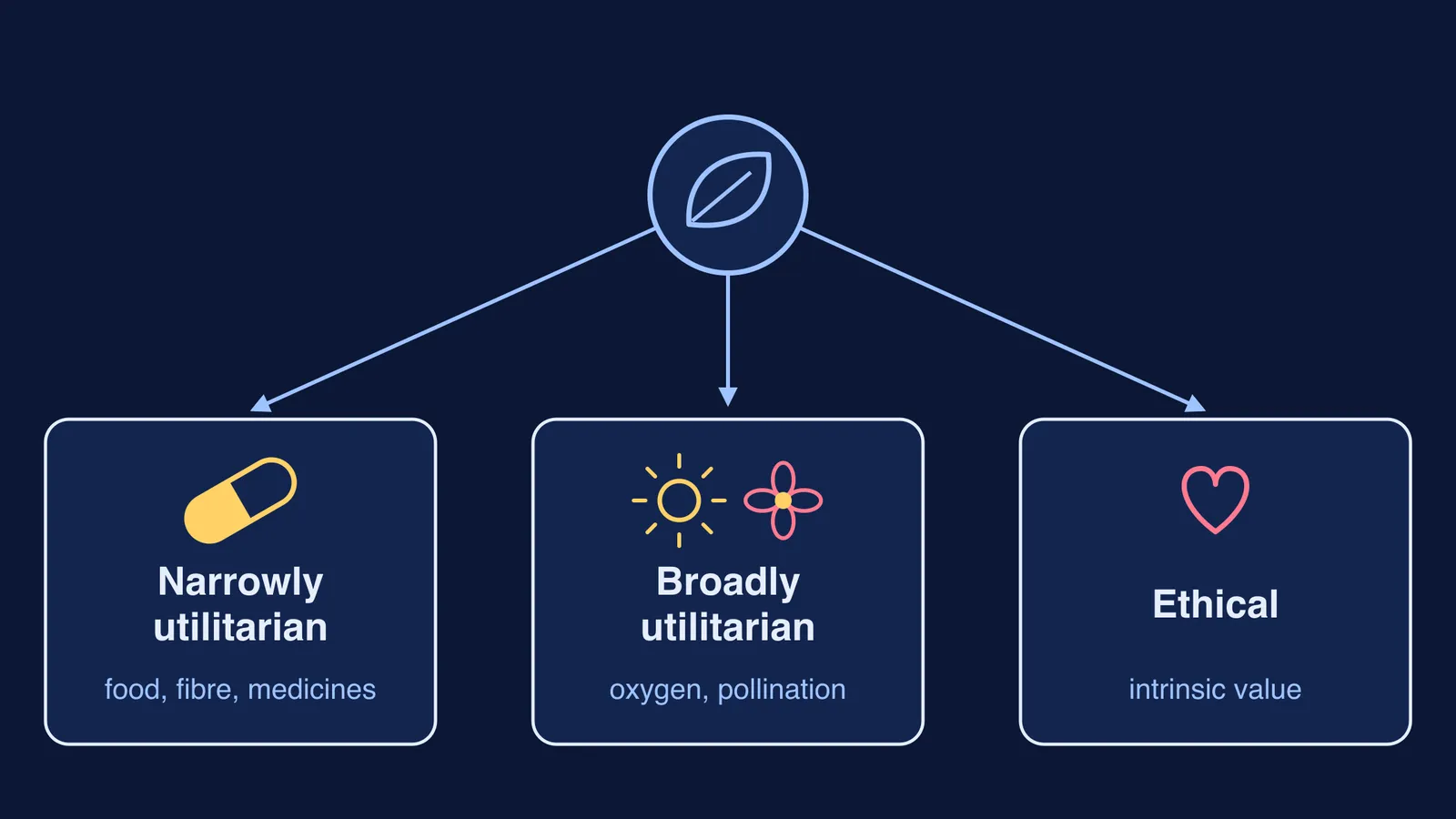
What are the three reasons to conserve biodiversity?
NCERT says the reasons "can be grouped into three categories: narrowly utilitarian, broadly utilitarian, and ethical" (NCERT Chapter 13).
Narrowly utilitarian: what we take directly. Humans get countless direct economic benefits from nature: food, firewood, fibre, construction material, industrial products such as tannins, dyes and resins, and medicines (NCERT).
For example, more than 25 per cent of the drugs sold worldwide are derived from plants, and 25,000 plant species contribute to the traditional medicines of native peoples, according to NCERT. The same chapter defines bioprospecting as exploring molecular, genetic and species-level diversity for products of economic importance.
Broadly utilitarian: what nature does for us. Biodiversity plays a major role in the ecosystem services nature provides (NCERT).
For example, NCERT says the Amazon forest is estimated to produce 20 per cent of the oxygen in Earth's atmosphere through photosynthesis. Its second example is pollination by bees, bumblebees, birds and bats, without which plants cannot give us fruits or seeds. For more on why these services are hard to put a price on, see our explainer on the ecosystem services of forests.
Ethical: what we owe other species. Every species has an intrinsic value, even if it has no current or future economic value to us, and we have a moral duty to care for species and pass on our biological legacy to future generations (NCERT).
For example, picture one of the tree frog species of the Western Ghats. NCERT mentions it earlier in the chapter, when it asks whether losing a few species really matters. The frog is not sold in any market, but the ethical argument says it still has a claim to exist.
What is the difference between narrowly and broadly utilitarian?
Ask three questions in order:
Do we take it out and use the product? Narrowly utilitarian.
Does it benefit us while staying where it is? Broadly utilitarian.
Would it matter even if it were useless to us? Ethical.
Try them on these examples:
Timber for building a house: narrowly utilitarian.
Bees pollinating a mango orchard: broadly utilitarian.
A plant used to make a medicine: narrowly utilitarian.
Waking up to a bulbul's song: broadly utilitarian.
A rare frog with no known use: ethical.
How do you write the 5-mark answer?
Use five parts. Give more space to the parts with examples and numbers. The marking scheme for your year is the final word on how marks are split.
Opening line: Biodiversity is the variety of life at all levels, and NCERT groups the reasons for conserving it into three: narrowly utilitarian, broadly utilitarian and ethical.
Narrowly utilitarian: a definition, a list of products (food, fibre, timber, dyes, medicines) and the drug figure. Mention bioprospecting.
Broadly utilitarian: a definition, then the Amazon oxygen and pollination examples, plus one intangible benefit.
Ethical: intrinsic value, moral duty and passing on our biological legacy.
Closing line: Losing species costs us products, services and something we cannot price, so conservation is necessary.
Underline the three category names so the examiner can find each one quickly.
A model paragraph for point 3, using the figures from NCERT section 13.2.1: "Broadly utilitarian: biodiversity provides ecosystem services. The Amazon forest is estimated to produce 20% of the oxygen in Earth's atmosphere through photosynthesis. Pollinators such as bees, birds and bats are needed for plants to produce fruits and seeds. Nature also provides aesthetic pleasures, such as a bulbul's song."
Is the Amazon really 20% of Earth's oxygen?
For the board exam, write NCERT's figure and keep the word "estimated". It helps to know that scientists dispute it. In a 2021 article for the University of Oxford, ecologist Yadvinder Malhi wrote that "the net production of oxygen by land ecosystems is close to zero", because plants and the microbes and insects that break them down use up almost all the oxygen they make. Rainforests still matter for biodiversity, carbon and climate. Our post on why the Amazon is called the lungs of the planet explains the debate.
If the terms in this chapter keep running together, the Fermi Concept Library covers every concept in biology, each with its own lesson and its place in the map. That helps you see how conservation connects to ecosystem services and species loss. Once you can write this answer from memory, move on to the next part of the chapter: in situ vs ex situ conservation, with examples.


