

On this page
Forests do more than just provide timber. They support life on Earth through carbon storage, water regulation, and providing a habitat for wildlife. But because many of these ecosystem services happen quietly in the background, their true value is often left out of global economics.
What are examples of forest ecosystem services?
In biology and environmental science, ecosystem services are typically divided into four main categories: provisioning (like food and timber), regulating (like climate and water control), supporting (like nutrient cycling), and cultural (like recreation and spiritual connection). The IPBES 2019 Global Assessment Report on Biodiversity and Ecosystem Services provides some of the clearest examples of what happens when these systems break down:
Carbon storage: Forests act as massive carbon sinks. Terrestrial and marine ecosystems sequester 5.6 gigatons of carbon annually, which is roughly 60% of global emissions. This regulating service is critical for climate stability.
Pollination: Forests provide a home for insects, birds and bats that pollinate crops. Over 75% of global food crop types rely on animal pollination, and pollinator loss puts 235 billion to 577 billion dollars in annual crop output at risk.
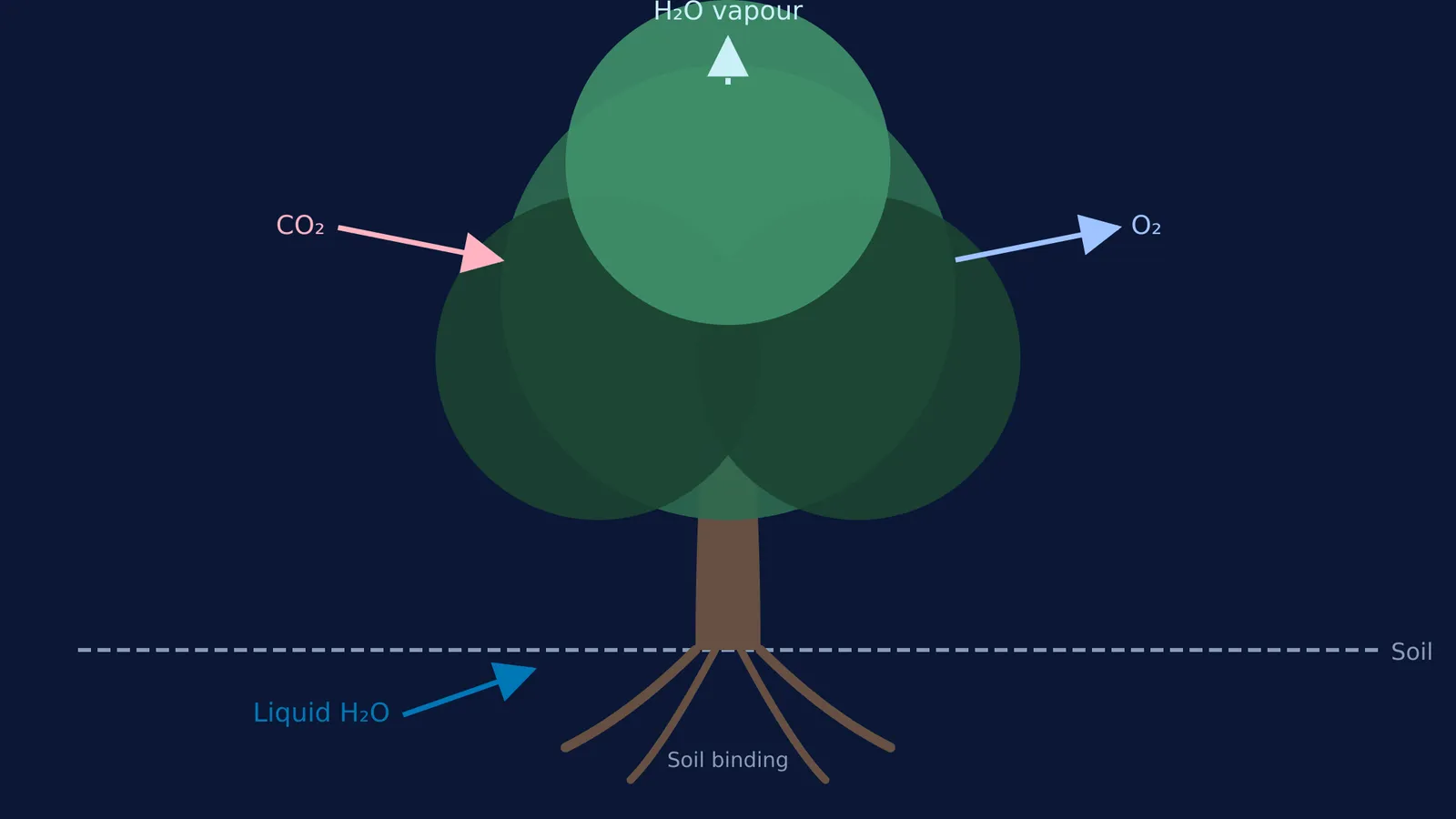
Soil binding: Tree roots hold the ground together, preventing erosion and landslides. If you are learning about The role of decomposers in an ecosystem, you will know that leaf litter also maintains soil fertility and organic carbon.
Water regulation: Through a process called evapotranspiration, trees absorb liquid water through their roots and release it as vapour from their leaves. This phase change consumes energy and acts as a local heat pump, cooling the climate and increasing rainfall. This means that a healthy forest does not just use water; it acts as a crucial part of the global water cycle, ensuring that agricultural lands hundreds of miles away receive the rain they need to survive.
Why are ecosystem services hard to price?
While the timber from a forest has a clear market price, services like oxygen production and carbon storage are "public goods". Because they are historically abundant and lack clear ownership, they are often treated as free.
When a farmer maintains a forest on their land, the local community benefits from cleaner water and a more stable climate. However, the farmer is rarely paid for providing these regulating services. This creates an incentive gap: the financial reward for cutting down trees to sell timber or clear land for agriculture is immediate, while the cost of losing the ecosystem services is borne by society as a whole over decades.
The Intergovernmental Science-Policy Platform on Biodiversity and Ecosystem Services (IPBES) notes that ecosystems are complex, interrelated systems. The loss of a single habitat can lead to unexpected consequences, like the Amazon rainforest tipping point, where the forest loses its ability to recycle its own rain. Furthermore, the cultural and spiritual values that many communities attach to forests cannot be captured by a dollar figure. Without clear, standardised metrics, financial markets struggle to price the long-term risk of losing these natural assets.
How to revise ecosystem services for exams?
Ecology is heavily weighted in biology exams because it tests your ability to see the bigger picture. Instead of memorising a list of facts, you should focus on the cause-and-effect relationships within an ecosystem. Start by looking at Eugene Odum's Fundamentals of Ecology: Ecosystems and energy flow to see how regulating and supporting services connect.
When you need to revise topics like evapotranspiration or the carbon cycle, the Fermi Concept Library has every concept in physics, chemistry, biology, mathematics and computing, each with its own lesson and its place in the map. It helps to understand the underlying mechanisms—for example, how stomata on a leaf manage gas exchange and water loss simultaneously.
Questions on ecology often ask you to link a biological process to a wider environmental impact. Try mapping out a diagram of a tree, labelling the inputs (carbon dioxide, water) and the outputs (oxygen, water vapour). Connecting these biological processes to their real-world impact makes the concepts much easier to remember. If you can explain how a tree acts as a water pump and a carbon sink, you will be well prepared for any long-answer question on the topic.


