

On this page
If nothing happened to the leaves that fall every autumn, forests would quickly be buried under kilometres of dead wood. The earth avoids becoming a massive dumping ground thanks to decomposers, which act as nature's cleanup crew.
In Class 10 Biology (Our Environment), you learn how energy flows and how matter cycles through a food web. While energy from the sun is eventually lost as heat, matter is recycled infinitely. Decomposers are the reason this recycling works.
What are decomposers in an ecosystem?
Decomposers are microorganisms, mainly bacteria and fungi, that feed on dead and decaying organic matter (detritus).
Unlike animals, they do not ingest their food. Instead, they secrete digestive enzymes outside their bodies to break down complex organic compounds—like the carbohydrates in dead plants and the proteins in animal bodies. They then absorb the simple nutrients they need to survive.
While scavengers (like vultures or hyenas) eat dead animals, decomposers work at the microscopic level, completing the final step of the food chain. They ensure that the chemical elements locked inside a dead organism are not lost forever.
What is the role of decomposers in an ecosystem?
When you are asked about the role of decomposers in ecosystem Class 10 exams, you are expected to list their main functions. Decomposers do more than just clean up; they keep the entire ecosystem running by driving the biogeochemical cycles.
Here is the checklist of their main roles:
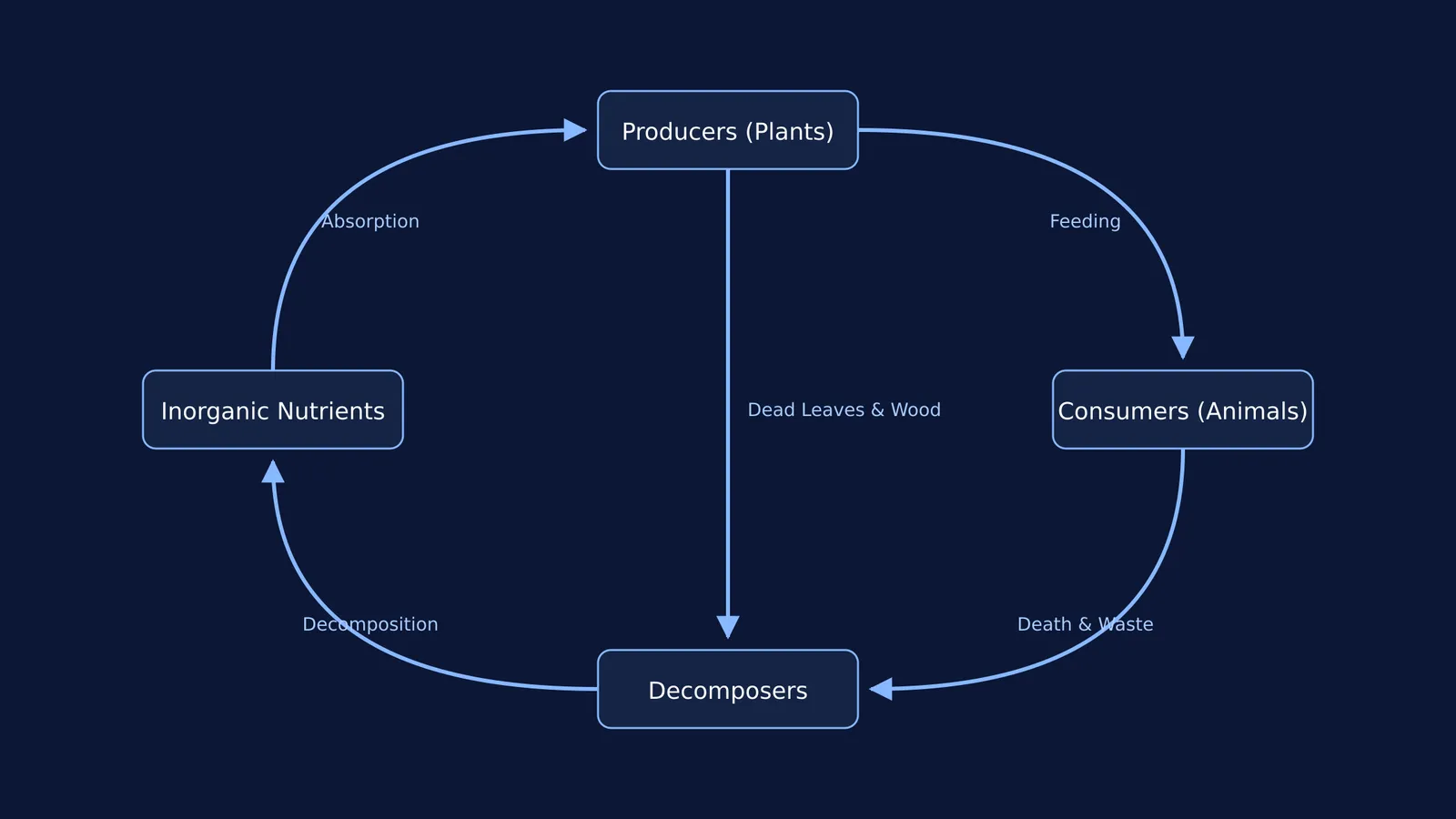
Recycling nutrients: Decomposers return essential elements like carbon, nitrogen, and phosphorus to the soil, water, and air. Without this constant supply, producers (plants) would run out of the raw materials they need to grow.
Processing carbon: Globally, the decomposition of organic matter by soil microbes releases roughly 49 gigatons of carbon back into the atmosphere each year (He et al., 2022, Global Change Biology). This makes them a massive part of the Earth's carbon cycle.
Cleaning the environment: By breaking down dead bodies, fallen leaves, and organic waste, they prevent the accumulation of garbage and stop the spread of diseases.
Maintaining soil fertility: The nutrients they release eventually form humus, a dark organic material that makes the soil fertile and helps it retain water for new life.
How do decomposers actually break down matter?
While Class 10 textbooks keep it brief, the process of decomposition involves several overlapping steps.
When a leaf falls to the ground, detritivores like earthworms first break it into smaller physical fragments. This increases the surface area, making it easier for microbes to do their job.
Once the matter is fragmented, bacteria and fungi take over. Because they cannot physically "eat" the wood or leaf, they secrete powerful digestive enzymes directly onto it. These enzymes break down complex carbohydrates, such as the cellulose in plant cell walls, into simple sugars. They also break down proteins into amino acids.
The microbes then absorb what they need for their own cellular respiration. Whatever is left over—the simple inorganic ions like nitrates, phosphates, and sulfates—seeps into the soil. This final step is called mineralisation, and it is what makes the soil rich enough to support a forest.
What would happen if there were no decomposers?
If decomposers disappeared, the nutrient cycle would stop completely. Dead plants and animal bodies would pile up indefinitely, trapping all the earth's carbon and nitrogen inside them.
Soon, the soil would run out of inorganic nutrients. Plants would not be able to grow, and without plants (the producers), the herbivores and carnivores that depend on them would follow. The entire food web would collapse from the bottom up.
This is why understanding decomposers helps you understand the broader rules of biology. Whether you are studying how plants bend toward light (phototropism and plant growth) or how different animals process their metabolic waste (like ammonotelic, ureotelic and uricotelic animals), everything traces back to the available nutrients in the environment.
If you are struggling to remember the exact phrasing or how the nutrient cycle connects to these other topics, the Fermi Concept Library has every concept in biology mapped out. Fermi works out what you already know and builds a plan for the session, teaching you the connections rather than just handing you a list to memorise.
How do you write the perfect 3-point board answer?
If a board exam question asks you to explain the role of decomposers, you need to hit the specific keywords examiners look for. Write these three points exactly:
They break down dead matter: Decomposers convert complex organic substances found in dead plants and animals into simple inorganic substances.
They recycle nutrients: These simple inorganic substances return to the soil and are used again by producers (plants) to synthesise food.
They clean the environment: By continuously breaking down biological waste, they prevent the earth from becoming a massive dumping ground.


