On this page
When Brazilian meteorologist Carlos Nobre began studying the Amazon basin at Brazil's National Institute for Space Research (INPE) after his doctorate at the Massachusetts Institute of Technology, climate models treated forests as passive terrain. Weather delivered rain, and trees merely absorbed it. Nobre asked an entirely different question: what if the rainforest manufactures its own climate, and what happens to continental weather when human clearing destroys that biological engine?
Over four decades of field measurements and climate simulations, Nobre proved that the Amazon functions as a continental heat-and-moisture pump. His research showed that clearing even a fraction of the forest could trigger "savannization"—the irreversible collapse of lush evergreen canopy into dry, fire-prone savanna.
How does the Amazon produce its own rainfall?
In 1979, an isotopic study led by Brazilian agronomist and climatologist Enéas Salati in Water Resources Research revealed that rainfall across the Amazon interior showed an extraordinarily small inland gradient of heavy oxygen-18 isotopes. If moisture blew in solely from the Atlantic Ocean, rainwater would turn lighter as vapour condensed inland. The only physical explanation was that moisture re-evaporated and rained out repeatedly as air masses moved west toward the Andes.
Nobre built upon this discovery to map the biotic pump. A single large Amazonian tree transpires up to 1,000 litres of water vapour daily through leaf stomata, as detailed in research synthesised in Science Advances. Across the basin, hundreds of billions of trees pump an estimated 20 billion tonnes of water into the air each day—exceeding the daily discharge of the Amazon River itself into the Atlantic.
These aerial vapour corridors, known colloquially as "flying rivers" (*rios voadores*), transport water southward to nourish rainfall across southern Brazil, Paraguay, Uruguay, and northern Argentina. As Lovejoy and Nobre documented in Science Advances, roughly 50% of the precipitation falling over the Amazon basin is generated by this internal biological recycling. This feedback loop illustrates what Vladimir Vernadsky recognized a century ago: living systems actively shape and regulate the planetary atmosphere.
What is the Amazon rainforest tipping point?
In 1991, Carlos Nobre joined atmospheric scientist Jagadish Shukla and Piers Sellers in the Journal of Climate004<0957:ADARCC>2.0.CO;2) to simulate replacing Amazonian forests with pasture. Their coupled general circulation model predicted an immediate 2.5 °C regional warming, a 25% to 30% reduction in annual precipitation, and an extended dry season. It provided the first quantitative physical proof of savannization.
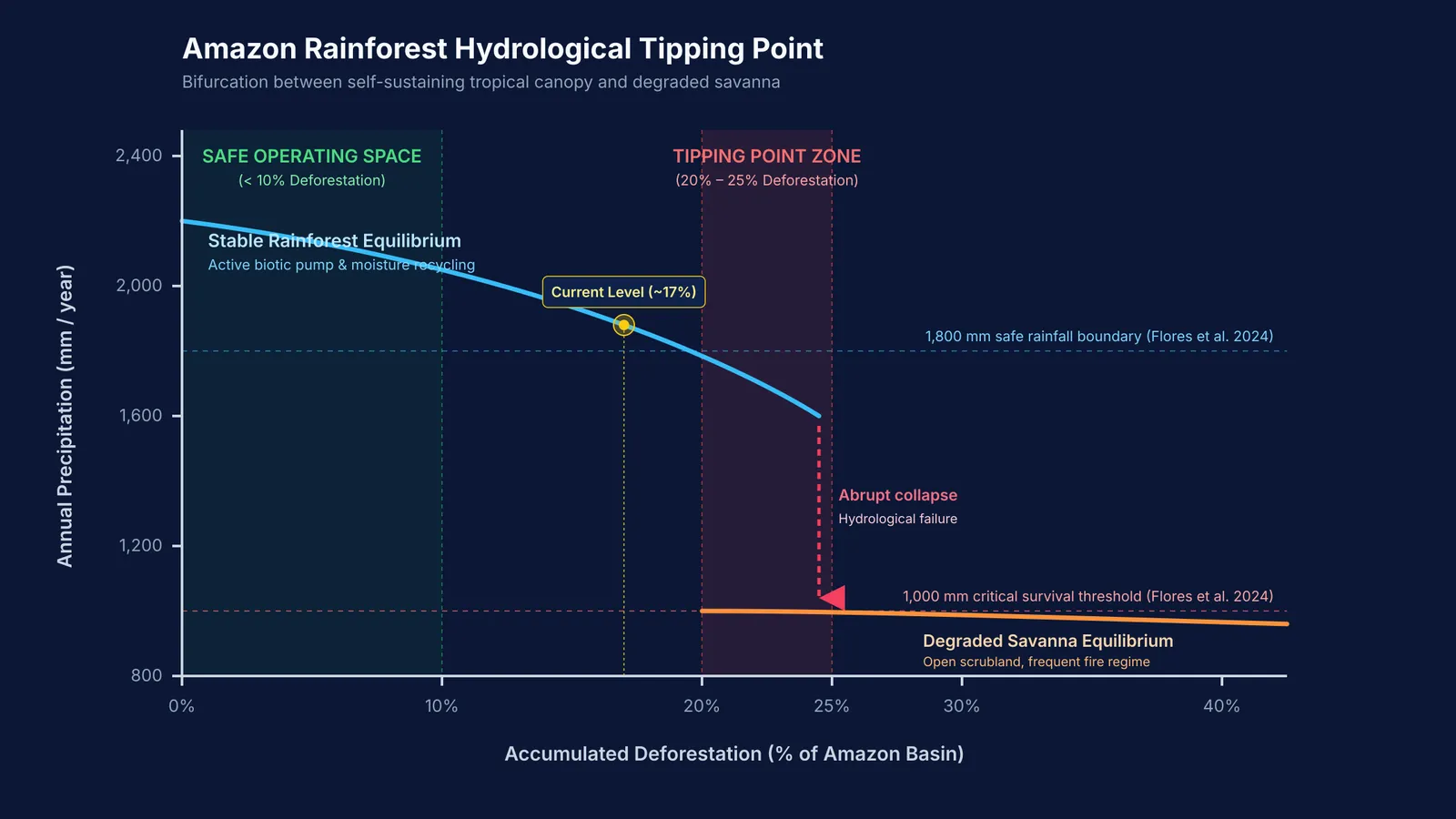
By 2018 and 2019, writing with conservation biologist Thomas Lovejoy in Science Advances, Nobre warned that the forest did not need total clearance to collapse. Instead, the critical tipping point sits at just 20% to 25% accumulated basin-wide deforestation.
This vulnerability stems from three compounding forces:
Deforestation directly halts local evapotranspiration.
Global warming increases atmospheric vapour pressure deficit, drying out surviving vegetation.
Agricultural fires penetrate drought-stressed edges, killing trees that lack fire defenses.
A 2024 assessment in Nature, co-authored by Nobre, projected that by 2050, between 10% and 47% of Amazonian forests will face compounding disturbances. The study established 10% deforestation as the safe boundary, with 20% to 25% marking the critical threshold where local forest loss cascades into biome-scale collapse.
What happens if the 20% to 25% threshold is crossed?
Ecosystems do not decline along a simple linear slope. As British botanist Arthur Tansley observed when introducing the ecosystem concept, natural assemblages maintain dynamic equilibrium until external stress pushes them across a stability boundary.
When accumulated clearing breaches 20% to 25%, annual rainfall drops toward the critical 1,000 mm threshold identified in Nature. If dry seasons expand into the 5- to 8-month bistability zone, tall evergreen trees suffer runaway hydraulic cavitation—air bubbles break sap columns inside xylem vessels, triggering canopy dieback.
As the canopy thins, direct sunlight bakes the forest floor. Pasture grasses invade cleared margins, and frequent surface fires prevent sapling regeneration. The ecosystem shifts into an open degraded savanna, releasing up to 150 billion tonnes of stored carbon, as documented in Nature, and permanently disrupting continental rainfall patterns.
How can students analyze feedback loops in ecosystems?
To understand how complex ecosystems collapse, students can model moisture recycling through a simple feedback multiplier based on hydrological balances in Science Advances and Nature.
Let annual precipitation P depend on incoming oceanic moisture P_ocean and an internal recycling fraction r:
P = P_ocean / (1 − r)
Suppose trade winds carry P_ocean = 1,000 mm/year into the basin:
Intact rainforest (r = 0.50): P = 1,000 / (1 − 0.50) = 2,000 mm/year. Total rainfall exceeds the 1,800 mm safe boundary required for evergreen canopy resilience.
Deforested canopy (r = 0.25): If deforestation halves the recycling fraction to 0.25, rainfall drops to P = 1,000 / (1 − 0.25) ≈ 1,333 mm/year.
Cutting the biological recycling fraction in half removes 667 mm of annual rainfall, pushing the regional climate toward the 1,000 mm threshold where evergreen rainforest cannot survive.
To explore how nonlinear feedbacks operate across biological systems, you can test interactive models in the Fermi Simulation Lab, which provides interactive simulations for the ideas that are easier to see than to read. When reviewing ecology, thermodynamics, or chemical cycles, the Fermi Concept Library covers every concept in physics, chemistry, biology, mathematics and computing, each with its own lesson and its place in the map. For step-by-step guidance on conservation laws and equilibrium calculations, the Fermi Problem Library has worked problems with a step-by-step solver that explains the reasoning rather than printing an answer.