

On this page
The Amazon rainforest is often the first example that comes to mind when we think about the incredible variety of life on Earth. In the biology curriculum, it serves as the ultimate case study for biodiversity and the urgent need for conservation.
Why is it called the "lungs of the planet"?
The Amazon is so massive that it is estimated to produce 20% of the total oxygen in the Earth's atmosphere through photosynthesis [[1]](https://ncert.nic.in/textbook/pdf/lebo115.pdf). Because of this vital, life-sustaining ecosystem service, it is popularly referred to as the "lungs of the planet".
While the exact net oxygen contribution of any mature forest is complex—since the plants and soil organisms also consume oxygen through respiration—the sheer scale of the Amazon's photosynthesis makes it a crucial regulator of our global climate. This immense oxygen output is often cited as a "broadly utilitarian" argument for conservation: we cannot easily put a price tag on the oxygen we breathe, but our survival depends on the ecosystems that produce it.
How much biodiversity does the Amazon hold?
The Amazon rainforest is the most biodiverse terrestrial region on Earth. When preparing for board exams or medical entrances, you will need to know exactly how many species are harboured within its borders.
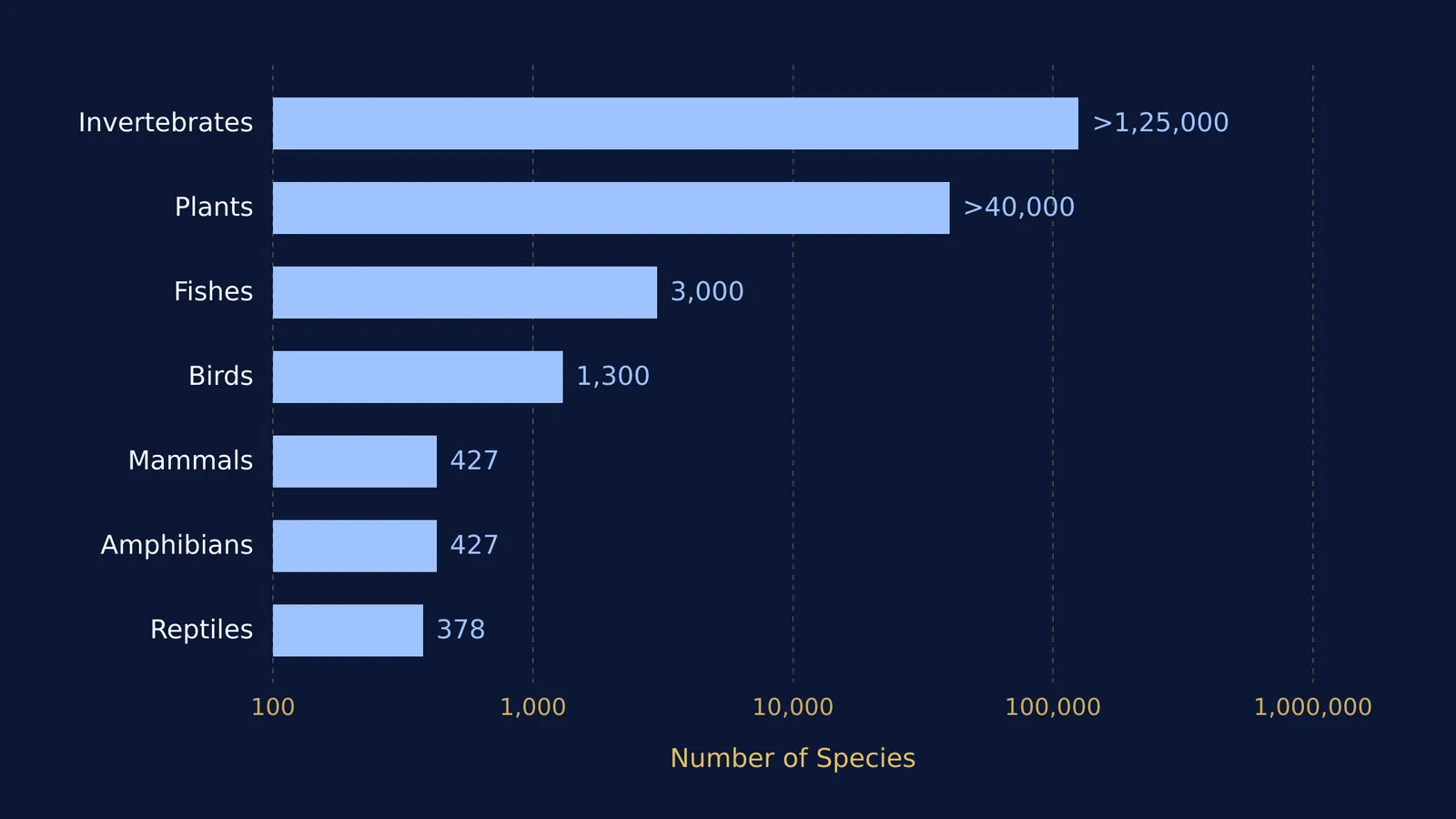
According to the official species counts [[1]](https://ncert.nic.in/textbook/pdf/lebo115.pdf), the Amazon is home to:
Plants: More than 40,000 species
Fishes: 3,000 species
Birds: 1,300 species
Mammals: 427 species
Amphibians: 427 species
Reptiles: 378 species
Invertebrates: More than 1,25,000 species
In addition to these known numbers, scientists estimate that there might be at least two million insect species waiting to be discovered and named in these forests. You can read more about how scientists map these numbers in our guide to Biodiversity and conservation: species-area sums and key facts.
Why is the Amazon rainforest being cleared?
Despite its immense ecological value, the Amazon is a prime example of rapid habitat loss—the most significant cause driving animals and plants to extinction. Tropical rainforests once covered more than 14% of the Earth's land surface, but today they cover no more than 6% [[1]](https://ncert.nic.in/textbook/pdf/lebo115.pdf).
The Amazon is being cut and cleared primarily for agriculture. Specifically, vast tracts of the forest are cleared for cultivating soya beans or converted into grasslands for raising beef cattle. When a continuous habitat is broken into small fragments by such human activities, mammals and birds requiring large territories are badly affected, leading to population declines. (You can explore the history of how we understand these ecosystems in our post on E. O. Wilson, island experiments and the word biodiversity.)
A quick framework for conservation arguments
When answering exam questions on why we should conserve biodiversity, use this three-part framework to structure your points:
Narrowly utilitarian: List the direct economic benefits. Mention food (cereals, pulses), firewood, fibre, construction materials, and medicinal products (like plant-derived drugs).
Broadly utilitarian: List the ecosystem services. Use the Amazon rainforest's 20% oxygen contribution [[1]](https://ncert.nic.in/textbook/pdf/lebo115.pdf) as your main example. Add pollination by bees and birds, and the aesthetic pleasure of nature.
Ethical: State the moral argument. Emphasise that every species has an intrinsic value, and we have a philosophical duty to pass on our biological legacy in good order to future generations.
If you need help breaking down these arguments or memorising the exact species counts, you can explore related topics in the Fermi Concept Library, or ask Fermi's AI tutor to quiz you. The tutor can work out what you already know and build a plan for the session, helping you master the facts you need for your exams.


