

On this page
NCERT's biodiversity chapter says the word was "popularised by the sociobiologist Edward Wilson". It is a single line, but behind it is a remarkably direct experiment in ecology and an equation that turns up in NEET questions. This post covers Wilson's island work, where the word biodiversity actually came from and how to calculate with the species-area relationship.
Who was E. O. Wilson?
Edward Osborne Wilson was born on 10 June 1929 and died on 26 December 2021, according to his Who Was Who entry. The same record lists him as Curator in Entomology at Harvard University from 1972 to 1997 and then Pellegrino University Research Professor. He was a specialist in insects, and the ecology ideas in this post came from his work on islands.
What is the theory of island biogeography?
In An equilibrium theory of insular zoogeography (1963), Robert MacArthur and Wilson proposed that the number of species on an island is a balance. New species arrive from the mainland, and species already there go extinct. Arrivals slow as the island fills up, and extinctions rise. Where the two rates meet, the species count settles, even though the species themselves keep changing.
How did Wilson test it?
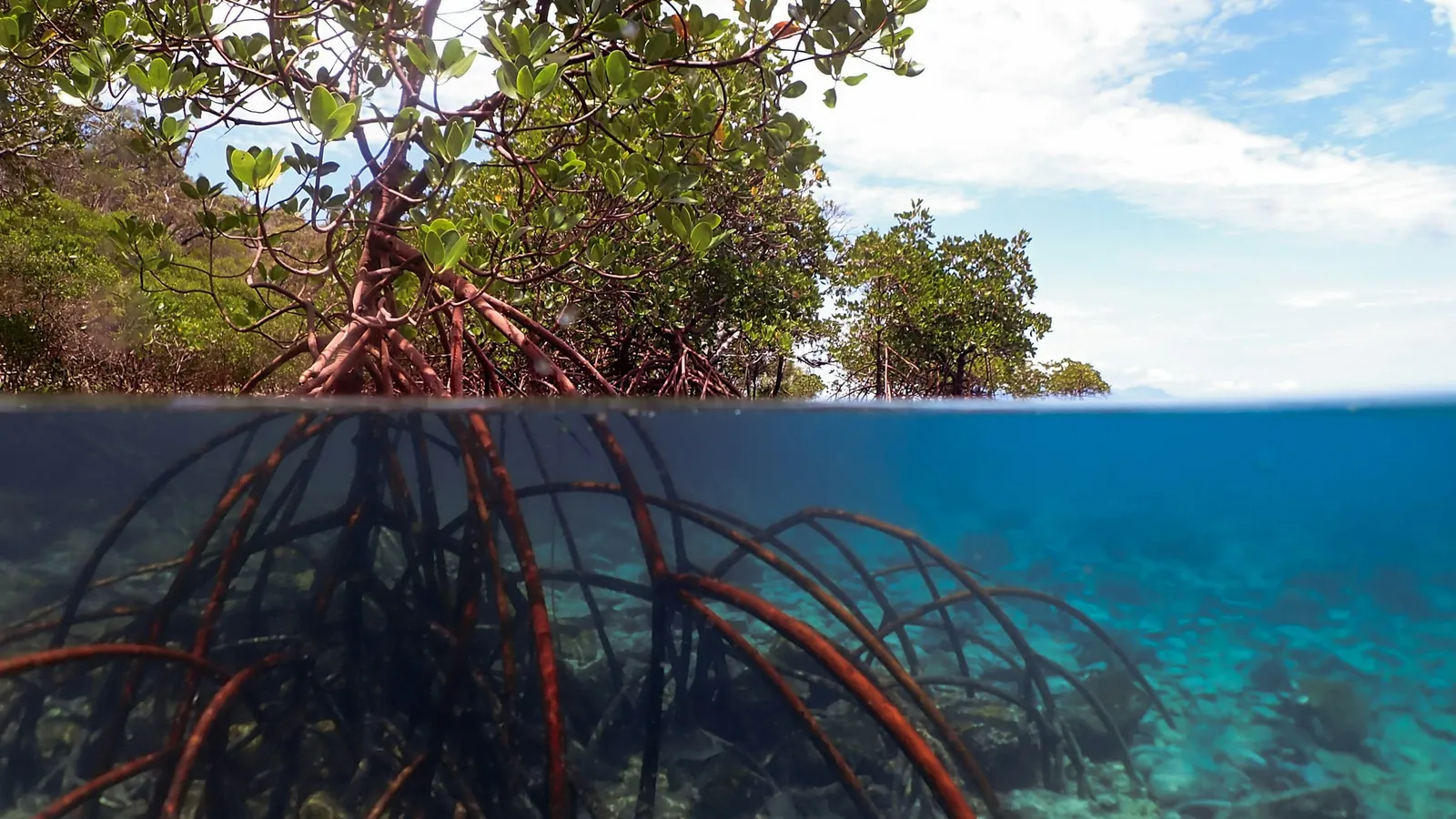
With Daniel Simberloff, Wilson ran the test described in Experimental zoogeography of islands (1969). They chose six small mangrove islands in Florida Bay, removed every insect and other arthropod by fumigating them with methyl bromide, and then recorded which species came back over a year.
Their abstract reports that by 250 days after clearing, all the islands except the most distant had regained species numbers and composition similar to untreated islands, though populations were still small. Ants, the dominant animals on mangrove islands, were among the last to arrive. Species kept turning over, with most observed rates between 0.05 and 0.50 species per day. They concluded that "a dynamic equilibrium number of species exists for any island".
Did Wilson invent the word biodiversity?
Not quite. The term spread through the National Forum on BioDiversity, held in Washington, D.C., on 21 to 25 September 1986. Wilson edited the papers from it as the 1988 book BioDiversity, published by the National Academy Press. In its acknowledgements, the book credits Walter G. Rosen of the National Research Council, who conceived the forum: "he introduced the term biodiversity". So Rosen introduced the word, and Wilson's book carried it to a wide audience, which matches NCERT's word "popularised".
Worked example: the species-area equation
The NCERT Class 12 biodiversity chapter gives the relationship as log S = log C + Z log A, where S is the number of species, A is area, C is a constant and Z is the slope. It says Z usually lies between 0.1 and 0.2, and is much steeper, 0.6 to 1.2, when whole continents are compared.
The equation is the same as S = C x A^Z. To compare two areas, divide, and C cancels: S2 / S1 = (A2 / A1)^Z.
A forest loses 90% of its area, Z = 0.2. A2 / A1 = 0.1. S2 / S1 = 0.1^0.2 = 0.63. The remaining forest is expected to support about 63% of the original species, so about 37% are lost.
Same loss, Z = 0.1. 0.1^0.1 = 0.79, so about 21% are lost.
Area halved, Z = 0.2. 0.5^0.2 = 0.87, about 13% lost.
To get 0.1^0.2 without a calculator, use logs: log(0.1^0.2) = 0.2 x (-1) = -0.2, and the antilog of -0.2 is about 0.63.
Common mistakes:
Treating Z as a percentage. Z is an exponent. Halving the area does not halve the species.
Using the continental Z for a local patch. NCERT gives separate ranges for the two scales.
Assuming species vanish at once. The equation gives the number an area can support. It does not say how quickly the others disappear.
Our guide to biodiversity and conservation for NEET covers the rest of the chapter, and our profile of Alexander von Humboldt tells the story of the explorer NCERT credits with first noticing the species-area pattern.
What can a student take from his way of working?
Think in rates. The equilibrium theory turned a vague idea about islands into arrival and extinction rates you can measure.
Turn a model into an experiment. Emptying islands tested a prediction no field survey could.
Work with others. Both the theory and its test came from partnerships.
Bring research to the public. His edited book took a technical forum to a wide audience.
Practising log problems
Species-area questions are really log and power questions. The Fermi Problem Library has worked problems with a step-by-step solver that explains the reasoning rather than printing an answer, which helps when the exponent step goes wrong.
Try it now: with Z = 0.15, work out what fraction of species an island keeps if its area falls to a quarter.


