

On this page
When revising the final chapters of NEET biology, the difference between conserving an ecosystem and saving an individual species is a reliable exam question. Both approaches stop extinctions, but they work in opposite ways.
Here is the difference between *in situ* and *ex situ* conservation, with the key examples you need for your exams.
What is in situ conservation?
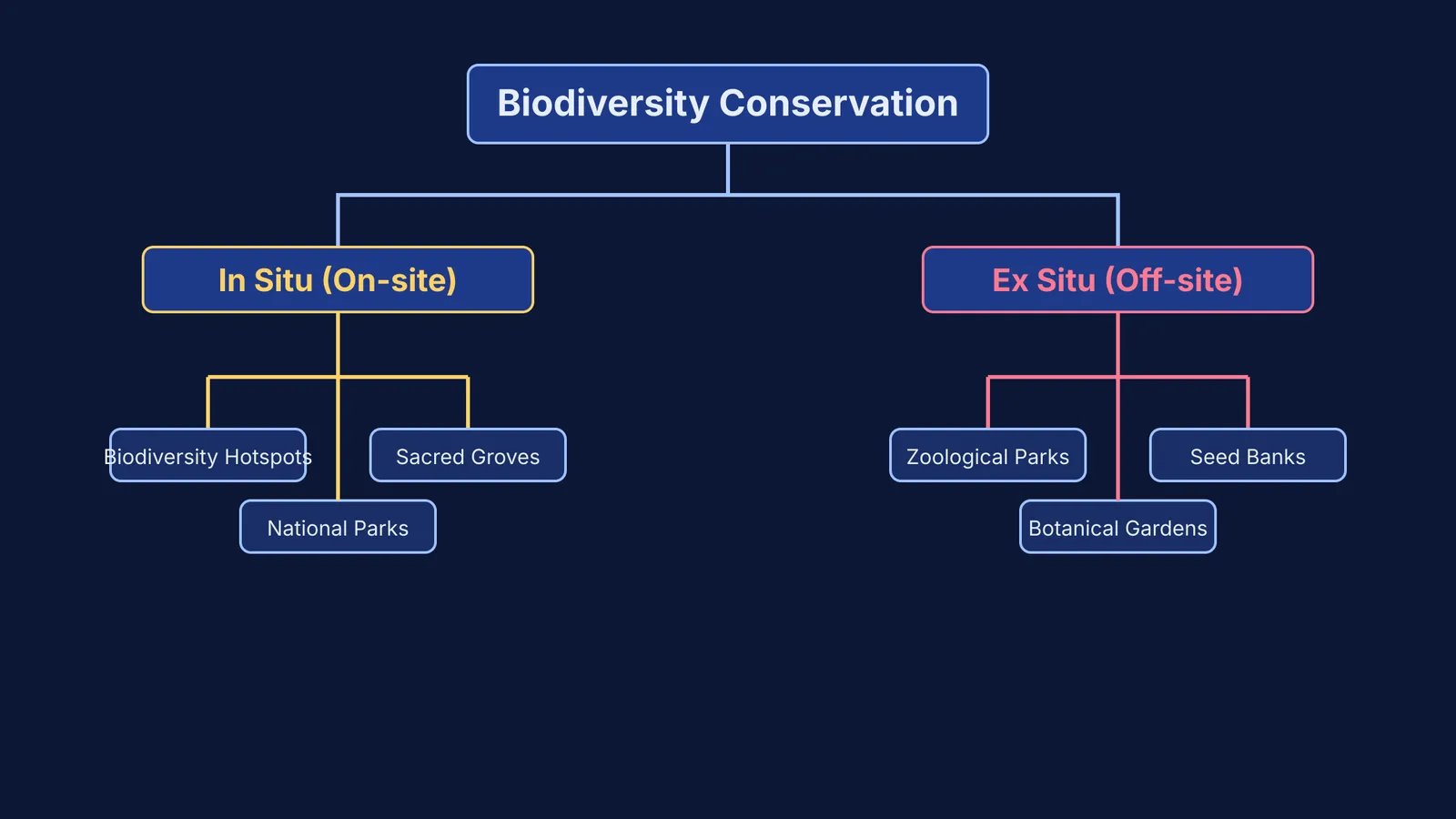
*In situ* (on-site) conservation means protecting the entire ecosystem where the plant or animal naturally lives. Instead of removing the endangered species, the government or community protects the forest, ocean or mountain range around it.
This allows species to evolve naturally (through processes like stabilising, directional and disruptive selection) and share their habitat with countless other known and unknown organisms.
Key examples include:
Biodiversity hotspots: Regions with extremely high species richness and endemism (species found nowhere else). Globally, 34 biodiversity hotspots have been identified, including the Western Ghats and the Himalayas. Strict protection of these hotspots could reduce ongoing mass extinctions by almost 30 percent.
National Parks and Wildlife Sanctuaries: State-protected areas where human activity is strictly limited. India currently has 106 National Parks and 567 Wildlife Sanctuaries.
Sacred groves: Forest fragments protected by local communities due to religious beliefs. These are often the last refuge for rare and threatened plants in heavily farmed regions, such as the Khasi and Jaintia Hills of Meghalaya.
What is ex situ conservation?
*Ex situ* (off-site) conservation involves taking a threatened animal or plant out of its natural habitat and placing it in a special setting where it can be protected and given special care. This is often the last resort when a species is too vulnerable to survive in the wild.
By moving the species to a controlled environment, biologists can manage breeding programmes, treat diseases and prevent poaching. If you find yourself confusing ecosystem definitions, the Fermi Concept Library maps out these biological terms so you can see exactly where they branch off.
Key examples include:
Zoological parks (Zoos) and Safari parks: Where animals are kept in enclosures for public education and conservation breeding. Many animals that have gone extinct in the wild continue to survive in zoological parks.
Botanical gardens: Live collections of wild and cultivated plants, used to preserve rare species and provide seeds for research.
Seed banks: Facilities that store seeds of different genetic strains of commercially important plants. India's National Gene Bank is among the largest globally, storing vast collections of accessions safely.
How does cryopreservation work?
In recent years, *ex situ* conservation has moved beyond keeping whole plants or animals alive. Scientists now preserve the microscopic building blocks of life.
Using cryopreservation, gametes (sperm and eggs) of threatened species are preserved in viable conditions at extremely low temperatures, typically in liquid nitrogen at –196°C. This means the genetic material can be kept frozen for decades and later fertilised in a laboratory.
Similarly, plants can be propagated using tissue culture methods—an artificial contrast to natural cloning like apomixis and polyembryony—allowing conservationists to grow identical genetic copies from a tiny sample of cells.
In situ vs ex situ conservation examples
To keep your definitions clear, use this breakdown when reviewing previous year problems in the Fermi Problem Library, where the step-by-step solver explains the underlying reasoning.
The habitat: *In situ* protects the whole natural habitat (e.g., a Biosphere Reserve). *Ex situ* uses an artificial or managed habitat (e.g., a Botanical Garden).
The scale: *In situ* saves entire webs of species at once, including insects and fungi. *Ex situ* focuses on specific target species (e.g., freezing a specific tiger's cells).
The cost: Protecting a vast national park takes significant political will and land, but managing an *ex situ* cryopreservation lab or zoo requires constant funding, electricity and daily human care.
Both strategies are essential. *In situ* conservation protects the web of life as it exists today, while *ex situ* acts as an insurance policy for tomorrow.


