On this page
Last night's rice comes out of the fridge as a firm, dry block. Nothing has gone wrong: you are looking at a well-studied piece of starch chemistry called retrogradation, and the same chemistry tells you how to undo it.
What happens to starch when rice cooks?
Rice is mostly starch, made of two glucose-based molecules: amylose, a long straight chain, and amylopectin, a bushy branched one. In a raw grain these chains are packed into tight, partly ordered granules.
Cooking pulls that packing apart. A 2023 study of rice from Assam and Karnataka, published in Gels, describes gelatinisation as heating starch in water so the native granules break up in "an order-to-disorder transition".
Swollen, water-filled grains are what make fresh rice soft. For why starch behaves so differently from sugar in water, see our explainer on why glucose dissolves in water but starch does not.
Why does cooked rice become hard in the fridge?
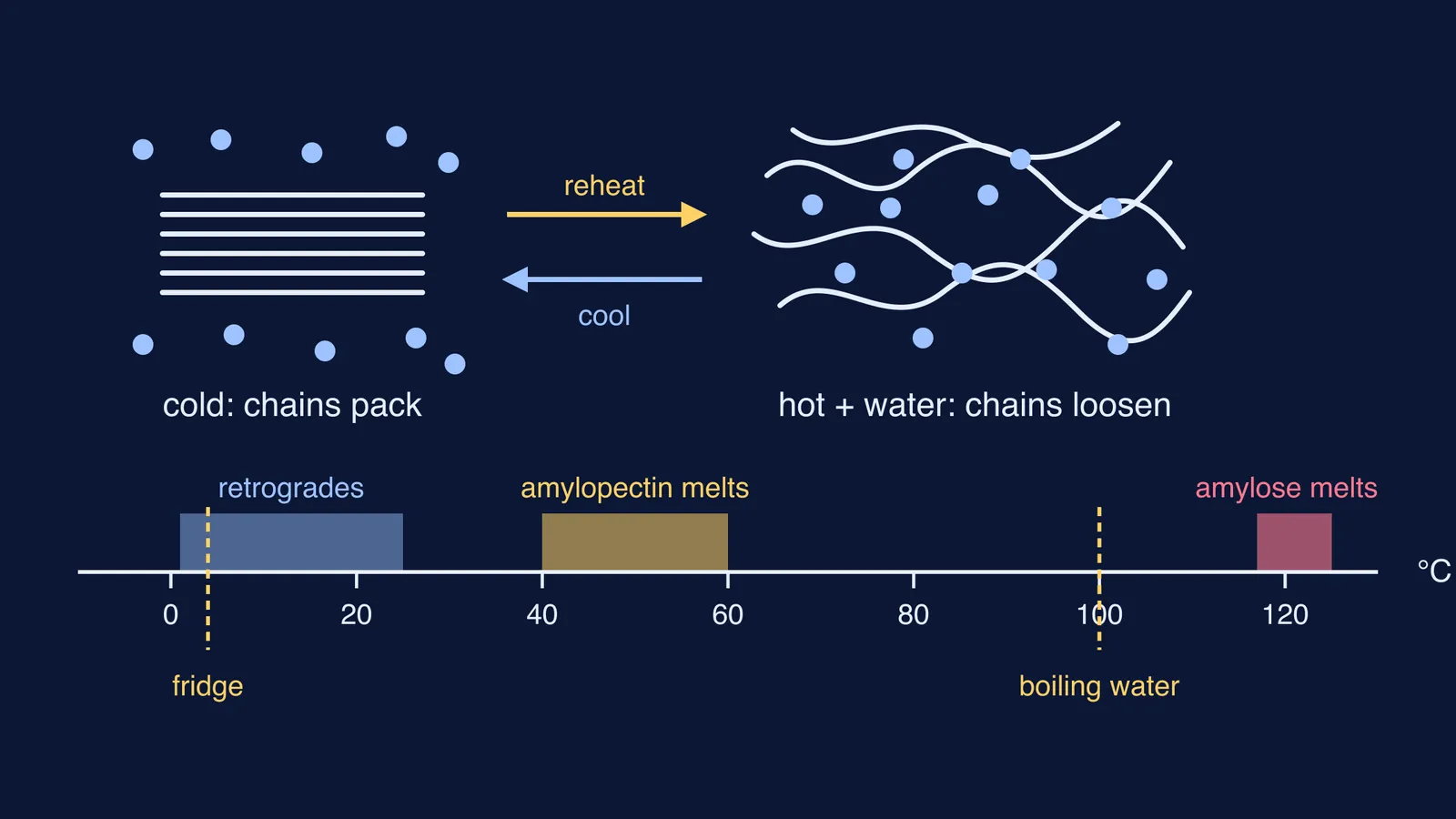
As cooked rice cools, the loosened chains find each other again. Starch retrogradation is the process in which amylose and amylopectin chains in gelatinised starch reassociate into more ordered structures, as defined in a review in Comprehensive Reviews in Food Science and Food Safety.
Picture the chains lining up side by side, held by hydrogen bonds. Tightly packed chains leave less room for water, so the grain firms up and water is pushed out. The authors of the Gels study explain that strong bonds between amylose chains "cause more water to expel from the starch gel (syneresis)" at lower temperatures. They found retrogradation increased the longer rice was stored (12 hours against 6) and the colder it was kept (−20 °C against 4 °C).
A 2015 study in the Asia Pacific Journal of Clinical Nutrition notes that retrogradation is optimal at 1–25 °C, which takes in fridge temperatures. Its authors put the result plainly: "cooling of cooked rice at low temperature tends to harden the rice and reheating is necessary to soften it."
Rice type matters too: the Gels paper notes that retrogradation is favoured by amylose. Our post on why some rice is sticky and basmati is not explains how amylose differs between rice types.
Why does sprinkling water and reheating soften rice again?
The ordered regions that form in the fridge are not all equally strong. The 2015 rice study, citing earlier work, gives two ranges: retrograded amylopectin "changes back" at 40–60 °C, while retrograded amylose is heat stable up to 117–125 °C.
So when you heat rice until it is steaming hot, you pass the amylopectin range easily, the branched chains let go, and the grains soften. The amylose regions survive, because rice heated with water stays at or below about 100 °C. That helps explain why reheated rice is soft again but not quite the same as fresh.
Water matters because gelatinisation needs water as well as heat. A splash turns to steam, helps heat the grains evenly and gives the loosened chains water to take back up. In the 2015 study, researchers reheated a rice-cooker batch (cooked from 4 cups of raw rice) with 240 mL of added water, a method chosen by trial and error to match the texture of freshly cooked rice.
How do you soften leftover rice safely?
This five-step plan follows the chemistry above and the rice safety advice from Food Standards Scotland.
Cool cooked rice quickly, ideally within 1 hour, taking it out of the hot pan or cooker so it cools faster.
Keep it in the fridge for no longer than 24 hours before eating.
Break up the block with a fork and sprinkle on a little water, enough to dampen the grains but not to pool.
Cover the pan or bowl so the steam stays in, and heat until the rice is steaming hot all the way through, well past 40–60 °C.
Eat it then: the agency says never to reheat rice more than once.
The safety steps matter because raw rice can carry spores of *Bacillus cereus* that survive cooking; if cooked rice is left at room temperature, the bacteria can make a toxin that causes food poisoning, the same page explains.
How do you explain this in an exam answer?
Three points cover it:
Cooking gelatinises starch: heat and water break up the ordered granules and the chains take up water, so rice is soft.
On cooling, especially in a fridge, amylose and amylopectin chains realign through hydrogen bonds and push water out. This retrogradation makes the grains hard.
Reheating with a little water melts the amylopectin regions and lets the chains take up water again, so the rice softens.
If chain diagrams in your textbook still feel abstract, the Fermi Concept Library has a lesson for every concept in chemistry and biology, each with its place in the map, so you can see how carbohydrates connect to hydrogen bonding.