

On this page
Cook a pot of basmati and a pot of sticky rice the same way and you get two different foods: long grains that fall apart on the plate, and a soft clump you can pick up with your fingers. Both grains are mostly starch. The difference is which starch they carry, and what hot water does to it.
What makes rice sticky?
Starch is built from two molecules made of the same glucose units. A 2024 review in Food Chemistry: X gives the definitions:
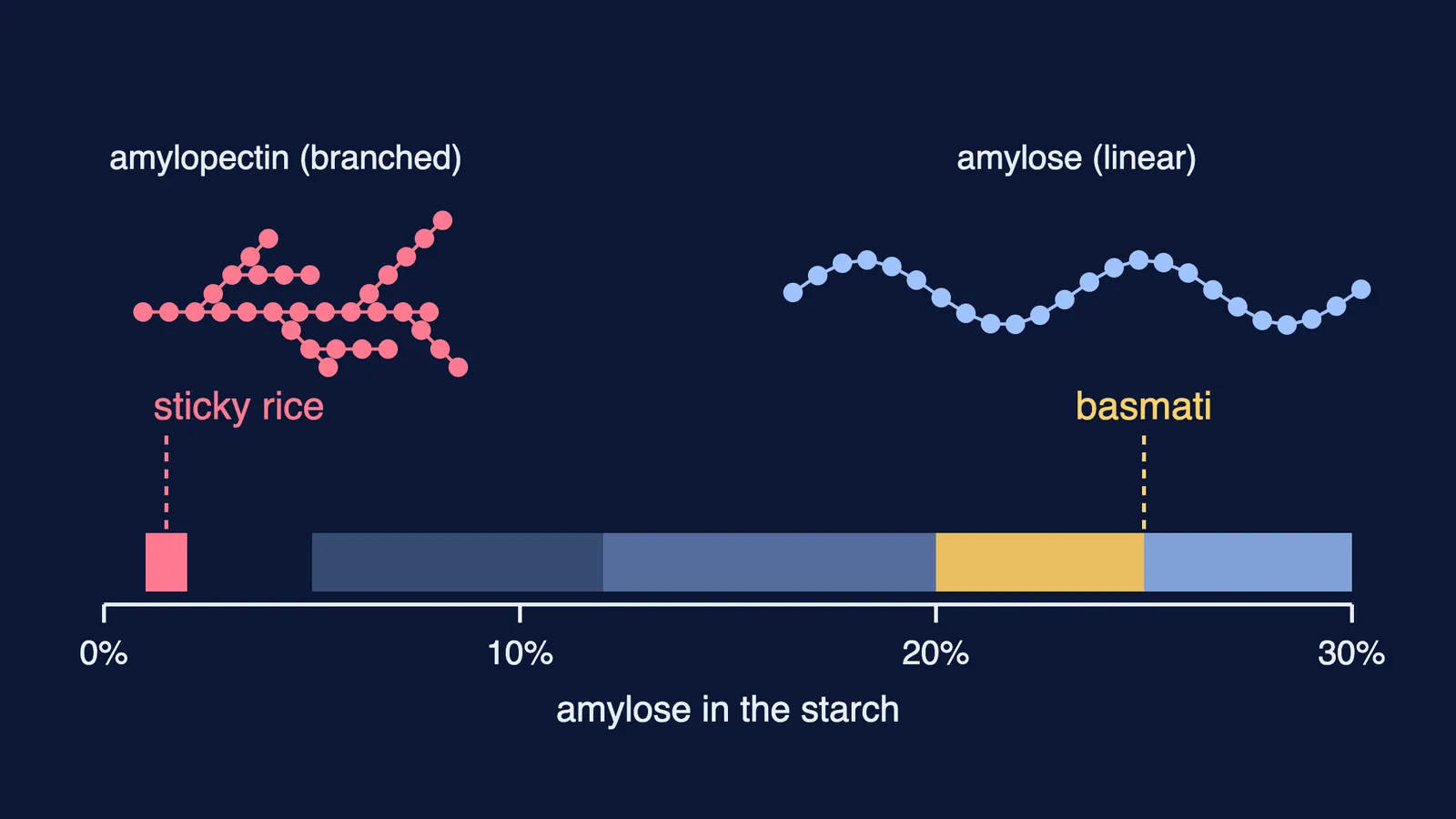
Amylose is a linear chain of glucose units joined by α-1,4 glycosidic bonds.
Amylopectin has the same α-1,4 chains plus periodic α-1,6 links, so it branches like a tree.
Rice scientists sort rice by how much of its starch is amylose. In a review of rice eating and cooking quality in Cereal Foods World, J. S. Bao of Zhejiang University lists the classes: waxy (1–2%), very low (5–12%), low (12–20%), intermediate (20–25%) and high (above 25%).
The same review gives the texture rule: cooked grains with high amylose are "dry, fluffy, separate, and hard", while those with low amylose are "glossy, soft, and sticky". Waxy rice, the sticky kind used in desserts and snacks, is almost all amylopectin. Intermediate-amylose rice "is soft but not sticky and is preferred by most consumers".
Why does sticky rice have so little amylose? One enzyme, granule-bound starch synthase (GBSS), makes amylose, and the Waxy (Wx) gene codes for it. Bao's review explains that in waxy rice a 23-base-pair duplication in this gene causes a premature stop signal and loss of the enzyme's function. No working enzyme, almost no amylose.
Where does basmati sit?
The FAO's Rice in human nutrition notes that intermediate-amylose rices were preferred in most countries, and that these include basmati rices.
A 2019 study in Scientific Reports measured its basmati parent at 25% amylose, which the authors call intermediate-high, with a high gelatinization temperature. Its grains grew from 6.38 mm milled to 14.47 mm cooked. The comparison variety, Pathum Thani 1, had 16% amylose and stretched far less, with an elongation ratio of 1.50 against basmati's 2.26.
At 25%, basmati sits on the line between Bao's intermediate and high classes, the range where cooked grains come out separate rather than sticky. Its smell is a separate story, which we cover in why basmati rice smells special.
What does cooking do to starch granules?
In a raw grain, starch sits in tight, partly crystalline granules. The Food Chemistry: X review describes what heat and water do. Water first enters the loosely packed amorphous regions, and amylose gradually leaches out. Above the gelatinization temperature, swelling breaks up the crystalline regions too, and the granules fall apart into a disordered gel. That change is called gelatinization.
Rice varieties differ in when it starts. Bao's review classes gelatinization temperature as low (below 70 °C), intermediate or high (above 74 °C), and notes that low-temperature rice needs less energy and less time to cook.
So the pot is doing chemistry. In basmati, about a quarter of the starch is straight amylose, and the grains cook firm and separate. In waxy rice, the starch is nearly all branched amylopectin, and the grains turn glossy, soft and sticky.
Why does leftover rice go hard in the fridge?
Cooling reverses part of the story. A 2021 study in Foods notes that in cooked rice, amylose molecules generally "reassociate rapidly and thus form a precipitate or gel upon cooling". This is retrogradation. The Food Chemistry: X review adds that short-term retrogradation comes mainly from amylose molecules aggregating, while the slower, long-term part, over days or weeks, comes from amylopectin.
This fits Bao's observation that high-amylose rice often becomes hard on cooling.
Try it: predict the texture in three questions
Before you cook any rice, ask:
How much amylose? Waxy means sticky; intermediate means soft but not sticky; high means dry and fluffy.
What gelatinization temperature? A high one means a longer cook.
Served hot or cooled? High-amylose rice tends to harden after a night in the fridge.
Then test it. Measure 10 raw grains of basmati with a ruler, cook them, and measure the same number of cooked grains. Divide the average cooked length by the average raw length. With the study's figures, 14.47 ÷ 6.38 gives about 2.3. Repeat with a short-grain or sticky rice and compare. Put some of each in the fridge overnight and press a grain between your fingers the next day.
These are the same two molecules you meet in school chemistry and biology. For why plants store energy this way at all, read why plants store starch, not glucose, and for the animal version, starch versus glycogen.
If α-1,4 and α-1,6 links still feel abstract, the Fermi Concept Library has a lesson for every concept in chemistry and biology, each with its place in the map. And if you are not sure where to start in carbohydrates, Fermi's AI tutor can work out what you already know and build a plan for the session.


