

On this page
Plants and animals both need a way to store glucose for later use, but they do it differently. While plants pack their energy into starch, animals and fungi rely on glycogen.
Both are polysaccharides made entirely of α-glucose, but their branching structures are adapted to the very different metabolic needs of a sedentary plant and an active animal.
Where are starch and glycogen found?
Plants store starch as microscopic granules in specialised plastids called amyloplasts, which are found in roots, tubers and seeds. When a plant photosynthesises and produces excess glucose, it links these sugar molecules together to form starch for long-term storage.
Animals, however, store glycogen primarily in the liver and muscle cells. When you eat a meal rich in carbohydrates, the surplus glucose in your blood is converted into glycogen. Liver glycogen acts as a reserve to maintain blood sugar levels between meals, while muscle glycogen provides fuel directly to muscle fibres during exercise.
For a complete breakdown of biomolecules and how they are isolated in the lab, you can read our guide to the acid-soluble pool vs acid-insoluble fraction.
How does branching frequency change glucose release?
The most crucial difference between starch and glycogen lies in their structure. Starch actually consists of two different polymers:
Amylose: A long, unbranched chain of α-glucose molecules coiled into a helix.
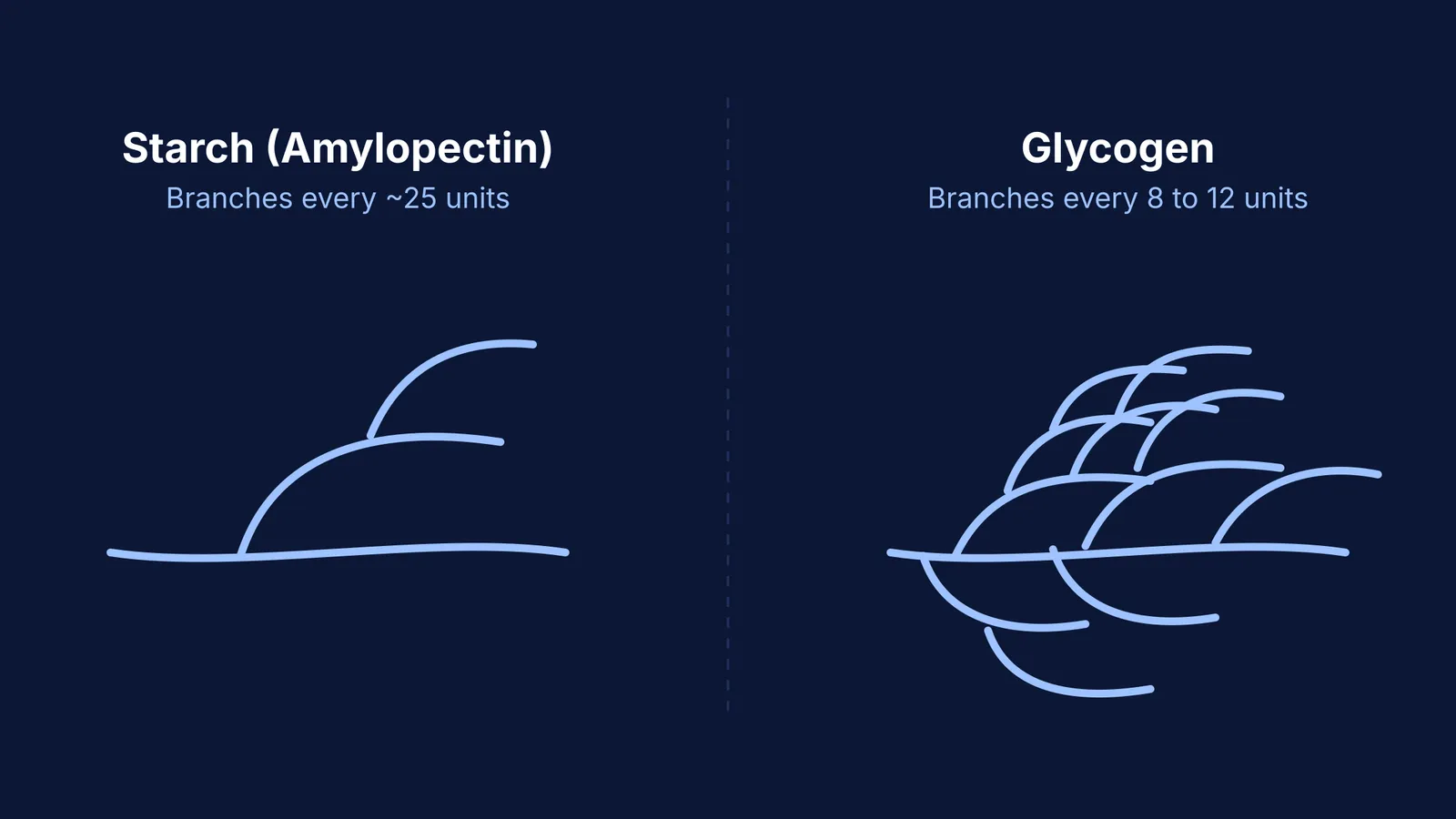
Amylopectin: A branched chain where branches occur approximately every 25 glucose units.
Glycogen is structurally similar to amylopectin, but it is much more compact and highly branched. In glycogen, a new branch appears every 8 to 12 glucose units.
This difference in branching frequency directly controls how quickly energy can be used. When an organism needs glucose, enzymes such as glycogen phosphorylase break down the polymer by snipping off glucose molecules from the "non-reducing ends" at the tips of the branches.
Because glycogen is so highly branched, it has a massive number of these ends. This means many enzymes can attach and work simultaneously, allowing for the rapid mobilisation and release of glucose into the bloodstream. This rapid release is essential for animals, which often require sudden bursts of energy to run, hunt, or react in a "fight or flight" response.
Plants, on the other hand, do not need to sprint away from predators. Their energy demands are lower and steadier. The less frequent branching in starch provides a slower, sustained release of glucose, making it an ideal compact storage molecule. If you are revising for NEET and want to explore the structural polysaccharides that make up plant cell walls, check out our comparison of the cell wall in plants, fungi, and bacteria.
How do you test for them?
In the laboratory, you can distinguish between these polysaccharides using the iodine test.
Starch: The helical structure of amylose can trap iodine molecules inside its coil, producing a distinct blue-black colour.
Glycogen: Because of its highly branched and compact structure, glycogen gives a red-brown colour with iodine instead.
How should you revise biomolecules?
When learning biomolecules for exams like NEET or board exams, active recall works better than just re-reading the textbook. Here is a simple framework:
Draw the structure: Sketch a rough diagram showing the linear α-1,4 bonds and the branched α-1,6 bonds.
Compare directly: Make a table listing the organism, branching frequency, storage location and iodine test result.
Ask why: Always connect the structure to its biological function. Why does a muscle cell need a highly branched polymer?
If you are confused by biomolecule structures or need to revise for an exam, the Fermi Concept Library explains every concept in biology, chemistry and physics. And when solving practice questions, if you make a mistake, Fermi's AI tutor can hold a line of reasoning across a session and notice where you are stuck.


