

On this page
The cell wall is the outermost layer of many cells, acting as a rigid suit of armour that provides shape, support, and protection against osmotic pressure. However, evolution has given different organisms completely different materials to build this wall.
If you are preparing for biology exams like NEET or board finals, questions often ask you to classify an organism or predict its response to an antibiotic based on its cell wall. Here is a breakdown of the three main types you need to know.
What is the cell wall made of in plants?
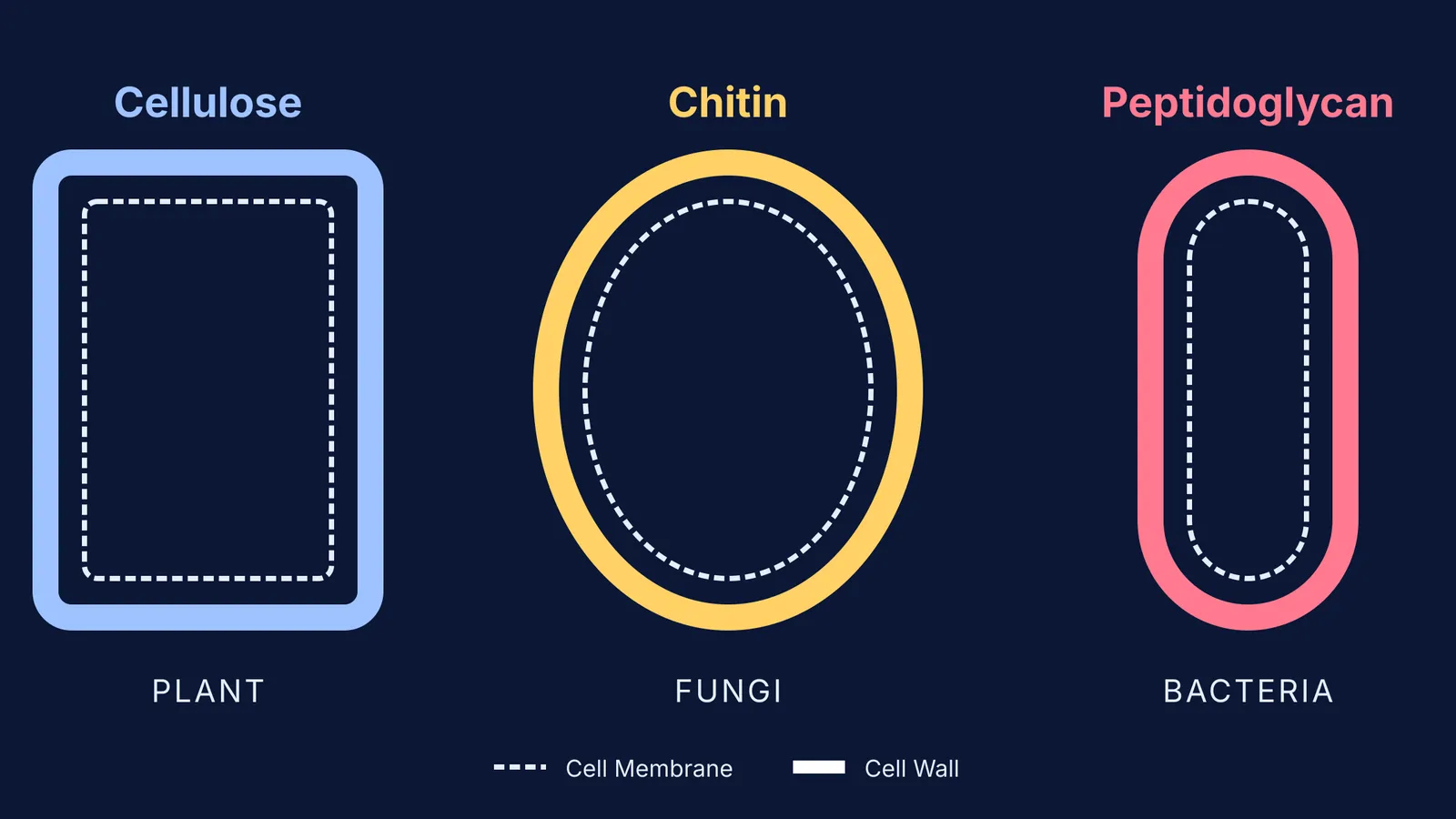
Plant cell walls are primarily composed of cellulose, a tough, fibrous carbohydrate (Wikipedia: Cell wall). Cellulose consists of long, straight chains of glucose molecules that bundle together into microfibrils, giving plants the structural strength to grow tall without a skeleton. This complex matrix ensures that plants can maintain turgor pressure, keeping their stems upright and their leaves flat to catch maximum sunlight.
Alongside cellulose, the primary plant cell wall contains hemicellulose and pectin, which provide flexibility. When two plant cells sit next to each other, they are glued together by the middle lamella. This layer is mainly composed of calcium pectate and acts like the cement between bricks.
What is the fungal cell wall made of?
Fungi are not plants, and their cell walls reflect this. Fungal cell walls are built from a matrix of chitin and glucans (Wikipedia: Cell wall). Chitin is a nitrogen-containing polysaccharide that is incredibly strong, forming the exact same material found in the exoskeletons of insects and crabs.
Because fungi lack cellulose, their cell walls allow them to absorb nutrients efficiently from their environment while resisting the high internal pressures necessary for hyphal growth. If you are reviewing the five kingdoms, this distinct wall composition is a major reason fungi have their own classification separate from plants (Kingdom Fungi for NEET: the four classes and how fungi reproduce).
What is the bacterial cell wall made of?
Bacteria rely on a unique, mesh-like polymer called peptidoglycan (also known as murein) (Wikipedia: Cell wall). Peptidoglycan is formed by alternating sugar chains cross-linked by short D-amino acid peptides.
This composition is a vital target in medicine. For instance, the antibiotic penicillin works by stopping bacteria from building their peptidoglycan walls, causing the cells to burst. Because human cells lack a cell wall entirely, and fungal and plant walls use different materials, penicillin kills the bacteria without harming the host.
Bacteria are further divided based on the thickness of this wall:
Gram-positive bacteria have a very thick layer of peptidoglycan and teichoic acids, and they lack an outer lipid membrane.
Gram-negative bacteria have a much thinner peptidoglycan layer, located between an inner plasma membrane and an outer lipid membrane that contains lipopolysaccharides and lipoproteins.
Why do questions ask which organism has which wall?
Examiners test this concept because it touches on taxonomy, evolution, and medicine all at once. Whether it is distinguishing a plant from a fungus or understanding why an antibiotic is ineffective against a fungal infection, the cell wall is the defining clue. Organisms that do not fit neatly into these rules, such as viruses, lack a cell wall entirely (Viruses, viroids and lichens: the misfits of five-kingdom biology).
A quick comparison framework
When revising, use this simple checklist to lock in the facts:
Plants: Cellulose, hemicellulose, pectin. (Glued by the middle lamella's calcium pectate).
Fungi: Chitin, glucans, and mannoproteins.
Bacteria: Peptidoglycan (murein).
If you find yourself mixing up these biological facts or have concept gaps, the Fermi Concept Library maps out these structures so you can trace the reasoning behind each kingdom's cell wall. Understanding the chemical basis of these walls makes it much easier to remember the broader rules of the living world, from simple algae (Plant kingdom for NEET: algae to gymnosperms and their life cycles) to the complex bacteria in a petri dish.


