

On this page
When a pot of basmati comes to the boil, the whole house knows. Plain rice doesn't do that. The difference is mostly one small molecule, and its story runs through chemistry, genetics and the biology of smell.
What makes basmati rice smell different?
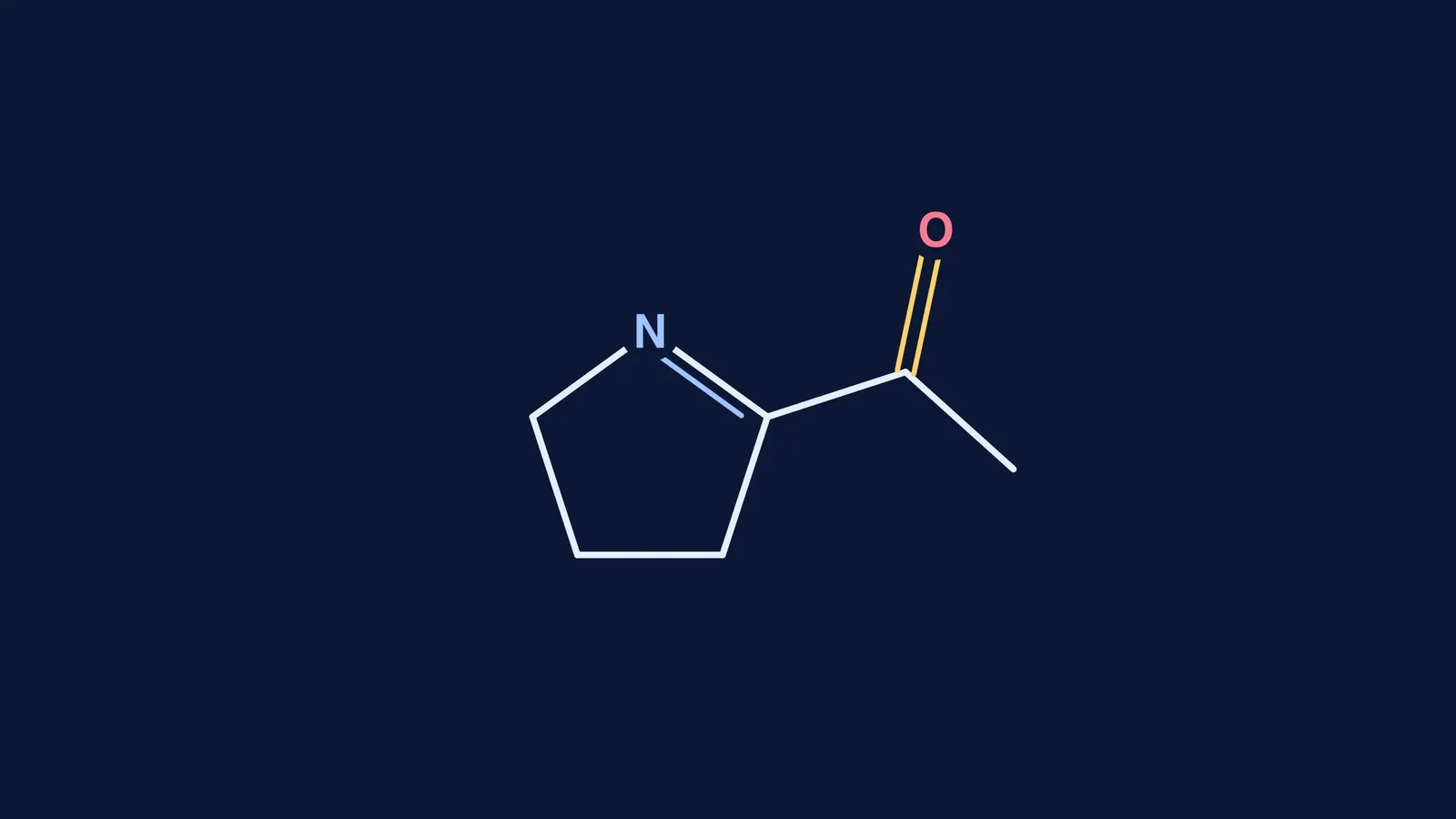
The key aroma compound in fragrant rice is 2-acetyl-1-pyrroline, usually shortened to 2AP. A 2026 review in the Indian rice journal *ORYZA* sums up decades of work: the fragrance of aromatic rice is primarily attributed to 2AP, a link first reported by Ron Buttery and colleagues in their 1983 paper Cooked rice aroma and 2-acetyl-1-pyrroline.
The molecule is a five-membered ring containing one nitrogen atom, with a carbon-nitrogen double bond and an acetyl group (C=O with a methyl on the end) attached. It is volatile, meaning it escapes easily from food into the air as a gas, and only molecules that reach your nose can be smelled.
Why does basmati make 2AP when most rice does not? In 2005 Bradbury and colleagues linked the fragrance of basmati and jasmine rice to a recessive gene on chromosome 8, and showed that in fragrant varieties it carries a mutation that disables the gene for an enzyme called BADH2. With that enzyme broken, a precursor molecule piles up instead of being processed, and it reacts to form 2AP, as a 2021 study from Pune and Queensland describes. Because the trait is recessive, a rice plant needs two copies of the broken gene to be fragrant.
Why does pandan smell like basmati rice?
A pandan-flavoured dessert smells like rice for a simple reason: same molecule. Researchers at Savitribai Phule Pune University and the University of Queensland reported that the pandan plant, *Pandanus amaryllifolius*, accumulates the highest concentration of 2AP in the plant kingdom.
In that study, pandan leaves held 4.38 ppm (parts per million) of 2AP, which the authors put at 20 to 22 times the level they measured in basmati varieties such as Basmati 370 (0.20 ppm), according to the same paper. The twist is that pandan has a *working* BADH2 enzyme, so it must make 2AP by a different route. The authors suggest one possible chemical pathway, which still needs to be tested.
How can such a tiny amount smell so strong?
This is where a quick calculation helps. Japan's agricultural research centre JIRCAS notes that 2AP, with its popcorn-like flavour, has an odour threshold of less than 0.1 ppb in water. In other words, the nose can pick it up in water at concentrations below one part 2AP per ten billion parts water.
Now take real rice. A 2021 study from the International Rice Research Institute (IRRI) tested Indian varieties and found about 16 ng of 2AP per gram in cooked Pusa Basmati-1509, and none detected in the non-aromatic variety IR-64.
Worked example:
1 ng per gram means 1 part per billion by mass, so 16 ng/g is about 16 ppb.
Divide by the threshold: 16 ÷ 0.1 = 160.
So cooked basmati carries roughly 160 times the 2AP level that can be smelled in water, and since the threshold is below 0.1 ppb, the ratio is at least that big.
A fair caveat: the threshold was measured in water, not rice, so treat 160 as a rough comparison. Still, the arithmetic shows why a few billionths can fill a kitchen.
Why does basmati smell strongest while it's cooking?
Heat matters. The IRRI team found that 2AP content rose sharply when rice was cooked, roughly 31 to 35 times higher than raw for the two Pusa Basmati varieties. Heat also gives molecules more energy to escape into the air, and once there they spread through the room, much like perfume diffusing across a room.
If the smell seems to fade after a few minutes at the stove, that is often your nose adapting rather than the rice: read why you stop noticing a smell after a while. Rain has its own signature volatiles too, explained in why the ground smells after the first rain.
How do you keep basmati's aroma at home?
The IRRI researchers found that significant 2AP is lost during storage: rice from the previous year's harvest had less than fresh rice. Since 2AP is a volatile, the practical rules follow from that.
Store rice in an airtight container, away from heat and sunlight.
Buy smaller packs you will finish, rather than one sack that sits for a year.
Cook with the lid on, so less aroma leaves before you eat.
Try a side-by-side test: cook a spoon of basmati and a spoon of ordinary rice in two covered cups, then lift the lids together and compare.
That last test turns a textbook word like "volatile" into something you can smell. For ideas that are easier to see than to read, the Fermi Simulation Lab has interactive simulations, and the Fermi Concept Library gives each chemistry and biology concept its own lesson.


