On this page
Almost every school science textbook uses the same example to teach diffusion: opening a bottle of perfume in the corner of a room. The book claims that the scent molecules move from an area of high concentration (the bottle) to low concentration (the room) until they reach your nose.
This is one of the most famous traps in physics education. While diffusion does happen, it is far too slow to explain what we experience. If diffusion were the only force at work, you would be waiting days to smell anything.
Why Does Diffusion Fail the Math?
Diffusion is driven by the random thermal motion of molecules. While individual air molecules move at hundreds of metres per second, they do not travel in a straight line. They collide with other molecules billions of times every second, causing them to bounce in a zigzag pattern known as a random walk (Physics Stack Exchange).
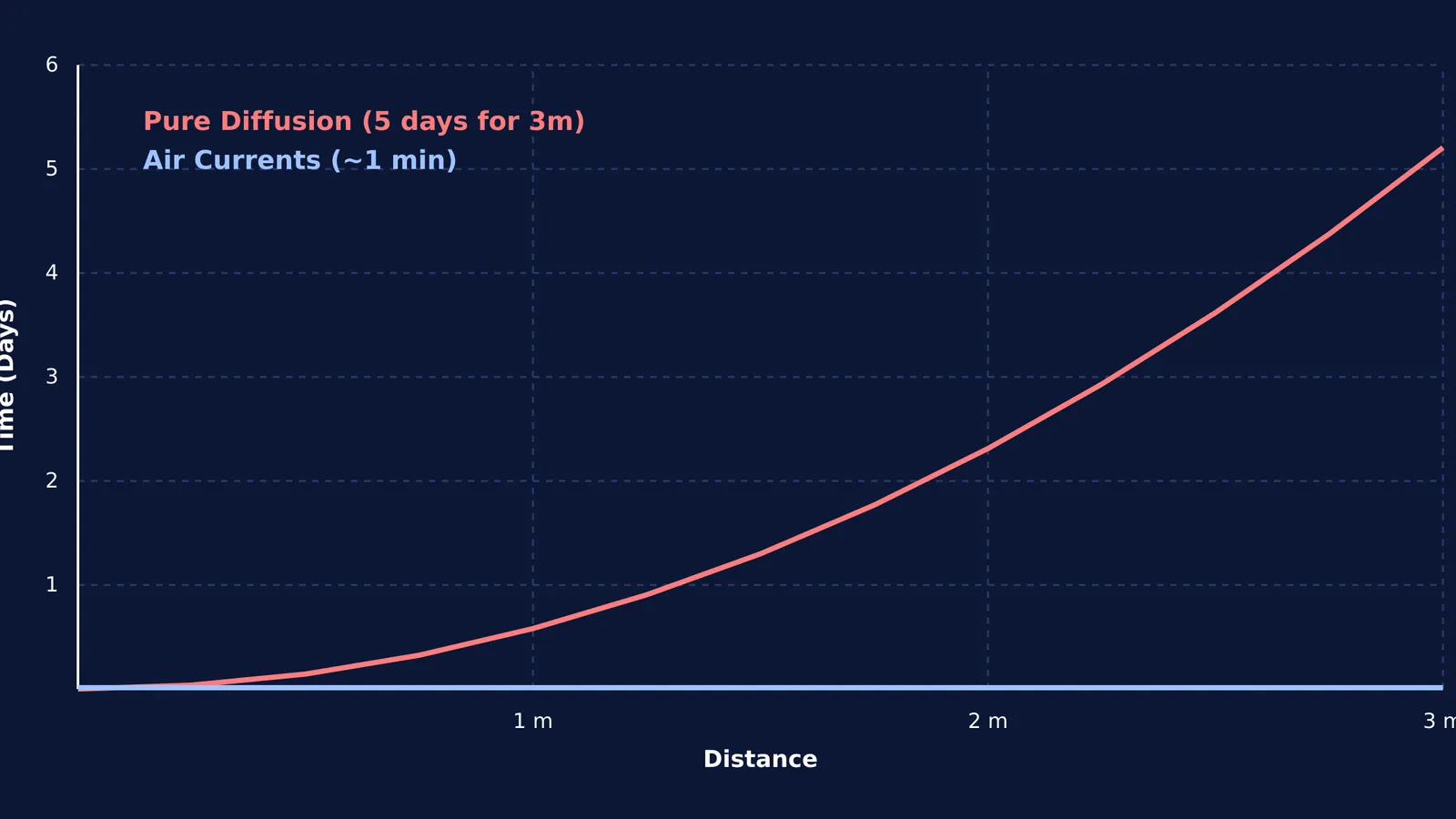
Because of this constant bouncing, a molecule makes very little net progress. According to Fick's Law of diffusion, the time it takes to travel a given distance depends on the square of that distance, making it incredibly inefficient over large scales. For typical organic molecules in air, the diffusion coefficient is approximately 10⁻⁵ m²/s (Physics Stack Exchange).
If we calculate the time to travel three metres across a perfectly still room using pure diffusion, the result is staggering: it would take about 450,000 seconds, or roughly five days. Even a much shorter distance of one metre would take over 13 hours (Physics Stack Exchange). This squared relationship means that while diffusion is an incredibly powerful mechanism for transporting nutrients across a single cell membrane, it is completely useless for moving scent across a macroscopic space like a bedroom or a laboratory.
How Do Convection Currents Carry Scent?
So how do we smell the perfume within seconds? The answer is fluid dynamics, specifically convection. Convection involves the bulk movement of fluid, carrying everything dissolved or suspended within it.
In reality, the air in a room is never perfectly still. Temperature differences create thermal plumes, such as the warm air rising off your own body or a sunbeam hitting the floor. Opening a door or simply walking into the room creates large eddies and drafts. These bulk movements of air—convection currents—carry "packets" of scent molecules with them across the room.
Even a barely perceptible draft will carry a scent across the room almost instantly compared to diffusion. Convection acts as the delivery vehicle, bypassing the slow random walk of diffusion entirely. The scent molecules are merely passengers on the macroscopic currents of the room's air.
You can explore how particles interact and mix in a gas by using the Fermi Simulation Lab. Interactive models are excellent for visualising ideas that are difficult to picture from equations alone. You can also read more about this in our guide on Graham's law in a simulation: heavy vs light gas diffusion.
How Can You Test Convection at Home?
You can test this physics phenomenon at home with a bottle of perfume, an orange peel or a cut onion. By controlling the air currents, you can dramatically change how fast the scent travels.
The Still Air Test: Choose a small, enclosed room. Close all windows, doors and air conditioning vents. Wait a few minutes for the air to settle completely. Have someone quietly open the scent source on one side of the room while you stand on the other side. Time how long it takes to smell it. It will likely take several minutes, as the scent relies on very weak residual convection currents.
The Convection Test: Turn on a slow ceiling fan or open a door to create a mild draft. Repeat the test. You will notice the smell almost instantly.
This experiment proves that when we talk about scents spreading through a house, such as Why Do Flowers Have a Strong Smell? Scent and Diffusion, we are really observing the power of moving air. The next time you see the perfume example in a textbook, you will know the real physics behind it and the difference between bulk flow and molecular random walks.