

On this page
Lift the barrier between a heavy gas and a light gas and the light one gets ahead. The skill that counts is saying how far ahead before you press play. Here is that prediction in a free simulation, then the classic ammonia and hydrogen chloride tube.
What does Graham's law say about heavy and light gases?
The rate of effusion of a gas is inversely proportional to the square root of its molar mass (LibreTexts, Molecular Effusion and Diffusion/10%3A_Gases/10.08%3A_Molecular_Effusion_and_Diffusion)). As a ratio, rate of A divided by rate of B equals the square root of M(B) divided by M(A). The reason is that at the same temperature all gases have the same average kinetic energy, so lighter molecules must move faster.
Diffusion through air is much slower than the molecular speeds suggest. The same LibreTexts page notes that gas molecules collide as often as 10^10 times per second, so they do not travel across a room in a straight line. Graham's law gives you the ratio between two gases. It does not tell you how long the mixing takes.
How do you test Graham's law in a diffusion simulation?
PhET's free Gas Properties simulation has a Diffusion screen. A divider splits the box, with one gas on each side, and you can change the number of particles, their mass, radius and starting temperature. Its teacher guide says the light particles have a mass of 4 AMU and the heavy ones 28 AMU (matching helium and nitrogen), colliding as hard spheres with no intermolecular forces.
Write down your predictions before you run it:
Keep both gases at the same temperature and radius, with equal numbers.
Predict the ratio: the square root of 28/4 is the square root of 7, about 2.65. Graham's law strictly describes effusion, so treat this as a rough guide to how much faster the light gas spreads.
Remove the divider. Watch the Center of Mass markers and the Particle Flow Rate arrows. The guide says the arrows are time-averaged over 300 ps, so read them over a stretch of time, not one frame.
Change one thing at a time. Make the masses equal and the head start should disappear. Raise the radius of both gases and mixing should slow, because the mean free path shrinks.
Write one line comparing result and prediction.
With about a hundred particles a side, single runs are noisy, so repeat before you decide the law has failed. Interactive simulations for ideas that are easier to see than to read are what the Fermi Simulation Lab is for, and the same predict-then-check habit works there.
Where does the ammonia and HCl ring form in a tube?
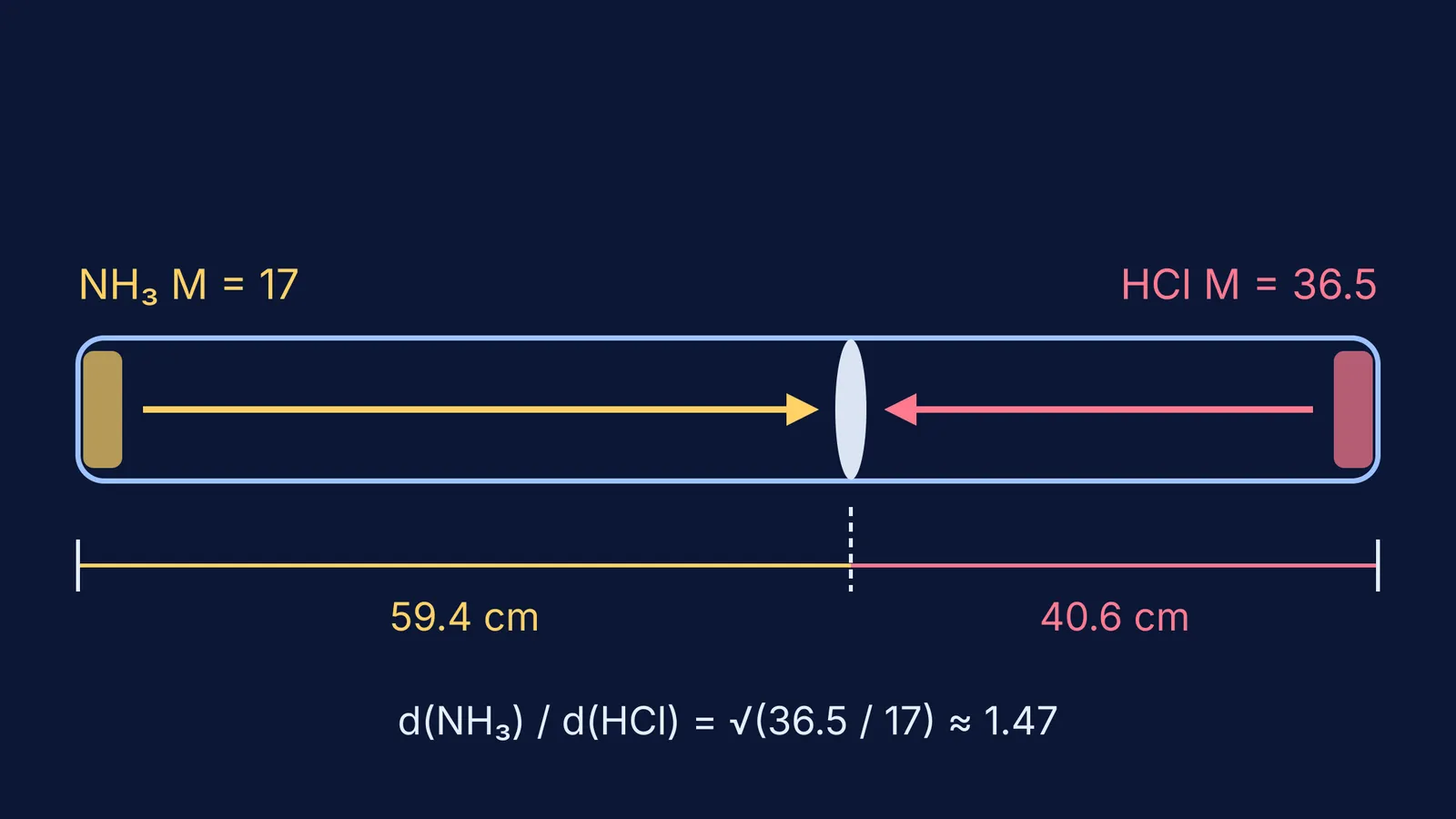
In the Royal Society of Chemistry demonstration, cotton wool soaked in concentrated ammonia solution goes in one end of a glass tube about 1 m long and concentrated hydrochloric acid goes in the other (RSC Education). Where the two gases meet, they form a white ring of ammonium chloride. The RSC write-up says the ring forms closer to the hydrogen chloride end, and gives the predicted distance ratio as the square root of 36.5/17, about 1.47.
Worked example for a 1 m tube:
Molar masses: NH3 is 17 and HCl is 36.5.
Both gases start at the same moment, so the distance each covers is proportional to its rate: d(NH3)/d(HCl) = the square root of 36.5/17, about 1.465.
Split 100 cm in the ratio 1.465 : 1. The ammonia's share is 100 × 1.465/2.465, about 59.4 cm.
Answer: the ring forms about 59.4 cm from the ammonia end, or 40.6 cm from the HCl end.
Timing varies: the RSC ring appears after a couple of minutes, while the University of Wisconsin-Madison demo lab describes about 15 to 20 minutes. Do not try this at home; the RSC calls for goggles, gloves and a fume cupboard.
What mistakes do students make with Graham's law?
Flipping the ratio. The lighter gas is faster, so its molar mass goes in the denominator of its own rate.
Mixing up rate and time. For the same volume, time taken is proportional to the square root of molar mass, so the heavier gas takes longer.
Using mass ratios instead of square roots. 36.5/17 is about 2.15, but the distance ratio is its square root, about 1.47.
Forgetting the conditions. The comparison assumes the same temperature and pressure for both gases.
If the ratio steps still feel shaky, the Fermi Problem Library has worked problems with a step-by-step solver that explains the reasoning rather than printing an answer.
Next, read about Thomas Graham and his 1833 diffusion paper, the kinetic theory of gases and rms speed, and the mean free path of gas molecules.


