

On this page
You walk into a kitchen where dinner is cooking, or sit next to someone wearing strong perfume. At first, the scent is overwhelming. Ten minutes later, you barely notice it. The smell is still in the air, and the molecules are still entering your nose, so why does it disappear?
Your brain simply stops reporting the scent to your conscious mind, a natural process called olfactory adaptation or "nose blindness".
Why does your nose ignore constant smells?
Like why we get goosebumps when we are cold, olfactory adaptation is an evolutionary survival mechanism. Your sensory systems are built to detect change.
If a smell has been present for several minutes without causing harm, your brain classifies it as safe background noise. By turning down the volume on that constant scent, your brain frees up its cognitive and sensory resources to notice new, potentially critical smells, such as smoke from a fire, a gas leak, or spoiled food.
The adaptation happens at two distinct levels. First, there is peripheral adaptation: the receptor neurons in your nasal cavity physically begin to fire less frequently when exposed to the same molecule continuously. Second, there is central adaptation: the olfactory cortex in your brain actively filters out the remaining signals. Even if your nose is still sending a faint signal, your brain decides the information is redundant and stops alerting your conscious mind.
How fast does olfactory adaptation happen?
Adaptation starts within milliseconds, but the noticeable drop in what you smell happens over a few minutes.
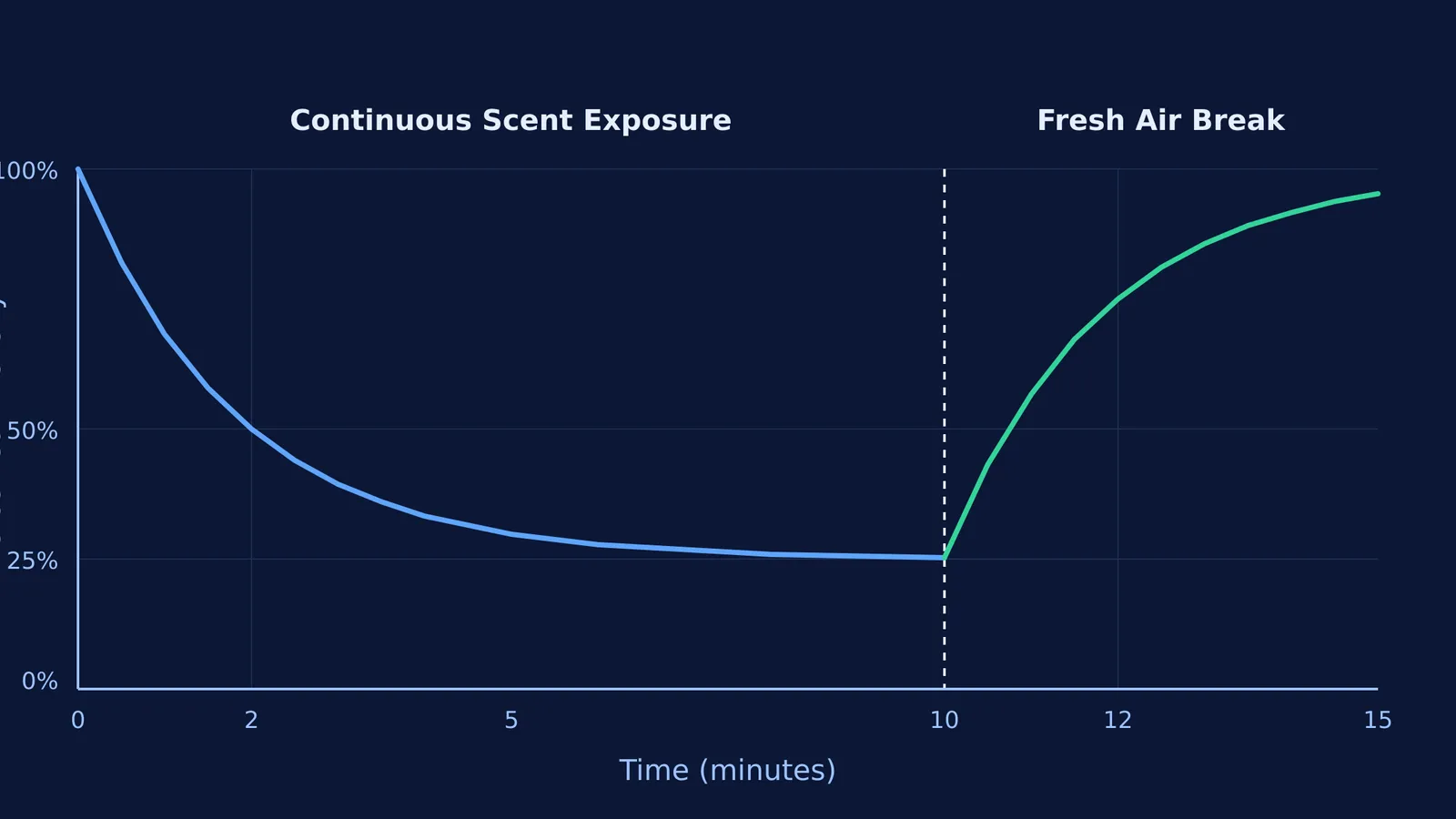
According to a classic 1970 study on olfactory adaptation in *Perception & Psychophysics* by Gordon Pryor, Gerald Steinmetz and Herbert Stone, the perceived intensity of a constant odour often drops by more than 50% within the first two minutes of exposure. After about ten minutes, the intensity usually levels off at around 25% to 30% of its original strength. You only go blind to that specific scent; your nose remains perfectly sensitive to any new odours that enter the room.
Test it with a fresh air break
You can test this adaptation time course yourself with a 15-minute home experiment.
Prepare the stimulus: Peel a strongly scented fruit like an orange, or spray a single pump of perfume onto a tissue in a closed room with still air.
Predict and observe: Stay in the room and pay attention to how strong the smell feels. Predict what it will be like at the 2-minute and 10-minute marks. Just as the graph above shows, you will likely find that it becomes faint and barely noticeable by the end of the ten minutes.
The fresh air break: Step completely out of the room and go outside into fresh air. Do not just move to an adjacent room where the scent might have drifted.
Recovery is just as fast as the initial decline. The 1970 study found that your sensitivity recovers by more than 50% after just two minutes in clean air. When you return to the scented room after a five-minute break, the smell will hit you almost as strongly as it did the first time.
What this teaches us about learning
This biological habituation is why feeling thirsty is a clearer signal than being full, and why proofreading your own essay right after writing it rarely works well. When you look at the same maths or physics working repeatedly, your brain predicts what should be there instead of reading what is actually on the page.
You need a "fresh air break" for your mind to see the problem accurately. This is where interactive tools help break the habituation. Instead of staring at a static textbook diagram until you stop processing it, the Fermi Simulation Lab lets you change the variables and see the system react in real time. Moving a slider to watch a planet's orbit stretch forces your brain to process new visual data, resetting your attention just like stepping into clean air.
A quick checklist to reset your focus
When you have been stuck on the same problem for more than ten minutes, treat it like olfactory fatigue. Use this three-step reset:
Change the context: Step into another room or look out of the window for two minutes.
Swap the stimulus: Do a few problems from a completely different subject, giving the "receptors" for your current subject time to clear.
Return fresh: Come back to the original problem. The error you could not see for ten minutes will often stand out immediately.


