

On this page
When a cold breeze hits your arms or you listen to an awe-inspiring piece of music, your skin might suddenly erupt in tiny bumps. The hairs stand on end, creating what we call goosebumps. But why does the human body still perform this trick, even though we lack the thick fur to make it useful? The answer lies in the biology of our ancient nervous system and a surprising new discovery about how our skin grows.
What causes goosebumps?
Goosebumps, scientifically known as piloerection or the pilomotor reflex, are an involuntary reaction mediated by the sympathetic nervous system. This is the same system that controls the "fight or flight" response, which prepares your body to deal with sudden stress or danger.
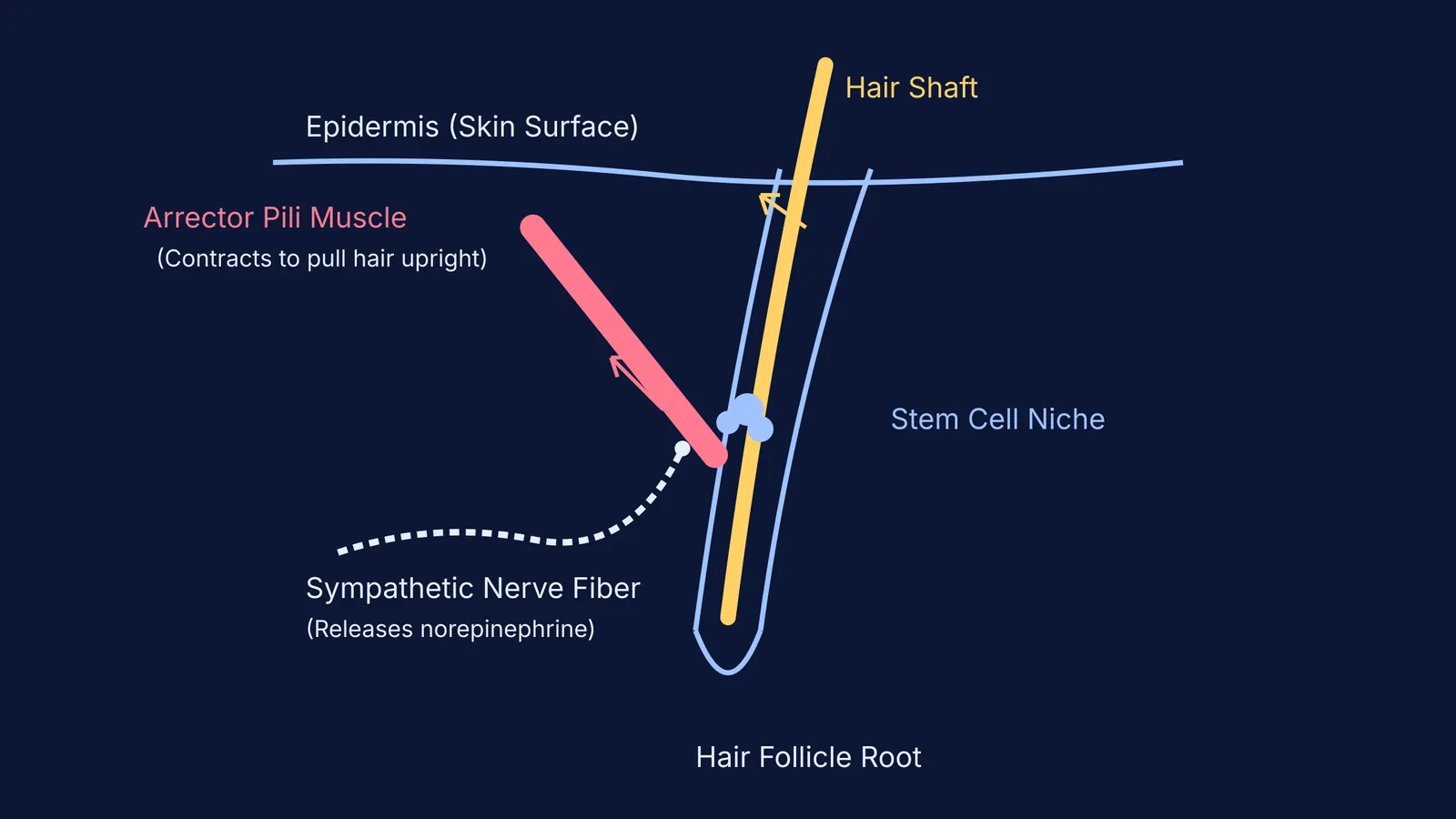
At the base of each hair follicle sits a tiny bundle of smooth muscle fibers called the arrector pili muscle. When the sympathetic nervous system is activated by cold temperatures or intense emotion, it sends a signal—using the neurotransmitter norepinephrine—to these muscles. The arrector pili muscles contract, pulling the hair follicle upright. As the muscle shortens, it creates a shallow depression on the skin's surface, while the area immediately surrounding the hair protrudes, forming the characteristic bump.
Why do mammals get goosebumps?
In our mammalian ancestors, and in modern animals with thick fur, piloerection serves two crucial purposes:
Insulation: When an animal is cold, standing hairs trap a layer of still air close to the skin. This air acts as a thermal barrier, preventing body heat from escaping.
Intimidation: When an animal is frightened or threatened, fluffing up its fur makes it appear physically larger and more dangerous to predators. Think of a scared cat arching its back with its fur puffed out. This is a classic example of Walter Cannon and the fight-or-flight response in action.
Are goosebumps vestigial in humans?
For a long time, biologists classified goosebumps as a vestigial trait in humans—a physiological leftover from our evolutionary past that no longer serves a significant purpose. Because humans have lost most of our thick body hair over millions of years, piloerection does not trap enough air to keep us warm, nor does it make us look more intimidating.
However, a landmark 2020 study published in the journal *Cell* (Shwartz et al., Harvard University) discovered that this system is not entirely useless after all. The researchers found that the sympathetic nerves and the arrector pili muscle form a dual-component "niche" that regulates hair follicle stem cells.
When you are cold, the nerve fires a signal that causes the immediate short-term response of a goosebump. But if the cold is sustained, the continued nerve activity stimulates the stem cells directly. The arrector pili muscle acts as a necessary structural bridge holding the nerve close to the stem cells. This mechanism ensures that a short-term reaction to cold is coupled with a long-term response: growing a thicker coat of hair.
How do you study the nervous system for biology exams?
If you are preparing for biology exams, you will need to trace these physiological pathways step by step. Understanding how a nerve impulse translates into a muscular contraction involves visualising synapses, neurotransmitters, and receptor proteins (for more on cellular signalling, see How hormones act: membrane receptors vs intracellular receptors).
Visualising how the sympathetic nervous system activates smooth muscles in the skin can be difficult when looking at a static textbook page. Interactive simulations in the Fermi Simulation Lab let you see the sequence of events clearly, from the initial nerve signal to the mechanical pull on the hair follicle.
Understanding the biology behind everyday phenomena like goosebumps not only helps you answer exam questions accurately but also reveals the elegant, deeply interconnected systems that keep us alive.


