

On this page
We have all felt the sudden, undeniable urge to drink a glass of water. But thirst is not just a vague feeling—it is a precise biological alarm system. It relies on specialized sensors in the brain, hormonal signals, and a balancing act known as osmoregulation to keep your body's fluids exactly where they need to be.
What triggers the sensation of thirst?
Osmoregulation is the process by which your body maintains a steady concentration of salt and other solutes in your blood, preserving homeostasis. When you sweat on a hot day or breathe out water vapour, your blood loses water. This causes its solute concentration—known as osmolality—to rise.
Deep in your brain, circumventricular organs in the hypothalamus monitor this concentration directly. These regions, specifically the subfornical organ (SFO) and the organum vasculosum of the lamina terminalis (OVLT), sit outside the protective blood-brain barrier. As blood becomes saltier, the cells in these organs literally shrink as water leaves them by osmosis. This shrinking triggers mechanical ion channels on the cell membrane to open, firing off neural signals that generate the conscious, uncomfortable feeling we recognize as thirst.
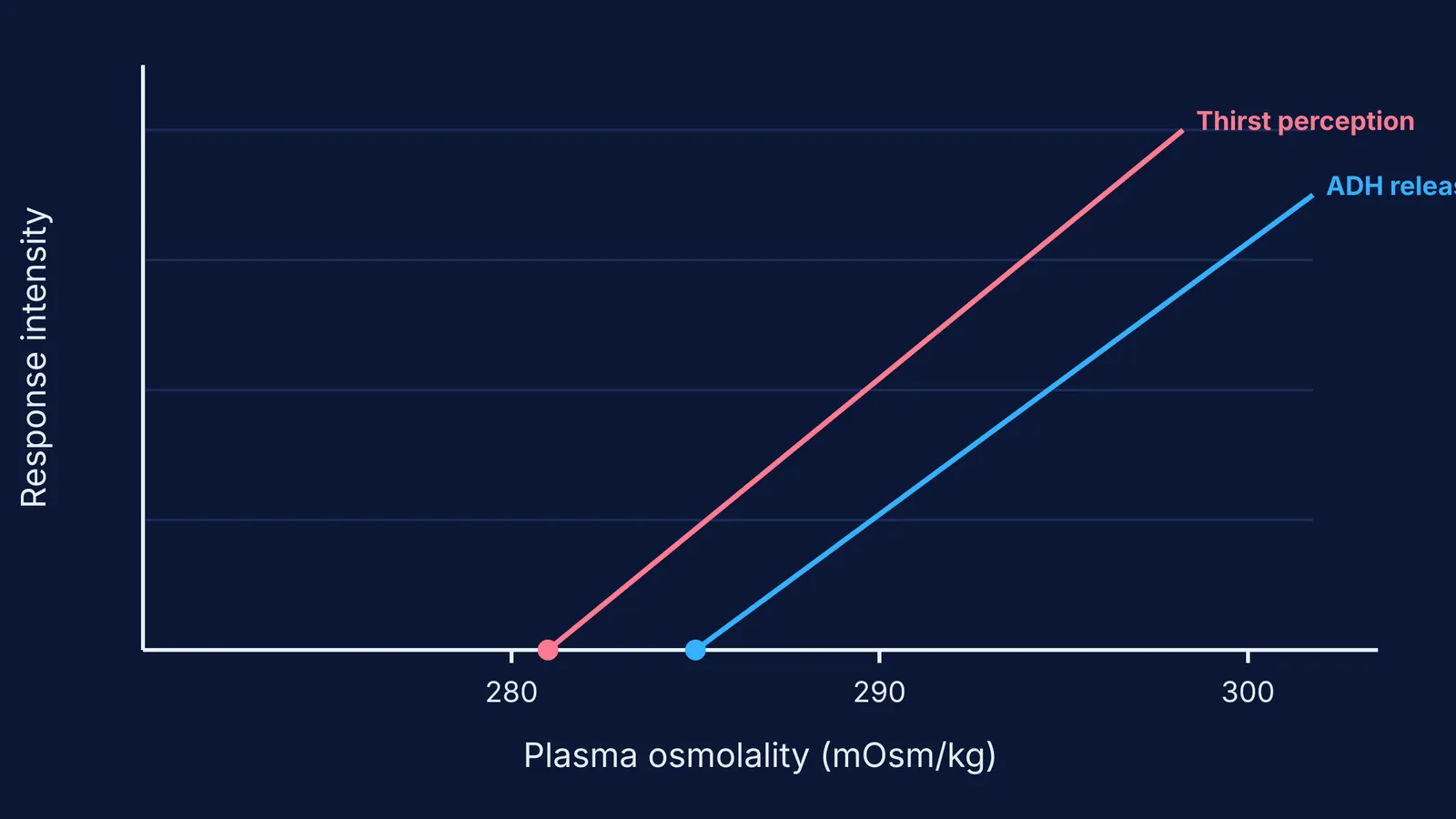
This system is remarkably sensitive. According to a landmark study published in *Clinical Science*, the onset of thirst is triggered when plasma osmolality reaches approximately 281 mOsm/kg.
The role of the kidneys and ADH
At almost the exact same time your brain makes you feel thirsty, the hypothalamus tells the pituitary gland to release antidiuretic hormone (ADH), also known as vasopressin. The threshold for ADH release sits right around 285 mOsm/kg (source).
ADH travels through the bloodstream to your kidneys. It binds to receptors on the collecting ducts, making them more permeable to water. Instead of flushing water out as dilute urine, the kidneys reabsorb it back into the blood, concentrating your urine and conserving your body's remaining fluid. (For a deeper look into how this works alongside other hormonal pathways, see our guide on regulating kidney function).
If you find it hard to picture how hormones and organs dynamically maintain this balance, the Fermi Simulation Lab has interactive models where you can change fluid intake and watch the resulting shifts in ADH and urine concentration in real time.
How does the body know when to stop feeling thirsty?
You usually feel quenched almost the moment you drink a glass of water. However, it takes time for that water to actually absorb from your gut into your bloodstream and dilute the salt. If your brain only relied on blood concentration to stop thirst, you would keep drinking until you were dangerously over-hydrated.
So how does the brain know you have had enough? A 2016 study published in *Nature* revealed that thirst neurons in the SFO use a "feed-forward" mechanism, shutting down within seconds of swallowing.
As you drink, sensors in your mouth and throat detect the physical act of swallowing and the temperature of the liquid (which is why cold water feels more refreshing). These sensors send immediate, rapid signals to the hypothalamus to temporarily switch off the thirst alarm. This "anticipatory satiety" gives the water time to reach your bloodstream. The same study found that these SFO neurons also activate immediately upon eating, before food is even digested, explaining why we often feel the urge to drink during a meal to preemptively balance the incoming solutes.
Bringing it to your studies
Understanding osmoregulation is critical for biology students. It perfectly illustrates how the nervous system (you can review the parts of the human brain here), the endocrine system, and the excretory system work together to maintain homeostasis. Exam questions often test your ability to predict what happens when one part of this loop fails, such as how a lack of ADH affects urine volume.
When reviewing these interconnected systems, try drawing out the feedback loop on a blank page. If you are struggling with the underlying concepts or how different variables affect the system, the Fermi Concept Library breaks down homeostasis and hormone action step by step. And when you are tackling tricky numericals or multiple-choice questions on these pathways, the Fermi Problem Library explains the reasoning behind each step of a physiological process, helping you trace the connections rather than just memorising facts.


