

On this page
A leaf makes sugar all day in the light, but when you test a potato or a sunlit leaf with iodine, what turns blue-black is starch. The reason is water: glucose dissolves and starch does not, so starch lets a plant store a lot of food without flooding its own cells.
Why don't plants just store glucose?
Because dissolved glucose pulls water into the cell. Water moves by osmosis towards the side with more dissolved particles. In OpenStax Chemistry 2e, the osmotic pressure of a dilute solution is Π = MRT, where M is the molarity of dissolved solute, R is the gas constant and T is the absolute temperature. It is a colligative property: it depends on the total concentration of dissolved particles, not on what they are.
So every free glucose molecule counts, and a cell packed with glucose would keep drawing water in and swelling. Join the same glucose units into one giant molecule and they count as one particle, not thousands. Put that molecule into a solid granule and it hardly counts at all.
What makes starch insoluble and compact?
Starch is an insoluble glucan made of two glucose polymers, amylopectin and amylose, according to a 2010 review by Zeeman, Kossmann and Smith.
Amylose is a mostly unbranched chain of glucose joined by α 1-4 links, and amylopectin is branched, with α 1-6 links at the branch points (OpenStax Biology 2e).
Amylopectin usually makes up 75% or more of a starch granule, and one amylopectin molecule has an estimated molecular weight of 10⁷ to 10⁹ daltons (Zeeman et al., 2010).
Neighbouring amylopectin chains pair into double helices that pack into crystalline layers, which alternate with amorphous layers in a pattern repeating every 9 to 10 nm, making the granule semicrystalline (same review).
That tight packing is the "compact" part of the answer. Animals use glycogen, which the same review calls a soluble polyglucan whose particles stay small, typically only 20 to 60 nm across. For more, see starch vs glycogen as storage polysaccharides.
How much does starch lower osmotic pressure?
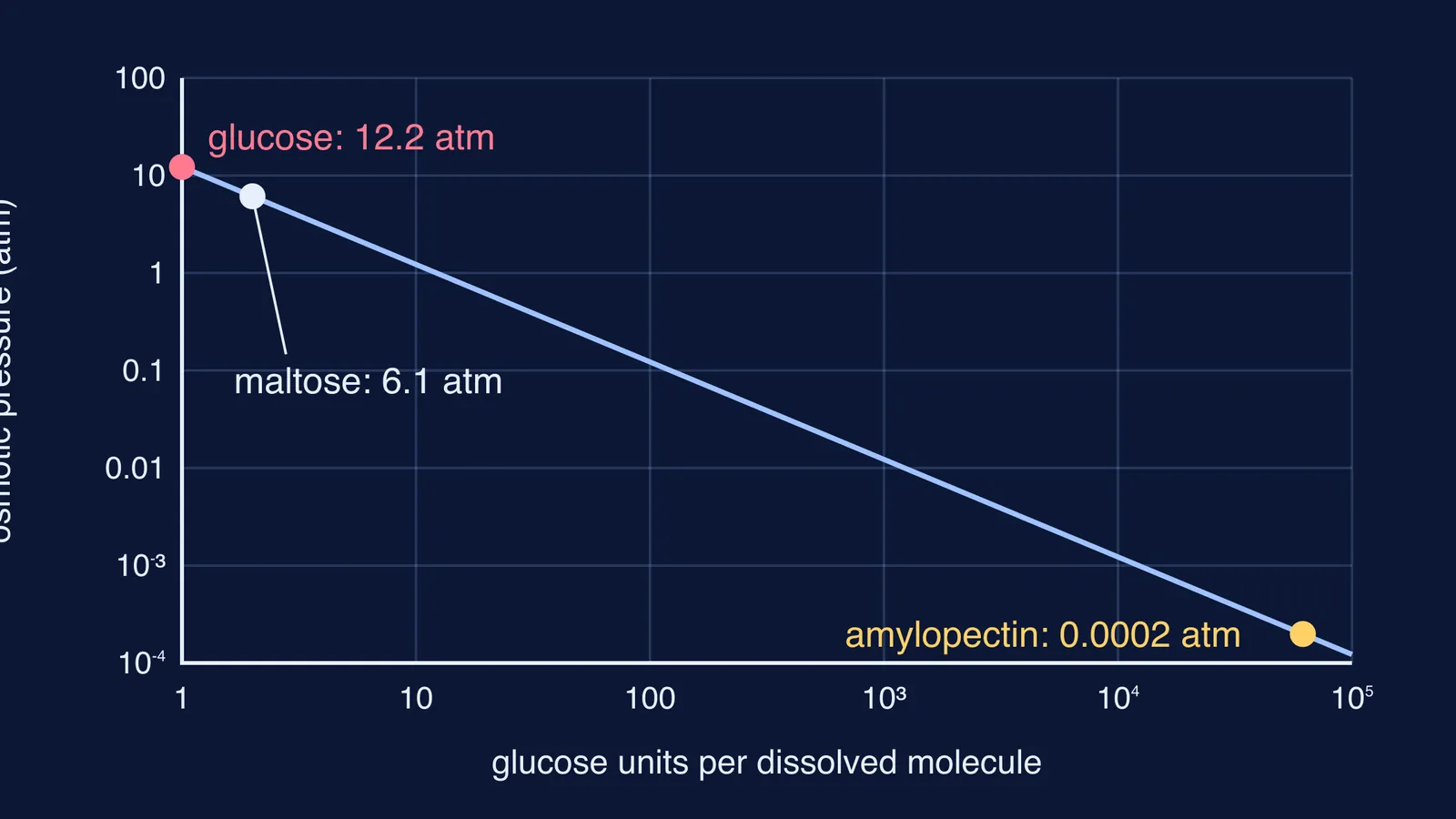
Suppose a cell holds 0.5 mol of glucose units per litre and sits at 25 °C (298 K). Use Π = MRT with R = 0.08206 L atm/mol K, the value used in OpenStax Chemistry 2e.
As free glucose: M = 0.5, so Π = 0.5 × 0.08206 × 298 ≈ 12.2 atm.
As maltose, two glucose units per molecule: M = 0.25, so Π ≈ 6.1 atm. Halve the particles, halve the pressure.
As amylopectin: take the smallest estimate, 10⁷ daltons (Zeeman et al., 2010). Each glucose unit in the chain (C₆H₁₀O₅) weighs about 162 g/mol, so one molecule holds about 62,000 units. M ≈ 0.5 ÷ 62,000 ≈ 8 × 10⁻⁶, so Π ≈ 0.0002 atm.
That is roughly 60,000 times lower, and still an overestimate, because real starch is not dissolved at all but packed into insoluble granules.
Where do plants store starch?
The 2010 review describes two kinds of starch store, both made inside plastids.
Leaves, short term. Some carbon fixed in photosynthesis stays in the chloroplast as transitory starch, broken down at night to keep the leaf respiring and exporting sucrose.
Storage organs, long term. In stems, roots, tubers and seeds, sucrose from the leaves is turned back into starch inside plastids called amyloplasts, and used later, for example when a seedling starts to grow.
The night-time breakdown is timed: Graf and colleagues found that Arabidopsis leaves use their starch at an almost steady rate, set by the circadian clock, so it is nearly all gone by dawn (PNAS, 2010).
Your staple foods are long-term stores: rice, wheat and maize grains, potato and yam tubers, cassava and taro roots, and beans and peas, with an estimated 2,500 million tonnes of starch crops harvested each year (FAO figures for 2007, cited in Zeeman et al., 2010). You can see the water side of this story at home with the potato osmosis experiment.
How should you write this in an exam?
A full answer to "Why do plants store carbohydrate as starch and not glucose?" hits four points:
Starch is insoluble, so it does not lower the cell's water potential or draw in water by osmosis.
Glucose is soluble; stored in bulk it would make cells take in water and swell.
Starch is compact: long, coiled and branched chains pack many glucose units into small granules.
Starch is easily broken back into glucose by enzymes when the plant needs energy.
A common slip is writing that starch "has more energy than glucose". It holds the same glucose units; the advantage is solubility and packing. For the chemistry behind that, see why glucose dissolves in water but starch does not.
To see how osmosis, polysaccharides and plastids connect, open each idea in the Fermi Concept Library, where every biology and chemistry concept has its own lesson and its place in the map. For practice with numbers like Π = MRT, the Fermi Problem Library has worked problems with a step-by-step solver that explains the reasoning rather than printing an answer.


