

On this page
Stir a spoon of glucose powder into a glass of water and it disappears. Stir a spoon of cornflour into the same glass and you get cloudy water with white sludge settling at the bottom. That looks odd, because starch is built from glucose. The difference comes down to size and shape: one small molecule versus a huge chain packed into a grain.
Why does glucose dissolve in water so easily?
A glucose molecule, C6H12O6, is small, and it carries five –OH groups. The NCERT Class 12 chemistry chapter on Biomolecules shows this through acetylation: glucose forms a pentaacetate, which means five –OH groups sit on different carbon atoms.
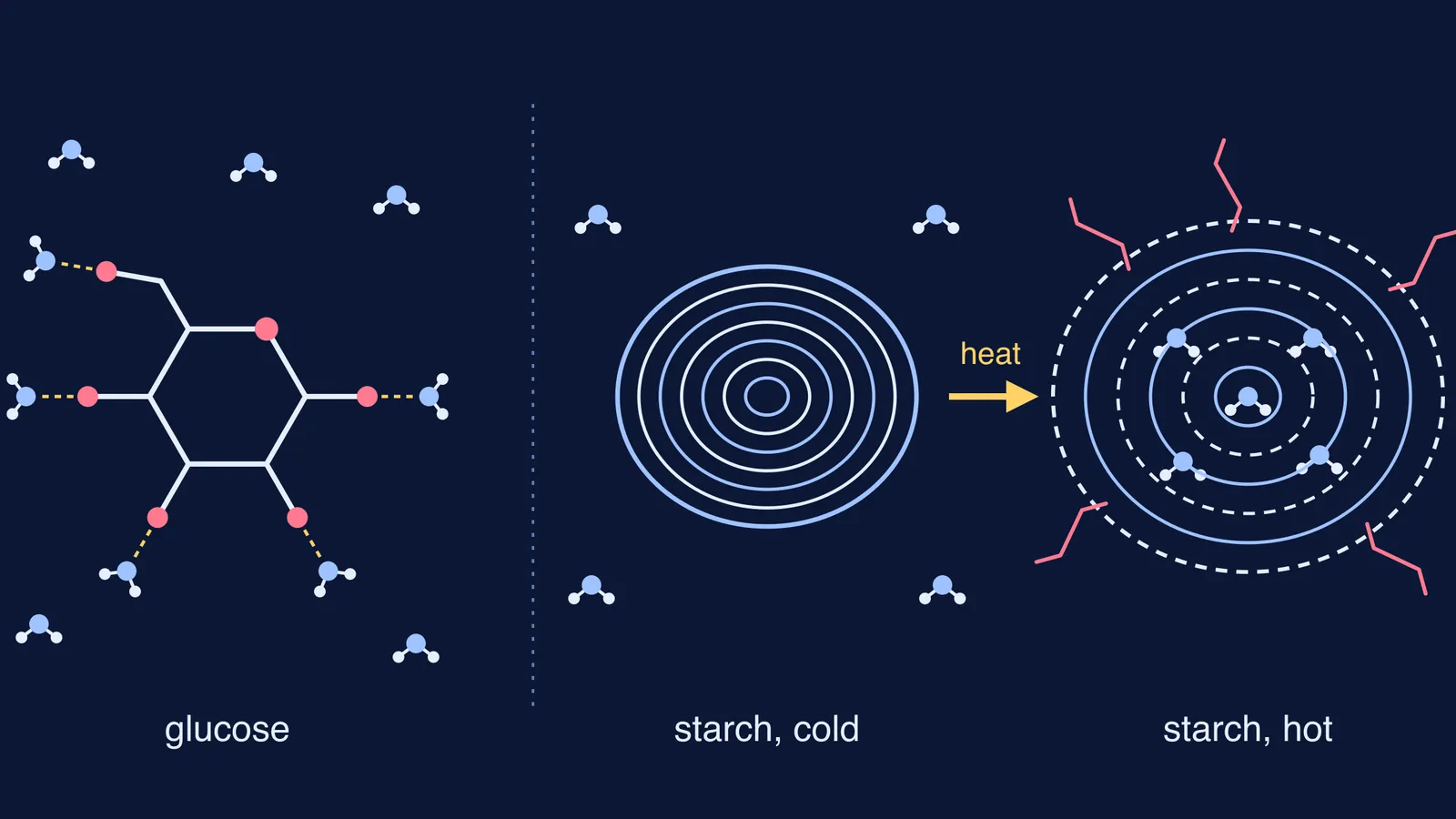
Each –OH can form hydrogen bonds with water, the same reason NCERT gives in its Amines chapter for why small amines dissolve: they “can form hydrogen bonds with water molecules”. Water surrounds each glucose molecule, pulls it away from the crystal, and the molecule moves freely through the liquid.
PubChem's glucose record lists a water solubility of 4.79 × 10^5 mg/L at 20 °C, about 479 grams per litre, citing the Handbook of Aqueous Solubility Data. The same record gives 5.46 × 10^5 mg/L at 30 °C, so warmer water holds even more.
Why doesn't starch dissolve in cold water?
Starch is a polymer of α-glucose, and it comes in two parts. According to the NCERT Biomolecules chapter, amylose makes up about 15-20% of starch and is a long unbranched chain of 200-1000 glucose units. Amylopectin makes up about 80-85% of starch, is branched, and NCERT describes it as insoluble in water.
Three things work against dissolving:
The chains are enormous. A chain of hundreds of glucose units has to be pulled into water as one piece, not one small molecule at a time.
The chains bond to each other. The same –OH groups that grab water also grab neighbouring chains, so starch chains hold on to one another.
They are packed into granules. Plants store starch as tiny grains with crystalline regions. A review by Serge Pérez and Eric Bertoft in Starch/Stärke describes these crystalline parts as platelet nanocrystals inside the granule, and a review by Tomoko Sasaki notes that amylopectin plays a major role in that crystallinity.
Amylose can also coil. The Wikipedia entry on amylose describes its most common helix as having six glucose units per turn, and iodine fits inside this helix in the blue-black starch test.
What happens to starch in hot water?
Heat gives water enough energy to break into the granule. Sasaki's review of wheat starch explains that when starch is heated with water, it “swells and is gelatinized”, and that on storage the chains reassociate and can form a gel if there is enough starch. In Sasaki's calorimetry measurements on wheat starches, gelatinisation began at roughly 46-52 °C and peaked at about 52-58 °C, depending on the sample.
So hot water does not dissolve starch the way it dissolves glucose. It swells the grains and loosens the packed chains, and, as the Wikipedia article on starch gelatinization puts it, amylose molecules eventually “leach into the surrounding water”. That is why the mixture thickens, and why rice water turns cloudy and sticky, as we explain in why rice water gets thick when cooking.
How do you write this in an exam answer?
For a 3-mark “explain why” question, make these points in order, using the figures from the NCERT Biomolecules chapter:
Glucose is a small molecule with five –OH groups that form hydrogen bonds with water, so it dissolves readily.
Starch is a polymer of α-glucose: amylose (about 15-20%, unbranched) and amylopectin (about 80-85%, branched, insoluble in water).
Its large chains hydrogen bond with each other and pack into granules, so cold water cannot separate them; on heating, granules swell and gelatinise rather than truly dissolving.
If the polarity idea behind point 1 is shaky, read why like dissolves like first. If the polysaccharide structures blur together, the Fermi Concept Library gives each concept in chemistry and biology its own lesson and its place in the map, so you can revisit glucose and glycosidic links before tackling starch.
Try it at home: a 10-minute kitchen test
You need two clear glasses, glucose powder, cornflour, a spoon and a small pan. Ask an adult to handle the stove and hot liquid.
Stir one spoon of glucose into the first glass of room-temperature water for a minute. It should vanish.
Stir one spoon of cornflour into the second glass. It clouds the water and then settles.
Pour the cornflour mixture into the pan and heat it gently while stirring. Note when it turns thicker and more see-through.
Let it cool and look again. It may set into a soft gel, a sign that the chains are bonding to each other again.
Write down your prediction before each step, then compare. For the colour test that tells starch apart from other glucose polymers, read why starch turns blue-black with iodine but cellulose does not.


